Sunday, April 20, 2025

๐Ÿช” How the Caste System Stunted Physical Growth in India


๐Ÿช” How the Caste System Stunted Physical Growth in India

India’s caste system is often discussed in terms of social injustice, economic inequality, and historical oppression. But one overlooked dimension is how it physically shaped the bodies of millions of Indians over centuries — stunting height, muscle development, and overall physical health.

This isn’t just about genes. It’s about how deeply entrenched social structures can biologically impact entire populations when passed down for generations.


๐Ÿงฌ 1. The Biology-Sociology Link: What Does Caste Have to Do With Height and Muscle?

Height and muscularity are not purely genetic traits — they are deeply influenced by:


  • Nutrition in early childhood
  • Access to healthcare
  • Physical activity
  • Sanitation and hygiene
  • Chronic stress (including social stress like discrimination)

The caste system, by design, limited access to all of these for a huge portion of the population, especially Shudras and Dalits.


๐Ÿฝ️ 2. Nutritional Disparity: Poor Diets for Lower Castes

  • Upper castes (especially Brahmins) had access to better food, often hoarded land and resources.
  • Lower castes, particularly Dalits, were denied access to protein-rich foods (like milk, ghee, and meat) either due to poverty or religious/cultural taboos.
  • In many places, Dalits were not allowed to eat in the same areas, touch upper-caste utensils, or access clean water sources.
  • This led to chronic malnutrition, especially in growing children, resulting in shorter adult height and weaker musculature
๐Ÿง  Modern studies still show a correlation between caste and stunting.
  • NFHS-5 (2021): Dalit and Adivasi children have significantly higher rates of stunting compared to upper castes.

๐Ÿ”จ 3. Labor Without Nutrition: Physical Work Without Muscle

Ironically, the lower castes often performed the hardest physical labor — manual scavenging, field work, construction — but:

  • Did so with extremely poor diets, which prevented muscle development.
  • Faced chronic fatigue and poor recovery, as their bodies were in a constant state of energy deficit.
  • Many children from lower castes began working at a young age, which further affected bone development and growth plates.

๐Ÿงด 4. Poor Sanitation = Poor Growth

Caste-based segregation extended to access to water and sanitation:

  • Dalit colonies were often built away from main villages, near sewage or garbage zones.
  • Constant exposure to gut parasites, contaminated water, and diarrheal diseases impaired nutrient absorption in children.
  • This is called “environmental enteropathy” — a condition linked to short stature despite enough calorie intake.

๐Ÿง  5. Psychological Stress Affects Growth Too

Long-term social discrimination causes chronic stress, which elevates cortisol (a stress hormone). High cortisol over time:

  • Suppresses growth hormone production
  • Impairs immune function
  • Increases risk of metabolic syndrome and fatigue

So even if a lower-caste child gets food, their body may still underperform due to invisible stressors of oppression.


๐Ÿงฌ 6. Epigenetics: The Biological Inheritance of Oppression

Recent science shows that malnutrition, stress, and trauma can “mark” your DNA, affecting how genes are expressed — not just in you, but in your children.

This is called epigenetic inheritance.

For example:

  • A grandmother who suffered caste-based starvation can pass on markers that reduce growth potential in her grandchildren — even if they now eat well.
  • Breaking this cycle takes multiple generations of good health, nutrition, and dignity.

๐Ÿ” 7. Upper Castes: Privilege Cemented in Biology

Upper castes not only had better access to food and rest, but were often encouraged to avoid manual labor as a status symbol.

Result?

  • More energy for growth
  • Less physical burnout
  • More opportunity to train in arts, sports, or intellectual pursuits

This created a feedback loop:

Better food + less physical stress → better growth → dominance in sports, jobs, and institutions → continued privilege.

๐Ÿ’ฅ Conclusion: Oppression Shapes the Body Too

The caste system didn’t just segregate people socially — it literally shaped their bodies through centuries of malnutrition, overwork, stress, and restricted access to resources.

If India is to truly move forward, dismantling caste isn’t just about rights or reservation debates — it’s about breaking biological chains that still echo in millions of Indian bodies today.


The Politics of Reaction: Why the "Sanghi Ecosystem" Tags Liberals in Times of Crisis

 In the modern age of instant communication, social media has become both a blessing and a curse, amplifying voices while also serving as an arena for the intensification of political battles. In India, particularly, incidents involving Hindu-Muslim tensions or any perceived harm to the Hindu community often bring the political and social discourse to a boiling point. A key strategy within the "Sanghi ecosystem"—a term often used to describe the right-wing, Hindu nationalist groups—has been to immediately tag liberals and intellectuals to pressure them into reacting, even when the facts are still unclear. This tactic, though not new, has become particularly pronounced in recent years.

But why is it that even small, unconfirmed incidents involving Hindus lead to such swift demands for a response? What purpose does it serve, and how does it impact the broader political narrative? To understand this, we need to delve into the interplay of social media, political polarization, and narrative control.

1. The Desire for Narrative Control

In the era of information overload, shaping the narrative has become a critical element in political discourse. For those on the right-wing, there’s often a concerted effort to seize control of the story from the moment it breaks. By tagging liberals or prominent public figures in the immediate aftermath of an incident, the aim is to preemptively force them to weigh in on the matter. This is particularly potent in a highly charged environment, where a delayed or hesitant response can be framed as indifference or political opportunism.

The tactic isn’t just about getting a reaction; it’s about setting the terms of the debate. By compelling liberals to react early, right-wing groups can dictate how the story is framed, often pushing the narrative in a direction favorable to their cause. For example, if a Hindu community member is attacked or hurt, an early reaction (even if premature or based on incomplete information) can paint liberals as either indifferent to the suffering of Hindus or, worse, as sympathizers of the perceived perpetrators. This is a powerful tool in a time when public perception is as valuable as policy itself.

2. Polarization: Amplifying the Divide

India’s political landscape has grown increasingly polarized over the years, particularly since the rise of Hindu nationalism. Events, even those that seem minor, are often viewed through the lens of this divide. Every incident involving Hindus is seen as an opportunity to deepen this divide. By tagging liberals in the wake of controversial or emotionally charged incidents, the right-wing seeks to reinforce the "us vs. them" narrative, wherein Hindus are the victims, and liberals are portrayed as being out of touch with the concerns of the majority.

This strategy is designed to invoke a quick emotional response, which further entrenches the polarization. If liberals fail to respond or delay their reaction, they risk being accused of tacitly supporting the other side. If they do respond too quickly, they might be accused of jumping to conclusions based on incomplete facts, thus losing their credibility. The intention is to put liberals in a position where they can’t easily win, no matter how they react.

3. Pre-Emptive Counter-Narrative: Shaping Perceptions Early

Another factor driving this tactic is the desire to counter any potential critique or scrutiny of the ruling ideology or government. In many cases, the right-wing ecosystem attempts to frame incidents through a specific lens right away. By tagging liberals, they force a reaction that can then be molded into a larger political argument. If the incident is later proven to be more complex or not as it first appeared, the narrative already formed will persist, as it has already gained traction.

This approach is all about staying ahead in the battle of ideas. By forcing liberals to comment early, even before all the facts are known, they can manipulate the situation to their advantage. It’s not just about handling the immediate issue at hand; it’s about making sure that the broader political and social narrative remains in their favor.

4. Social Media Amplification: Echo Chambers and Virality

The role of social media in amplifying such incidents cannot be understated. With the rise of platforms like Twitter, Facebook, and WhatsApp, the reach of any given incident has grown exponentially. In this ecosystem, once something is tagged and begins to trend, it becomes difficult to control. Social media users, often locked in echo chambers, amplify the stories that align with their political leanings, pushing them into viral territory.

The tagging of liberals is part of this amplification strategy. It serves to initiate a cycle where individuals or groups with opposing views are constantly drawn into the fray. In turn, these reactions are scrutinized, dissected, and repurposed to fit a preordained narrative. Even a single misstep can snowball into a larger controversy, potentially undermining the credibility of those who are targeted.

5. Solidarity or Strategy?

While some may argue that the tagging of liberals is simply an attempt to call for solidarity or raise awareness about incidents involving Hindus, the timing and the method often make it clear that this is more about political strategy than genuine concern. Rather than waiting for the facts to emerge or allowing for a nuanced discussion, the primary goal is to generate a reaction that can be spun into a larger political argument.

However, it’s worth noting that in some cases, the desire for solidarity is real. Yet, even then, the pressure to respond quickly can undermine meaningful dialogue and turn complex issues into black-and-white debates, with little room for critical thought.

Conclusion: The Price of Reactionary Politics

The strategy of tagging liberals and pressuring them to respond to incidents involving Hindus in India, while effective in polarizing and controlling narratives, has serious consequences. It reduces complex issues to mere points in a political game, where the truth takes a backseat to expedient narratives. In a democratic society, it is essential to allow space for informed debate, where facts are allowed to emerge before conclusions are drawn.

While the tactic may win short-term battles in the war of words, it often undermines the possibility of constructive dialogue. It is a reminder of how powerful social media can be in shaping public opinion and how quickly a reactionary strategy can spiral out of control, reducing serious political discourse to shallow, knee-jerk responses.

In the end, the challenge is not just about responding or reacting quickly but about finding a way to engage with these issues thoughtfully, allowing the truth to take precedence over the need for immediate political gain.

Friday, April 18, 2025

Breaking the Silence: ADHD and Autism Awareness in India


Breaking the Silence: ADHD and Autism Awareness in India

It’s time India talks openly about neurodiversity.

In a country of over 1.4 billion people, the conversations around neurodevelopmental disorders like Autism Spectrum Disorder (ASD) and Attention-Deficit/Hyperactivity Disorder (ADHD) remain startlingly quiet. While awareness is slowly growing, India still has a long way to go when it comes to understanding, diagnosing, and supporting individuals with these conditions.


The Numbers We Can’t Ignore

  • ADHD affects an estimated 7.2% of children globally, according to a meta-analysis published in The Lancet. In India, a 2018 study published in the Indian Journal of Psychiatry found that 11.32% of schoolchildren aged 6–12 in urban areas showed symptoms of ADHD.
  • Autism prevalence in India is estimated to be 1 in 100 children, based on the 2018 report by the Indian Council of Medical Research (ICMR). That’s over 2 million individuals on the spectrum — yet services, resources, and public understanding remain scarce.

These are not just statistics. Behind each number is a child struggling to focus in class, a parent seeking answers, a young adult trying to find a job while navigating an invisible challenge.


The Diagnosis Gap

One of the biggest hurdles in addressing ADHD and Autism in India is the lack of early diagnosis. Most Indian children with ADHD or Autism are either misdiagnosed or diagnosed late — often after significant distress to both the child and the family.

Why the delay?

  • Stigma: Neurodivergent behavior is often dismissed as bad parenting or simply “naughty” or “weird” behavior.
  • Lack of awareness among teachers and doctors: Many pediatricians in India are still not trained to recognize early signs.
  • Limited access to specialists: Rural and even semi-urban areas lack access to developmental pediatricians, child psychiatrists, or clinical psychologists.

Education and Inclusion: A Long Road Ahead

India’s Right to Education Act (2009) mandates inclusive education. But inclusion on paper doesn’t always translate to real change.

  • Many schools lack trained special educators.
  • Neurodivergent children are often pushed out of mainstream classrooms, or asked to leave due to “behavioral issues.”
  • Public schools rarely have the resources for Individualized Education Programs (IEPs).

There is progress — some private schools in metro cities offer special education support — but it’s far from enough, and often prohibitively expensive for the average Indian family.


The Urban Privilege Problem

Most diagnostic centers, therapists, and inclusive schools are concentrated in urban hubs like Delhi, Mumbai, Bengaluru, and Chennai. This urban-centric system leaves out millions of neurodivergent children in Tier 2 and Tier 3 cities, not to mention rural areas.

What happens then?

  • Parents blame themselves or resort to pseudoscience and unproven “treatments.”
  • Children grow up misunderstood, often developing secondary mental health issues like anxiety, depression, or low self-esteem.

Fighting the Stigma

The stigma around ADHD and Autism in India is profound. Terms like “mental,” “mad,” or “paagal” are thrown around carelessly. Parents often hesitate to seek help due to fear of social judgment or concerns about their child’s future marriage prospects.

We must change the narrative:

  • ADHD is not a result of bad parenting.
  • Autism is not a “disease” to be cured.
  • Neurodivergence is not a tragedy — it’s a different way of experiencing the world.

What Needs to Be Done?

  1. Government Policy & Funding:
  • Invest in early screening programs in government hospitals and schools.
  • Provide subsidies for therapy and medication.

2. Education Reform:

  • Train teachers in inclusive practices.
  • Make IEPs mandatory for neurodivergent students in both public and private schools.

3. Awareness Campaigns:

  • Use television, social media, and community centers to spread accurate information.
  • Bust myths around ADHD and Autism through government-endorsed PSAs.

4. Mental Health Integration:

  • Integrate child psychiatry into primary healthcare systems.
  • Offer teletherapy and teleconsultation services to bridge the urban-rural divide.

The Way Forward

Neurodivergent people in India don’t need sympathy. They need acceptance, accessibility, and action. As a society, we must move beyond labeling people as “slow,” “distracted,” or “difficult” and instead build systems that support their unique strengths and challenges.

Raising awareness is the first step. But it must lead to change — in policies, in schools, in homes, and in hearts.

Let’s make India a country where every mind is understood, supported, and celebrated.

If you found this article valuable, please consider sharing it to spread awareness. For parents and educators seeking resources, check out organizations like Action for Autism (AFA), Ummeed Child Development Center, and the National Institute for Empowerment of Persons with Multiple Disabilities (NIEPMD)

Thursday, April 17, 2025

Behind the Medal: The Global Doping Crisis and India’s Troubling Spotlight


Behind the Medal: The Global Doping Crisis and India’s Troubling Spotlight


In the high-octane world of competitive sports, where milliseconds separate legends from the forgotten, the temptation to bend the rules is real — and disturbingly common. A new wave of anti-doping data has revealed troubling trends across the globe. But one country stands out for all the wrong reasons: India.

Despite having modest infrastructure and limited global sporting dominance, India consistently ranks among the top nations for doping violations. But it isn’t alone. The global sports arena is riddled with controversy, from Russia’s state-sponsored doping to shocking lapses in anti-doping scrutiny in China.

This is a deep dive into the athletes, the substances, the systems — and the red flags.


๐Ÿ‡ฎ๐Ÿ‡ณ India: High Ambitions, Higher Violations

In 2022, India posted a doping violation rate of 3.26%, the highest in the world among nations testing more than 2,000 samples.

  • 4,064 samples tested
  • 127 adverse analytical findings
  • Anabolic steroids, SARMs, and testosterone derivatives were the most common substances.

Unlike powerhouse countries with extensive Olympic pipelines, India’s violations point to structural weaknesses — poor awareness, shady coaching practices, and systemic gaps in athlete education.

๐Ÿงจ Notable Indian Cases

  • Narsingh Yadav (Wrestling): Banned for 4 years just before the 2016 Rio Olympics. Claimed sabotage, but lost appeal.
  • Mandeep Kaur & Ashwini Akkunji (Track): Both tested positive for anabolic steroids; blamed contaminated supplements.
  • Nirmala Sheoran (Track): Banned for 8 years after her second offense involving testosterone and steroid use.
  • Aishwarya Babu (Triple Jump): Failed for Ostarine in 2022 — a selective androgen receptor modulator (SARM).

๐ŸŒ Global Lens: Doping Is Everywhere

Doping isn’t an “India problem” — it’s a global epidemic that taints even the most celebrated arenas.

๐Ÿ‡ท๐Ÿ‡บ Russia: Systemic and State-Backed

  • Known for a state-sponsored doping program.
  • Multiple Olympic bans.
  • In 2020, recorded 135 violations, the highest that year.
  • Continues to struggle with whereabouts violations and weak internal checks.

๐Ÿ‡จ๐Ÿ‡ณ China: Quiet, But Controversial

  • Conducted 19,228 tests in 2022 (most in the world).
  • Violation rate: Only 0.2% — but this low number has raised eyebrows.
  • 23 Chinese swimmers tested positive for Trimetazidine in 2020, but were cleared after a kitchen contamination claim. WADA accepted it. Critics didn’t.

๐Ÿ‡บ๐Ÿ‡ธ United States: Moderate Rate, Vocal Watchdog

  • Violation rate: 1.24% (84 positives in 6,782 samples).
  • USADA remains one of the most vocal watchdogs, especially critical of how China and WADA handled recent controversies.
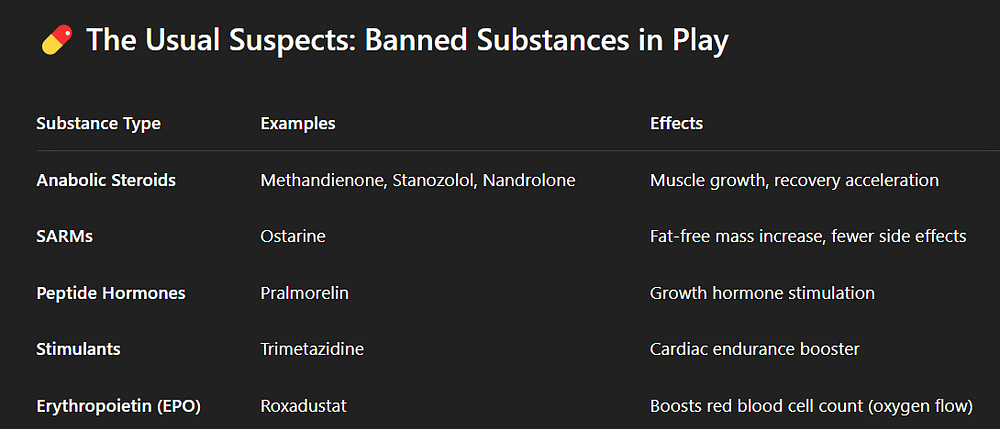
The Usual Suspects: Banned Substances in Play

⚠️ Why Do Athletes Dope?

  • Performance Pressure: National, social, and financial expectations can push athletes to cut corners.
  • Ignorance: Many Indian athletes cite ignorance or contaminated supplements as reasons.
  • Lack of Access to Clean Nutrition: In India and some developing countries, access to certified supplements is limited.
  • Weak Institutional Support: Inconsistent testing, lenient penalties, and poor athlete education create an environment of impunity.

๐ŸŽฏ The Road Ahead

If countries want to restore faith in the spirit of fair competition, anti-doping agencies must:

  1. Educate athletes at grassroots levels.
  2. Increase out-of-competition testing.
  3. Blacklist unregulated supplements.
  4. Implement a zero-tolerance approach — without bias or political interference.

Final Thoughts

The medal may glisten on the podium, but behind the shine, a darker truth often lurks. As India aspires for sporting greatness, it must first win the war against doping. And globally, it’s time we asked hard questions — not just of athletes, but of federations, agencies, and entire sporting cultures.

The Red Flags in Indian Research: A Wake-Up Call for Scientific Integrity


The Red Flags in Indian Research: A Wake-Up Call for Scientific Integrity


India’s research ecosystem has been growing rapidly, but so have the red flags. In recent years, the country has emerged as a global hotspot for scientific misconduct, trailing only the United States and China in the number of paper retractions. While this may suggest a thriving academic environment on the surface, a deeper look reveals troubling trends that threaten the credibility of Indian science.

The Retraction Surge

Between 2020 and 2022, scientific paper retractions from India increased by a staggering 2.5 times compared to 2017–2019. India now ranks third globally in total retractions, an alarming indicator of underlying issues in research integrity.

Why Are Papers Being Retracted?

Analysis shows that the majority of Indian paper retractions are not due to honest errors but deliberate misconduct:

  • Plagiarism: 34.45%
  • Fabrication & Image Manipulation: 29.92%
  • Duplicate Publications: 21%
  • Fake Peer Reviews: Common, particularly in private institutions

These figures highlight a systemic problem that goes far beyond individual cases.

Institutional Misconduct

Several prestigious institutions have been repeatedly flagged:

  • Indian Institute of Toxicology Research (IITR): 73 problematic papers listed on PubPeer, many involving manipulated Western blots.
  • IIT Dhanbad: At least 20 papers retracted for image manipulation.
  • CSIR Labs: Multiple cases of data duplication and ethical lapses.

The widespread nature of these issues indicates institutional gaps in ethics enforcement and review processes.

The Predatory Journal Problem

Predatory publishing is another serious concern. These journals often bypass rigorous peer-review processes, allowing substandard or fraudulent research to be published. Indian authors, particularly from tier-2 and tier-3 institutions, have been frequent contributors to such outlets, sometimes due to pressure to publish or lack of awareness.

Systemic and Cultural Factors

Several structural problems fuel this crisis:

  • Pressure to Publish: University rankings, promotions, and PhD requirements are tied to publication count.
  • Lack of Oversight: India does not yet have a central regulatory authority equivalent to the U.S. Office of Research Integrity.
  • Weak Journal Ethics: Only 50.9% of Indian biomedical journals have a dedicated ethics section. Around 38.2% don’t reference any bioethics guidelines.

Not Just a Numbers Game

Behind every retracted paper is a loss of trust in Indian science. It affects the global credibility of our researchers and institutions, making it harder for genuine scientists to gain international respect and funding.

The Way Forward

  1. Establish a National Ethics Authority: India urgently needs a central body to monitor research integrity.
  2. Mandatory Ethics Training: For students, researchers, and faculty across all disciplines.
  3. Journal Reforms: Implement strict peer review and ethical transparency.
  4. Promote Open Science: Encourage data/code sharing and pre-registration of studies.
  5. End the Publish-or-Perish Culture: Shift the focus from quantity to quality.

Final Thoughts

India’s potential as a global scientific leader is immense. But to fulfill that promise, we must address the rot within. It’s time for academia, policymakers, and the public to unite in demanding transparency, accountability, and integrity in Indian research.

Let this be our wake-up call.

If you’re a student, researcher, or concerned citizen, share this article to spread awareness. Science thrives only when trust does.

Wednesday, April 16, 2025

๐Ÿ“š A Global Pressure Cooker: Comparing College Entrance Exam Toughness in India, China, and Beyond


๐Ÿ“š A Global Pressure Cooker: Comparing College Entrance Exam Toughness in India, China, and Beyond

When it comes to college entrance exams, a few countries stand out as pressure-cookers of academic competition. In India, China, South Korea, Japan, Iran, and parts of Europe, students prepare for years for a single test that could define their futures. In contrast, the United States offers a more holistic (and often criticized) approach. But how do these systems actually compare?

Let’s break it down country by country.


๐Ÿ‡ฎ๐Ÿ‡ณ India: The Gauntlet of Competitive Exams

๐ŸŽฏ Exams:

  • JEE Advanced for IITs (Engineering)
  • NEET for Medical colleges
  • CUET for Central Universities

๐Ÿ“Š Acceptance Rates:

  • JEE Advanced: ~2% of applicants qualify. For top IITs, a rank in the top 1,000 (out of ~180,000 who qualify) is needed.
  • NEET: 2.1 million+ appear, but only ~7% get into government medical colleges.

๐Ÿ‹️ Coaching Culture:

  • A billion-dollar industry. Kota, Rajasthan is a “coaching city” with lakhs of students. Coaching starts as early as Class 8 or 9.
  • Some students spend 14–16 hours a day studying.

๐Ÿ˜“ Pressure:

  • Sky-high. Parental expectations, social comparisons, and fear of failure often cause anxiety and depression. Unfortunately, student suicides in coaching hubs are not uncommon.

๐Ÿ‡จ๐Ÿ‡ณ China: The Gaokao — Life’s Final Boss

๐ŸŽฏ Exam:

  • Gaokao (National College Entrance Exam)

๐Ÿ“Š Acceptance Rates:

  • Top universities like Tsinghua or Peking University admit <0.1% of Gaokao takers (~10 million sit the exam annually).
  • Students often need to score in the top 0.01% for elite programs.

๐Ÿ‹️ Coaching Culture:

  • “Gaokao factories” exist. Some high schools resemble boot camps. Morning study starts at 5 a.m., with school ending as late as 11 p.m.

๐Ÿ˜“ Pressure:

  • Incredibly intense. Gaokao is called a “once-in-a-lifetime” test. It is often the sole criterion for university admission.

๐Ÿ‡ฐ๐Ÿ‡ท South Korea: The Suneung Survival Game

๐ŸŽฏ Exam:

  • Suneung (CSAT) — College Scholastic Ability Test

๐Ÿ“Š Acceptance Rates:

  • Seoul National University: Admits less than 0.5% of test-takers.
  • Students aim for the “SKY” universities (Seoul National, Korea, Yonsei), which are highly selective.

๐Ÿ‹️ Coaching Culture:

  • Hagwons (private cram schools) are everywhere. Students often attend until midnight.
  • The government has attempted to limit evening study hours to combat burnout.

๐Ÿ˜“ Pressure:

  • National stress levels spike during Suneung day. Flights are grounded during listening tests to avoid noise. Students rehearse for years.

๐Ÿ‡ฏ๐Ÿ‡ต Japan: Exam Hell with a Gap Year Culture

๐ŸŽฏ Exam:

  • National Center Test (now called the Common Test) + University-specific entrance exams

๐Ÿ“Š Acceptance Rates:

  • University of Tokyo: Acceptance rate ~1.8%
  • Many students take a gap year (“ronin”) to reattempt exams after failing.

๐Ÿ‹️ Coaching Culture:

  • Juku (cram schools) are common. Many students also enroll in prep schools during gap years.

๐Ÿ˜“ Pressure:

  • Social stigma of being a “ronin” is real, but the pressure is slightly less intense than Korea or China due to multiple entry points.

๐Ÿ‡ฎ๐Ÿ‡ท Iran: The Konkur — One Exam to Rule Them All

๐ŸŽฏ Exam:

  • Konkur (National University Entrance Exam)

๐Ÿ“Š Acceptance Rates:

  • Less than 1% get into top programs like medicine at the University of Tehran.

๐Ÿ‹️ Coaching Culture:

  • Coaching is widespread and often expensive. Students study rigorously for years, especially for medical and engineering tracks.

๐Ÿ˜“ Pressure:

  • The entire university system is dependent on one test. High stress, especially in a society with limited job opportunities for graduates.

๐Ÿ‡บ๐Ÿ‡ธ USA: The Holistic and Chaotic Alternative

๐ŸŽฏ Exams:

  • SAT / ACT, plus GPA, extracurriculars, essays, recommendations

๐Ÿ“Š Acceptance Rates:

  • Harvard: ~3%
  • MIT: ~4%
  • However, less than 1% of U.S. students apply to Ivy League-level schools.

๐Ÿ‹️ Coaching Culture:

  • Growing test-prep market, but nothing close to India/China.
  • Wealth plays a role: private counseling, legacy admissions, and “donations” tilt the odds.

๐Ÿ˜“ Pressure:

  • High for top schools, but not tied to a single national exam. Students have more pathways: community college, transfer routes, etc.

๐Ÿ‡ช๐Ÿ‡บ Europe: More Balanced, But Varies By Country

๐ŸŽฏ Exams:

  • Depends on the country. Some use Baccalaureate-style exams (France), others use GPA + entrance test hybrids (Germany, Italy).

๐Ÿ“Š Acceptance Rates:

  • Generally higher. Public universities are accessible if you clear national or regional thresholds.
  • For example, Germany’s Numerus Clausus system limits spots in medicine and psychology, but other disciplines are open.

๐Ÿ‹️ Coaching Culture:

  • Minimal compared to Asia. Emphasis is on school performance, not separate coaching centers.

๐Ÿ˜“ Pressure:

  • Moderate. Less extreme societal pressure due to affordable education, free or low-cost universities, and strong vocational pathways.

๐Ÿง  Conclusion: Who Has It the Toughest?

In terms of pure exam difficulty and pressure, here’s an informal global toughness ranking:

  1. China (Gaokao — mass scale, single shot, insane cutoffs)
  2. India (IIT-JEE/NEET — huge competition, expensive coaching culture)
  3. South Korea (Suneung — national obsession, sky-high stakes)
  4. Iran (Konkur — one chance, brutal cutoffs)
  5. Japan (Gap year culture softens blow, but still intense)
  6. USA (Low pressure unless aiming for top Ivies)
  7. Europe (Generally more balanced and humane)

๐Ÿ•ฏ Final Thoughts:

In countries like India, China, and South Korea, college entrance exams are more than tests — they are national obsessions, economic lifelines, and psychological crucibles. While some systems offer flexibility, others leave little room for error. Reform is slow, but needed. After all, no single exam should define a teenager’s future.


Why Ayurveda as a "Science" Is Inferior to Modern Medicine

 Ayurveda is often praised for its ancient roots, holistic approach, and natural remedies. While it may offer lifestyle insights and wellness practices, it's important to recognize a crucial distinction: Ayurveda is not a science in the modern sense. When compared with contemporary biomedical science, Ayurveda is fundamentally inferior as a scientific framework. Here's why:


1. Non-Falsifiable Concepts

Science thrives on testable hypotheses — ideas that can be proven wrong if evidence contradicts them. Ayurvedic principles like doshas (Vata, Pitta, Kapha), prana (life force), and agni (digestive fire) are non-falsifiable metaphysical constructs. They can’t be objectively measured or disproven, which puts them outside the boundaries of science.


2. Lack of Mechanistic Understanding

Modern medicine understands diseases and treatments down to molecular, cellular, and biochemical levels. Ayurveda does not offer such mechanistic clarity. There's no understanding of DNA, viruses, neurons, or hormones — foundational elements in explaining how the body works and how illnesses arise.


3. No Evolution Through Empirical Feedback

Science progresses by correcting itself. New experiments challenge old theories, and outdated models are revised or discarded. Ayurveda, by contrast, is largely frozen in time, based on ancient scriptures. It does not adapt or evolve in response to new evidence, which is anti-scientific by nature.


4. Absence of Quantification

Scientific disciplines rely heavily on quantitative data and mathematical modeling. In contrast, Ayurveda is qualitative and descriptive. It lacks precision, which makes standardization, replication, and cross-verification nearly impossible.


5. Epistemologically Pre-Scientific

Ayurveda emerged long before the scientific method was developed. It is based on philosophical intuition, personal observation, and textual reverence, rather than hypothesis testing, controlled experiments, and peer review — the pillars of scientific knowledge.


6. No Common Scientific Language

Modern science speaks in a universal, standardized vocabulary. Terms like “neuron,” “insulin,” or “photosynthesis” mean the same thing worldwide. Ayurvedic terms are vague, rooted in Sanskrit, and often metaphorical — making meaningful integration with global science impractical.


7. Disconnection from Natural Sciences

Modern medicine is closely tied to biology, chemistry, physics, genetics, and data science. Ayurveda exists largely in isolation from these disciplines, which makes it unable to benefit from — or contribute to — the broader scientific enterprise.


8. Reliance on Scriptural Authority

A science that puts textual authority above experimental evidence is inherently flawed. Ayurveda’s reliance on ancient texts like the Charaka Samhita or Sushruta Samhita makes it prone to confirmation bias, rather than encouraging critical questioning or data-driven refinement.


9. No Predictive Capability

Good scientific theories don’t just explain the past — they predict the future. Newton’s laws predict how a rocket will move. Medical models predict how a virus will spread. Ayurveda, however, cannot generate consistent, testable predictions about disease progression or treatment outcomes.


10. Incompatibility with Modern Technology

Ayurveda’s theoretical framework does not interface with modern innovations like MRI, genome sequencing, robotics, AI diagnostics, or drug design. It cannot meaningfully contribute to or benefit from these technologies because its foundations are incompatible with modern scientific systems.


Conclusion: Tradition Is Not Science

Ayurveda can still play a role in personal wellness, preventive care, or cultural traditions. But when viewed through the lens of modern science, it falls short on every critical metric: testability, quantifiability, adaptability, and predictive power.

It’s not an insult to tradition to acknowledge its limitations — it’s a necessary step toward intellectual honesty and public health. Reverence for ancient wisdom should not come at the cost of scientific truth.

The Shadow of Karma: How an Ancient Doctrine Cemented Centuries of Suffering for India’s Untouchables

  The Shadow of Karma: How an Ancient Doctrine Cemented Centuries of Suffering for India’s Untouchables In the labyrinth of India’s social h...