Showing posts with label caste system. Show all posts

Tuesday, December 16, 2025

When Privilege Gets Help, It’s “Networking”; When Others Get Help, It’s “Quota”


When Privilege Gets Help, It’s “Networking”; When Others Get Help, It’s “Quota”

Unpacking the Double Standards of Caste Privilege in India

In India, the conversation around social mobility often reveals a stark hypocrisy. For those in the “general category” — a polite euphemism for upper castes — opportunities handed down through family ties, alumni networks, or social circles are celebrated as savvy “networking.” It’s seen as a natural extension of merit, hard work, and personal connections. But when lower castes, including Scheduled Castes (SC), Scheduled Tribes (ST), and Other Backward Classes (OBC), access affirmative action through reservations or quotas, it’s frequently demonized as unfair favoritism, a handout that undermines true achievement. This double standard isn’t just rhetoric; it’s rooted in centuries of systemic inequality that continues to shape Indian society today.

This article delves into how upper castes justify their privileges as legitimate networking while vilifying quotas for others. We’ll trace the historical factors that built these upper-caste networks from ancient times and explore why lower castes have been systematically denied the same advantages. Drawing from historical context and contemporary analyses, the goal is to highlight how caste operates as an invisible force, often unacknowledged by those who benefit from it most.

The Myth of Merit: How Upper Castes Frame Privilege as “Networking”

Upper castes in India have long positioned their advantages as the fruits of individual effort and strategic connections, rather than inherited privilege. For instance, in professional fields like tech, finance, and academia, upper-caste individuals often leverage family legacies, elite school alumni groups, and informal referrals to secure jobs or promotions. This is praised as “networking” — a skill anyone can supposedly learn. Yet, as discussions on platforms like Reddit point out, these networks are rarely accessible to outsiders, and they’re built on generations of exclusivity.

A key justification is the narrative of “meritocracy.” Upper castes argue that their success stems from superior education and skills, ignoring how caste has historically monopolized access to these resources. In the tech industry, for example, upper-caste dominance in Silicon Valley and Indian IT firms is often attributed to talent, but research shows it’s largely due to early migration waves favoring those with pre-existing privileges like English education and urban connections.

This framing allows privilege to hide in plain sight: when a Brahmin or Kshatriya gets a leg up from a relative in a high position, it’s “using connections wisely.” Meanwhile, quotas are labeled as “reverse discrimination,” eroding standards.

This hypocrisy extends to everyday discourse. Upper-caste individuals might dismiss caste as irrelevant in modern India, claiming society is now “casteless” for the privileged. But as one analysis notes, this invisibility is itself a privilege — upper castes don’t “see” caste because it works in their favor, maintaining homogeneity in elite spaces like universities and corporations.

Studies from higher education institutions reveal that upper-caste students often view their advantages as earned, while perceiving lower-caste peers as undeserving beneficiaries of quotas.

Demonizing Quotas: The Backlash Against Lower-Caste Support

On the flip side, affirmative action programs — designed to counteract centuries of exclusion — are routinely attacked as unjust. The 10% quota for economically weaker sections (EWS) among upper castes, introduced in 2019 and upheld in 2022, sparked outrage from activists who argued it further entrenches privilege by benefiting those already advantaged, while diluting reservations for historically oppressed groups. Critics from lower castes see this as a “violation” of constitutional equity, yet upper castes frame it as a fair extension of economic aid.

The demonization often boils down to resentment: quotas are portrayed as “stealing” opportunities from the “meritorious.” In media and social commentary, lower-caste success via reservations is dismissed as tokenism, ignoring the barriers they overcome. For example, in science and academia, upper castes dominate due to inherited networks, but quotas for lower castes are blamed for any perceived drop in quality.

This narrative conveniently overlooks how upper-caste “networking” functions as an unofficial quota system, reserving spots through referrals and social capital.

In essence, when lower castes get institutional help, it’s seen as charity at the expense of others. But upper-caste networking? That’s just business as usual.

From Ancient Roots: The Historical Foundations of Upper-Caste Networking

The origins of this disparity trace back to India’s ancient caste system, formalized in texts like the Manusmriti around 200 BCE to 200 CE. This varna system divided society into four hierarchical groups: Brahmins (priests and scholars), Kshatriyas (warriors and rulers), Vaishyas (traders), and Shudras (laborers), with Dalits (formerly “untouchables”) outside it entirely. Upper castes, particularly Brahmins, were granted exclusive rights to education, land ownership, and religious authority, creating early networks of power.

Over centuries, these structures evolved under various rulers, from medieval kingdoms to British colonialism. Upper castes adapted by aligning with colonial administrators, gaining access to English education and civil service roles. This built intergenerational wealth and connections: families passed down knowledge, property, and social ties, forming closed networks in bureaucracy, business, and academia.

In the modern economy, these networks persist. In Mumbai’s industrial era, upper castes used caste-based associations to secure jobs in mills and factories. Today, in global migration, upper castes dominate tech and professional diasporas because historical privileges like better schooling and urban access enabled them to capitalize on opportunities first. Economic studies show Brahmins enjoy higher education, income, and social connections, reinforcing their networks.

Caste-based segregation in cities further cements this, with upper castes clustering in affluent areas for mutual benefit.

These factors — rooted in ancient hierarchies and amplified through history — have created a self-perpetuating system where upper castes “network” effortlessly, often without recognizing it as privilege.

Barriers to Entry: Why Lower Castes Don’t Have the Same “Networking” Privileges

Lower castes have been systematically excluded from building similar networks due to entrenched discrimination and resource deprivation. Historically, they were barred from education, property ownership, and social mixing, enforced through untouchability and violence. This legacy persists: lower castes face poorer schools, underfunded institutions, and exclusion from elite networks.

Economically, caste restricts access to finance and entrepreneurship. Dalits and OBCs encounter discrimination in hiring, loans, and business partnerships, limiting their ability to form robust networks. In rural areas, landlessness and manual labor trap generations in poverty, while urban migration favors those with prior advantages — often upper castes.

Socially, caste homogeneity in elite spaces makes integration difficult. Lower castes report invisibility or outright bias, with upper castes refusing to collaborate or mentor. During crises like the COVID-19 pandemic, lower castes suffered disproportionately due to lack of safety nets and networks. Macroeconomic analyses estimate that caste discrimination reduces entrepreneurial potential and overall growth, as lower castes are denied the capital and connections upper castes take for granted.

In short, lower castes aren’t just starting from behind; the system is rigged to keep them there, without the “networking” luxuries afforded to others.

Toward a More Equitable Future

Recognizing this double standard is the first step toward dismantling it. While quotas provide essential redress, true equity requires addressing the invisible networks that perpetuate upper-caste dominance. As India evolves, conversations around caste must move beyond denial to acknowledgment — only then can networking become a tool for all, not just the privileged few.By examining these dynamics, we see that privilege isn’t always overt; it’s often woven into the fabric of society. For a nation aspiring to meritocracy, confronting caste head-on is non-negotiable.

Thursday, December 4, 2025

The Shadow of Karma: How an Ancient Doctrine Cemented Centuries of Suffering for India’s Untouchables


The Shadow of Karma: How an Ancient Doctrine Cemented Centuries of Suffering for India’s Untouchables

In the labyrinth of India’s social history, few concepts have wielded as much power — and inflicted as much pain — as the theory of karma. For millennia, this philosophical pillar of Hinduism has been invoked to explain, and often justify, the rigid hierarchies of the caste system. At the bottom of this pyramid lay the “untouchables,” now known as Dalits, whose lives of destitution, discrimination, and dehumanizing labor were framed not as societal failures, but as cosmic consequences. Imagine being told that your poverty, your exclusion from temples, and even the violence inflicted upon you are all deserved — payments for sins committed in a life you can’t remember. This is the insidious logic that karma imposed on millions, turning oppression into divine decree.

But how did this happen? How did a idea meant to encourage moral living become a tool for perpetuating inequality? In this exploration, we’ll unpack the historical and philosophical threads that wove karma into the fabric of untouchability, revealing a system so entrenched that even its victims often accepted it as fate.

The Foundations: Caste and Karma in Ancient India

India’s caste system, one of the world’s oldest forms of social stratification, traces its roots back to the Vedic period around 1500 BCE. Described in the Rig Veda, society was initially divided into four varnas (classes): Brahmins (priests and scholars), Kshatriyas (warriors and rulers), Vaishyas (merchants and farmers), and Shudras (laborers). Outside these varnas were the outcastes, or untouchables — groups deemed so impure that contact with them was believed to pollute higher castes. These untouchables, often indigenous tribes or defeated communities, were relegated to the fringes of society, performing the most menial and degrading tasks, like cleaning sewers, handling dead bodies, or manual scavenging.

Enter karma, a core tenet of Hindu philosophy derived from the Upanishads (circa 800–200 BCE). Karma posits that every action — good or bad — generates consequences that carry over into future lives through reincarnation (samsara). The cycle of birth, death, and rebirth continues until one achieves moksha (liberation), breaking free from this wheel.

In theory, it’s a system of cosmic justice: live righteously, and you’ll reap rewards in the next life.But in practice, karma was twisted to reinforce birth-based hierarchies. Texts like the Chandogya and Kaushitaki Upanishads linked one’s rebirth to past deeds, suggesting that good karma led to birth in higher varnas, while bad karma resulted in lower ones — or worse, as an untouchable. 

The Manusmriti, an influential legal text from around 200 BCE to 200 CE, codified this by prescribing harsher punishments for lower castes and restricting their access to education, property, and rituals. Thus, an untouchable’s suffering in this life wasn’t random; it was penance for sins in a previous existence.

Justifying the Unjust: Suffering as Deserved Fate

This linkage created a powerful narrative: If you’re born an untouchable, it’s because of your own past misdeeds. Your current hardships — poverty, social isolation, and backbreaking labor — are not the fault of the upper castes or the system, but a direct result of your soul’s history. Upper castes, conversely, enjoyed their privileges as rewards for prior virtue, giving them a moral license to maintain the status quo.

The doctrine went further by tying karma to dharma (duty). For untouchables, salvation lay in faithfully performing their assigned roles — no matter how degrading. Manual scavenging, for instance, was seen as their dharma; by enduring it without complaint, they could accumulate good karma, potentially earning a higher birth in the next life and eventual moksha. The Bhagavad Gita reinforces this in verses like 18:47, stating that it’s better to perform one’s own dharma imperfectly than another’s well, implying that straying from caste duties invites more bad karma.

This framework didn’t just justify exploitation; it sanctified it. Untouchables were barred from entering temples, drawing water from common wells, or even casting shadows on higher castes, all under the guise of preserving ritual purity. Violence against them, including beatings or killings for “transgressions,” was rationalized as upholding cosmic order. For thousands of years, from the Vedic era through medieval times and into colonial India, this ideology held sway, ensuring social stability at the expense of human dignity.

The Tragic Acceptance: Internalization and Brainwashing

Perhaps the most heartbreaking aspect is how untouchables themselves internalized this belief. Through generations of religious indoctrination, many came to view their plight as self-inflicted, a form of radicalization that turned victims into unwitting enforcers of their own oppression. System Justification Theory in psychology explains this: Believing in karma provides a sense of certainty and security, making unbearable suffering feel meaningful rather than arbitrary. It fosters low self-esteem and diminished aspirations, perpetuating the cycle without needing overt coercion.

This brainwashing was amplified by religious leaders and texts. Shankaracharya of Puri, a prominent Hindu figure, emphasized that caste (jati) is determined by birth alone, not actions, to preserve “pure” lineages. Untouchables were taught that rebellion would only worsen their karma, dooming them to even lower rebirths. Even today, echoes of this persist in rural India, where Dalits sometimes accept discrimination as fate, despite constitutional protections.

Breaking the Cycle: Lessons for Today

The story of karma and untouchability is a cautionary tale about how philosophies can be co-opted to serve power. It reminds us that true justice requires questioning inherited beliefs, not accepting them as destiny. As India evolves, shedding these shadows could pave the way for a society where birth doesn’t dictate worth — and where karma inspires personal growth, not perpetual chains.

Monday, November 17, 2025

The Parallel Shadows: White Supremacy in the West and Caste Supremacy in India


The Parallel Shadows: White Supremacy in the West and Caste Supremacy in India


In an increasingly globalized world, discussions about discrimination often focus on race or caste as isolated phenomena. Yet, beneath the surface, striking parallels emerge between white supremacist ideologies in the West — particularly in the United States — and caste supremacist attitudes in India. Both systems, rooted in notions of inherent superiority and inferiority, have historically justified oppression and continue to fuel resistance against efforts to level the playing field. This article explores how both groups decry affirmative action (or reservations in India) as “reverse discrimination” and selectively highlight underperformance among marginalized groups to perpetuate myths of lesser capability, intelligence, or work ethic — echoing the justifications once used to defend slavery.

Historical Foundations: Myths of Inferiority

White supremacy in the West didn’t emerge in a vacuum. During the era of transatlantic slavery, enslavers propagated the idea that Black people were inherently inferior, biologically suited for subjugation. This “myth of Black inferiority” portrayed Africans as less intelligent, more primitive, and naturally subservient, making slavery not just economically expedient but morally defensible.

Enslaved individuals were seen as wearing a “racial uniform” that marked them for exploitation, with pseudoscientific arguments claiming their supposed traits made them ideal for labor-intensive roles. After emancipation, these ideas intensified, evolving into Jim Crow laws and segregation to maintain white dominance.

Similarly, India’s caste system has long entrenched hierarchies based on birth, with upper castes (particularly Brahmins) viewing themselves as superior. Dalits (formerly “untouchables”) and other lower castes, including Scheduled Castes (SC) and Scheduled Tribes (ST), were historically deemed impure and fit only for menial tasks. This system, predating modern racism, shares ontological roots with white supremacy, where discrimination is cyclical and self-reinforcing.

As Isabel Wilkerson argues in her book Caste, both caste supremacy and racism function as hidden structures of domination, with white supremacy in the U.S. mirroring the “Caucasian caste” that enforces solidarity to secure privilege.

In India, caste manifests in servitude and disproportionate incarceration of Dalits, much like racism’s impact on Black Americans.

These parallels aren’t coincidental. Both ideologies rely on descent-based discrimination, where one’s birth determines worth. Efforts to equate caste with race have been debated globally, with Dalits pushing for recognition at forums like the UN, arguing that caste supremacy is a form of racism.

While differences exist — caste is more fluid in some contexts than race — the core mechanism of exclusion through perceived inferiority binds them.

Affirmative Action as “Reverse Discrimination”: A Shared Refrain

One of the most telling similarities is the backlash against policies aimed at rectifying historical injustices. In the U.S., affirmative action — designed to address systemic racism — has been lambasted by white supremacists as “reverse racism.” They claim it unfairly disadvantages whites, promoting a colorblind narrative that ignores ongoing white privilege. Phrases like “it’s OK to be white” have been co-opted to frame affirmative action as anti-white discrimination, echoing broader supremacist rhetoric. Critics argue it violates meritocracy, but this often masks resistance to challenging white supremacy’s hold on power. Even post-civil rights, “respectable” white supremacist ideas adopt reverse discrimination frames to delegitimize such programs.In India, caste-based reservations for SC/ST communities — quotas in education, jobs, and politics — face analogous attacks. Upper-caste opponents, often embodying caste supremacist views, decry them as “reverse casteism,” arguing they compromise efficiency and merit by favoring the “undeserving.” They claim reservations perpetuate division rather than dismantle caste, with some asserting that SC/ST beneficiaries are inherently less capable, thus lowering standards.

This mirrors the U.S. narrative: both frame equity measures as unfair advantages, ignoring centuries of exclusion that created the need for them in the first place.

Data, however, debunks efficiency losses, showing reservations often enhance representation without sacrificing quality — yet the myth persists to preserve upper-caste privilege.

On platforms like X (formerly Twitter), anti-reservation discourse amplifies these caste supremacist arguments, often under hashtags like #EndReservation and #FightForMerit.

Users frequently share examples of candidates with negative or low scores securing positions via reservations while high-scorers are denied, claiming this proves reservations reward “birth over worth” and push beneficiaries toward “lifelong shame.”

Common refrains include calls to “stop rewarding birth” and assertions that reservations undermine meritocracy, leading to inefficiency and a lack of dignity for all involved.

Influential accounts highlight stories of general category successes without quotas to argue that the system punishes talent, framing reservations as a “permanent seat” rather than a temporary ladder.

Others label anti-Brahminism or criticism of upper castes as “reverse discrimination,” drawing parallels to broader caste politics and votebank strategies.

These online echo chambers reinforce the narrative that reservations are a form of “new-age reverse casteism,” often ignoring socioeconomic contexts and portraying them as tools for division rather than justice.

Politicians in both contexts exploit these divisions. In the U.S., resistance to affirmative action aligns with broader anti-Black policies; in India, caste politics fuels anti-reservation sentiments, uniting upper castes against perceived threats.

As one analysis notes, these arguments serve as a “smokescreen” for maintaining hierarchy.

Weaponizing Performance to Reinforce Inferiority

Both ideologies selectively use data on “poor performance” to imply innate deficiencies. White supremacists historically cited enslaved Blacks’ supposed laziness or low intelligence to justify slavery, postulating that freedom would expose their “inferiority.”

Today, this evolves into claims that affirmative action admits “unqualified” minorities, whose underperformance “proves” racial hierarchies. Such narratives ignore structural barriers like unequal education and bias, instead blaming victims.In India, caste supremacists point to lower academic or professional outcomes among SC/ST groups as evidence of lesser capability, arguing reservations “prove” their point by promoting the unprepared. This overlooks systemic discrimination: unequal access to resources, prejudice in evaluations, and intergenerational trauma from caste oppression. Studies show that disparities stem from “unequal treatment” rather than inherent traits, yet the rhetoric endures to undermine reservations. Just as slavery’s defenders used pseudoscience, modern caste supremacists wield anecdotal “evidence” to argue that SC/ST communities are less hardworking or intelligent, echoing the racial justifications for bondage.These tactics aren’t just rhetorical — they perpetuate cycles of marginalization. In both societies, extractive capitalism thrives on such divisions, with racism and caste supremacy fueling exploitation.

Why These Parallels Matter

Recognizing the similarities between white supremacy and caste supremacy isn’t about equating experiences but understanding shared mechanisms of power. Both systems rely on myths of inferiority to resist change, framing equity as oppression. In the U.S., caste-like racism persists in incarceration and wealth gaps; in India, caste discrimination mirrors Jim Crow in exclusion and violence. Global migration has even exported caste to places like the U.S., where South Asians report ongoing bias.Dismantling these requires confronting the myths head-on. Affirmative action and reservations aren’t perfect, but they’re essential counters to entrenched privilege. As debates rage — from U.S. Supreme Court rulings to India’s reservation expansions — acknowledging these parallels can foster solidarity across borders, challenging the hierarchies that divide us.

Note: Views expressed are based on historical and sociological analyses; this article aims to inform, not endorse division.

Friday, October 3, 2025

The Carrot of Caste Census and the Stick of Anti-Reservation Propaganda


The Carrot of Caste Census and the Stick of Anti-Reservation Propaganda


Disclaimer: The views expressed are those of the user alone and are shared here for discussion purposes only. No legal liability is assumed, and readers are encouraged to form their own judgments based on independent research.

In the intricate chessboard of Indian politics, the Bharatiya Janata Party (BJP) appears to be employing a classic carrot-and-stick strategy when it comes to caste dynamics and affirmative action. On one hand, the party has dangled the promise of India’s first comprehensive public caste census since independence, slated to begin in 2027, as a sweetener to woo lower-caste voters. 

On the other, a surge in anti-reservation rhetoric — often amplified by the BJP’s IT cell and affiliated social media handles — seems designed to stoke resentment among upper castes and dilute demands for expanded affirmative action once the census results emerge. This duality raises questions about the party’s long-term intentions: Is this a genuine step toward social justice, or a tactical maneuver to maintain power without upsetting its traditional upper-caste base?

The Carrot: Promising a Long-Awaited Caste Census

The BJP-led central government announced in June 2025 that the 16th national census, delayed multiple times due to the COVID-19 pandemic, would commence on March 1, 2027, and for the first time in nearly a century, include a detailed enumeration of castes. This move, described by sources as focusing on “caste, not class,” requires individuals to declare their caste and religion, marking a significant shift from previous censuses that only tracked Scheduled Castes (SC) and Scheduled Tribes (ST). The process is set to unfold in two phases, with data collection wrapping up by 2030 — conveniently after the 2029 Lok Sabha elections.

For lower-caste communities, including Other Backward Classes (OBCs), SCs, and STs, this census represents a potential game-changer. It could provide empirical data to address longstanding disparities, potentially justifying demands for increased reservations in education, jobs, and even the private sector. BJP leaders have positioned this as a fulfillment of social justice commitments, with party campaigns in states like Uttar Pradesh emphasizing it as a tool for equitable representation. Critics from opposition parties, such as the Rashtriya Janata Dal (RJD), have claimed credit for pressuring the government into this decision, but the BJP has framed it as a proactive step under Prime Minister Narendra Modi’s leadership.Heading into the 2029 elections, this announcement could serve as a powerful electoral carrot. The party might rally lower-caste voters by highlighting its role in conducting the census, portraying it as a pathway to “equitable representation.” Gullible or hopeful sections of these communities might buy into the narrative, believing that post-census reforms will follow. However, with results not expected until 2030, any substantive changes — like raising the 50% reservation cap or introducing private-sector quotas — would come after the polls, allowing the BJP to secure votes without immediate commitments.

The Stick: Fanning Anti-Reservation Flames on Social Media

Contrasting sharply with this promise is the relentless anti-reservation propaganda flooding social media platforms, particularly X (formerly Twitter), which has intensified since late 2024 and early 2025 — coinciding suspiciously with the census announcement. BJP-affiliated accounts and IT cell operatives have been accused of amplifying content that blames reservations for everything from infrastructure failures to societal ills, reaching what many describe as “delusional levels.”

Examples abound: In one viral incident, an Indian-American professor sparked outrage by attributing a deadly Air India crash to India’s reservation policies, claiming “freeloaders are more important.” Social media posts link reservations to brain drain, with users lamenting that talented individuals flee abroad due to “unfair” quotas. Even mundane issues like potholes or bridge collapses are absurdly pinned on affirmative action, as if meritocracy alone could pave roads or build sturdy infrastructure. X searches reveal a pattern: Queries for “anti reservation” or “blame reservation” yield posts tying quotas to unrelated crises, often with high engagement and from accounts echoing BJP narratives.

This rhetoric isn’t organic; it’s amplified by organized efforts. Reports from 2024–2025 highlight a spike in hate speech and divisive content on social media, peaking during elections and policy announcements. BJP IT cell members have been caught sharing edited videos or misleading claims to portray opposition leaders as anti-reservation, while subtly undermining the system itself. The pace has quickened post-census reveal, suggesting a deliberate strategy to desensitize the public to quota demands. By 2030, when census data might reveal stark inequalities, the ground could be prepared for upper-caste outrage to suppress calls for reform, ensuring the status quo persists.

The Underlying Realities: Persistent Backwardness Among SC/ST/OBC

This speculated strategy hinges on ignoring — or downplaying — the harsh realities faced by SCs, STs, and OBCs, who remain economically backward and under-represented despite decades of reservations. Data from recent surveys paints a grim picture.

Economically, these groups lag significantly. In Bihar’s 2023 caste survey (a precursor to the national one), OBCs and Extremely Backward Classes comprised 63% of the population but faced disproportionate poverty. Nationally, indicators from the Mandal Commission and recent reports show higher poverty rates among SC/ST/OBC, with limited access to quality education and jobs. For instance, systemic exclusion manifests in “deep-rooted deprivation,” as argued in a Madhya Pradesh Supreme Court affidavit defending OBC quotas. Estimates suggest that if the census confirms 75–80% of Indians belong to backward classes, demands for breaching the 50% quota cap could intensify — but only if propaganda doesn’t preempt them.Under-representation is equally stark. In central government jobs, OBCs hold about 22% of positions as of 2022–23, below the 27% mandate, while SCs and STs often fill lower-rung roles but remain below 11% and 5% in teaching posts, respectively. Thousands of reserved vacancies go unfilled annually, signaling inequality rather than abundance. In private higher education institutions, representation of marginalized students is “abysmal,” with calls for mandatory quotas unmet. Population-wise, OBCs, SCs, and STs make up over 70% of India, yet their share in elite jobs and education doesn’t reflect this.

BJP’s Balancing Act: Appeasing Bases Without Real Change

Historically backed by upper castes, the BJP has expanded its reach among OBCs and lower castes through figures like Modi (an OBC himself). Yet, this carrot-and-stick approach suggests a desire to placate lower castes with symbolic gestures like the census while using propaganda to ensure upper-caste “savarna” outrage mutes any push for meaningful reforms. In an ideal scenario for the party, the census proceeds, but demands for private-sector reservations or quota hikes are drowned out by anti-reservation noise.

This speculation isn’t without precedent. Past BJP moves, like lateral entry in civil services or privatization drives, have been criticized as anti-reservation. If the pattern holds, the 2027 census could be a masterstroke: Win 2029 votes with promises, then leverage built-up resentment to stall action by 2030.

Ultimately, this strategy risks alienating both sides if exposed. Lower castes might see through the delay tactics, while upper castes grow wary of endless appeasement. As India hurtles toward 2029, the true test will be whether this duality fosters unity or deepens divisions. For now, the carrot dangles enticingly, but the stick looms large.

Sunday, September 21, 2025

The Doctrine of Karma: A Tool for Justifying Caste Discrimination in Hinduism, Past and Present


The Doctrine of Karma: A Tool for Justifying Caste Discrimination in Hinduism, Past and Present


In Hindu philosophy, karma represents the universal law of cause and effect, where an individual’s actions in one life determine their fate in subsequent rebirths. This concept, intertwined with the caste system (varna), has historically served as a mechanism to rationalize social hierarchies and discrimination. The caste system divides society into four primary varnas: Brahmins (priests and scholars), Kshatriyas (warriors and rulers), Vaishyas (merchants and farmers), and Shudras (laborers and servants), with those outside often labeled as Dalits or “untouchables.” Proponents argued that one’s birth into a specific caste reflects accumulated karma from past lives — good deeds leading to higher castes and bad deeds to lower ones. This framework not only perpetuated inequality but also discouraged social mobility, framing discrimination as a form of cosmic justice.

While ancient texts like the Manusmriti and Bhagavad Gita provide scriptural backing for this view, modern interpretations and societal attitudes reveal how these ideas remain deeply ingrained, despite legal prohibitions on caste discrimination in India.

Historical Justification Through Scriptural Texts

Ancient Hindu scriptures explicitly link karma to caste, portraying social status as a direct outcome of past actions. This interpretation justified discrimination by suggesting that lower castes deserved their plight as penance for previous sins, while higher castes enjoyed privileges as rewards for virtue.The Manusmriti, a foundational Dharma Shastra text dated between the 2nd century BCE and 3rd century CE, is particularly explicit. In Chapter 12, it details how actions (karma) dictate rebirth into various forms, including castes. For instance, Manusmriti 12.9 states: “In consequence of (many) sinful acts committed with his body, a man becomes (in the next birth) something inanimate, in consequence (of sins) committed by speech, a bird, or a beast, and in consequence of mental (sins he is re-born in) a low caste.”

This verse directly ties moral failings to rebirth in a “low caste,” implying that Shudras or outcastes are paying for past transgressions.

Further, Manusmriti 12.3 explains: “Action, which springs from the mind, from speech, and from the body, produces either good or evil results; by action are caused the (various) conditions of men, the highest, the middling, and the lowest.”

Here, “highest” and “lowest” conditions refer to caste positions, with virtuous actions leading to elevated rebirths and sinful ones to degradation. Manusmriti 12.40–41 elaborates on the three gunas (qualities): “Those endowed with Goodness reach the state of gods, those endowed with Activity the state of men, and those endowed with Darkness ever sink to the condition of beasts; that is the threefold course of transmigrations. But know this threefold course of transmigrations that depends on the (three) qualities (to be again) threefold, low, middling, and high, according to the particular nature of the acts and the knowledge (of each man).”

Sudras are associated with the middling state of Darkness (Manusmriti 12.43: “Elephants, horses, Sudras, and despicable barbarians, lions, tigers, and boars (are) the middling states, caused by (the quality of) Darkness”), reinforcing their inferior status as karmic punishment.

The Bhagavad Gita, part of the Mahabharata (circa 400 BCE–200 CE), also connects karma and guna to caste duties. In Gita 4:13, Lord Krishna declares: “I created mankind in four classes, different in their qualities and actions; though unchanging, I am the agent of this, the actor who never acts!”

This verse attributes the four varnas to divine creation based on gunas and karma, not birth alone, but it has been interpreted to justify hereditary castes. Gita 18:41–44 outlines duties: “The actions of a brahmana arising from his own nature are serenity, self-control, austerity, purity, tolerance, honest, knowledge of the Vedas, wisdom and firm faith… The actions of a sudra born of his own nature consists in service to brahmana, ksatriyas and vaisyas.”

Gita 18:47 reinforces adherence: “It is better to engage in one’s own svadharma (occupation), even though one may perform it imperfectly than to accept another’s occupation and perform it perfectly. Duties prescribed according to one’s nature are never affected by sinful reactions.”

Such passages encouraged acceptance of one’s caste role as karmically ordained, perpetuating discrimination.

Justification of Brahmin Privilege

Brahmins, positioned at the apex of the varna system, were granted extensive privileges, justified as rewards for superior karma from past lives. Texts portray them as spiritually elite, with their high status reflecting accumulated merit.

Manusmriti I-31 states: “For the welfare of humanity the supreme creator Brahma, gave birth to the Brahmins from his mouth, the Kshatriyas from his shoulders, the Vaishyas from his thighs and Shudras from his feet.”

This origin myth elevates Brahmins symbolically and karmically. Manusmriti VIII-20 to 22 asserts: “Any country, where there are no Brahmins, of where they are not happy will get devastated and destroyed.”

Privileges include exemptions from harsh punishments and rights over others; Manusmriti VIII-50,56 and 59 allows Brahmins to enslave Shudras without remuneration, as “the Shudra is created by Brahma to serve the Brahmins.”

Karma theory amplifies this: Being born a Brahmin indicates “good past life karma,” granting “direct access to religious learning and to the Law (Dharma).”

Manusmriti 12.48 places Brahmins in the highest rank of Goodness: “Hermits, ascetics, Brahmanas, the crowds of the Vaimanika deities, the lunar mansions, and the Daityas (form) the first (and lowest rank of the) existences caused by Goodness.”

This karmic justification framed Brahmin supremacy as divine and unassailable, allowing them to monopolize knowledge, rituals, and social power.

Justification for Shudra Oppression

Conversely, Shudras were depicted as the lowest varna, their status rationalized as punishment for poor karma, condemning them to servitude and exclusion.

Manusmriti 1–91 declares: “God said the duty of a Shudra is to serve the upper varnas faithfully with devotion and without grumbling.”

Education was forbidden; Manusmriti IV-78 to 81 states: “A Shudra is unfit of receive education. The upper varnas should not impart education or give advice to a Shudra… Violators will go to as amrita hell.”

Punishments were severe and discriminatory: Manusmriti VIII. 270: “A Shudra who insults a twice born man with gross invectives shall have his tongue cut out; for he is of low origin.”

Intercourse with higher castes invited death (Manusmriti VIII. 374).

Karma provided the rationale: “A person of bad deeds [is reborn] as a dog or a Chandala (a lower caste).”

Manusmriti 12.9 and 12.43 link sins to rebirth as Sudras or worse, justifying their subjugation as self-inflicted through past actions.

This discouraged resistance, as enduring hardship was seen as a path to better rebirth.

Persistence in Modern India

Though India’s 1950 Constitution outlawed caste discrimination and implemented affirmative action, karma-based justifications remain embedded in cultural attitudes. Surveys show belief in karma correlates with support for caste hierarchies, including opposition to inter-caste marriages and reduced aid for the poor.

In rural areas, lower castes face exclusion from jobs, education, and neighborhoods, often rationalized as “karmic fate.”

Critics argue karma is “fundamentally casteist,” blaming victims while absolving systemic oppression.

Reform movements, like those led by B.R. Ambedkar, challenge these views, but ingrained beliefs perpetuate subtle discrimination in marriage, employment, and social interactions.

Conclusion

The use of karma to justify caste discrimination, as enshrined in texts like the Manusmriti and Bhagavad Gita, created a resilient ideological framework that privileged Brahmins while oppressing Shudras. This not only historical but persists today, hindering social equality. Addressing it requires reevaluating scriptural interpretations through a lens of justice and humanity.

Tuesday, May 13, 2025

The Hidden Inequality in India's Reservation System: Why OBCs Face the Toughest Competition

 India's reservation system is often painted in binaries: reserved vs. unreserved, merit vs. quota. But the true picture is far more complex—and far more unfair to the very communities reservations are meant to uplift.

Recent data from the Karnataka caste survey—the most detailed since the 1931 British census—reveals something shocking: the Other Backward Classes (OBCs), despite being the largest social group, are vastly underrepresented in the actual seats reserved for them.


🔍 The Numbers: What the Karnataka Caste Survey Revealed

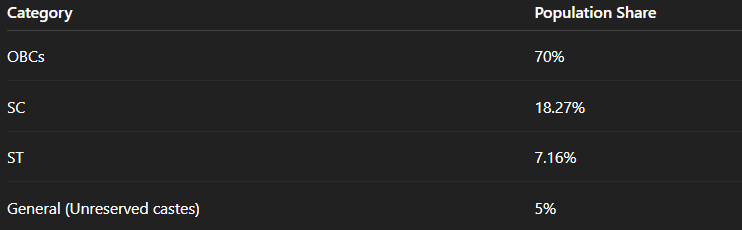
The Socio-Economic and Educational Survey (2015), submitted in 2023 by the Karnataka State Commission for Backward Classes, estimated the population composition of the state as:

This means OBCs alone form the overwhelming majority of Karnataka’s population.


🎯 But What About Seat Allocation?

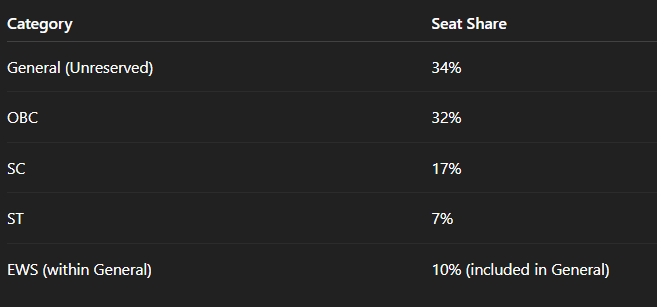
Let’s look at how government jobs and education seats are allocated in Karnataka:

The Real Shock: Seat-to-Population Ratio

By comparing each group's share of seats with their share of population, we get the seat-per-capita ratio—a clear indicator of how much competition a member of that category faces.

This means:

  • General category candidates have almost 7× more seats per capita than their population share. Their competition is the lowest.

  • OBCs, despite being the largest group, have less than half the seats they proportionally deserve.

  • SC/ST categories, while historically disadvantaged, now receive seats roughly in proportion to their population.


🧠 What Does This Really Mean?

It means OBCs are fighting for crumbs on their own table. A student or job aspirant from an OBC background faces nearly double the competition as an SC/ST counterpart—and more than 13× the competition faced by someone from an unreserved (General) caste.

And yet, public discourse often portrays OBCs as having an “easy ride” due to reservations. The numbers say otherwise.


❓ Why Is This Happening?

  1. Cap on total reservation: The Supreme Court has historically capped reservations at 50% (though Karnataka exceeds this), meaning even large groups like OBCs can’t get proportional seats.

  2. No proportional quotas: Reservations aren’t based on current caste population data (except in Tamil Nadu and now Bihar).

  3. General category advantages: The General category, which includes dominant castes, ends up with a disproportionate share despite being numerically tiny.


🔁 What Needs to Change?

  • Make caste census data public across India

  • Base reservation percentages on actual population share

  • Sub-categorize OBCs so that dominant OBCs don’t crowd out marginalized ones

  • Include seat-to-population ratio in policy-making


⚖️ Final Thought

The reservation debate often turns emotional, but data helps us see clearly. And the data is unambiguous:

The biggest victims of India’s flawed reservation system are often those it claims to empower: the OBCs.

It’s time to recalibrate the system—not against one group, but in favor of justice, logic, and equality.

The Hidden Inequity in Reservation: Why Bihar’s Backward Classes Face the Toughest Competition

 In a country where debates around reservation policies are often politically charged and emotionally sensitive, hard data can be the clearest guide. A close look at Bihar’s recently released caste survey and its 2023 reservation policy reveals something surprising, even counterintuitive: despite receiving the largest share of reservation, Backward Classes (OBC + EBC) in Bihar are actually the most disadvantaged when it comes to per capita access to seats in jobs and education.

Meanwhile, General category, Scheduled Castes (SC), and Scheduled Tribes (ST)—despite having fewer total reserved seats—actually face less competition per seat within their respective categories.

This article breaks down the numbers to explain how and why this happens.

This data shows that nearly two-thirds of Bihar’s population falls under the OBC/EBC umbrella, forming the majority.


🪑 Reservation Breakdown (Bihar, 2023)

In November 2023, Bihar passed a landmark law increasing total reservation to 75% in public employment and education. 


This means General (unreserved) category students are competing for just 25% of total seats—yet that’s still more per capita access than any other group.


🧮 Let’s Do the Math: Seats per Person

To understand which category is most competitive within itself, we compare each group’s percentage of population to the percentage of seats available to it.


🎯 Interpretation:

  • A ratio > 1 means more seats per capita than your population share (easier competition).

  • A ratio < 1 means fewer seats per capita than your population share (harder competition).

So, despite having the largest share of reservation, the Backward Classes collectively face the toughest odds simply because they have to share it with a huge chunk of the population.


🧠 Why This Feels Counterintuitive

The public narrative often assumes that reserved seats automatically mean advantage—but this ignores how many people are competing for those reserved seats.

A General category candidate might be competing for fewer seats overall, but they’re also part of a much smaller population group (15.52%). Meanwhile, a BC candidate is fighting for more seats (43%) but against more than 4 times the number of people (63.14%).


⚖️ A Broken Equity?

This leads us to a simple but overlooked conclusion: seat distribution does not automatically mean equity unless it’s proportional to population. While Bihar has gone further than most states in trying to align reservation with caste numbers, the most populous category—Backward Classes—still ends up short.

Unless the seat-to-population ratios are brought into balance, meritorious candidates from backward groups will continue to be under more pressure to outperform their peers, even within the quota system.


🛠️ What Could Be Done?

  • Subcategorization of OBC/EBC: Breaking them into more granular quotas, as suggested by several commissions, could balance internal disparities.

  • Dynamic seat allocation: Using a model that adjusts seat percentages based on real-time population and demand data.

  • Horizontal reservations within OBC/EBC to ensure representation of the most marginalized (e.g., Muslim OBCs, Most Backward Castes).


📌 Final Thoughts

This data-driven view forces us to rethink assumptions about reservation and merit. Equity is not just about allocating seats—it’s about fair access per person. And by that measure, Bihar’s reservation system, while progressive on paper, still leaves its largest and most disadvantaged population group at a competitive loss.

The system isn’t unfair because it gives “too much” to some—it’s unfair because it doesn’t give proportionately enough to the ones who need it most.

Wednesday, May 7, 2025

Why India Needs Caste-Based Reservations in the Private Sector

 India’s reservation system for Scheduled Castes (SC), Scheduled Tribes (ST), and Other Backward Classes (OBC) has historically been implemented in government jobs and public educational institutions. While it has provided life-changing opportunities for many, there's a glaring structural gap: over 90% of employment in India is now in the private sector, which has no mandatory reservation policy. This reality makes one thing clear — to truly uplift marginalized communities, reservation must extend into the private sector.


The Numbers Don't Lie: Public Sector Is Shrinking

Liberalization and privatization since the 1990s have steadily reduced the number of jobs in the public sector. From banks and railways to telecom and airlines, many sectors have either been privatized or stopped large-scale hiring. Today:

  • Private sector accounts for over 90% of jobs.

  • Only 4–5% of the total workforce benefits from affirmative action through public sector reservation.

  • Meanwhile, SC/ST/OBCs continue to be underrepresented in top-tier private jobs, leadership roles, and high-income brackets.

This creates a contradiction: we acknowledge caste-based inequality, yet limit corrective measures to a tiny and shrinking part of the economy.


Why Private Sector Reservation Is Essential

1. Historical Discrimination Isn’t Limited to the Government Sector

Caste discrimination is a centuries-old social problem that permeates all aspects of life, including hiring practices, workplace culture, and access to networks in the private sector. Many private companies hire through informal channels—friends, family, alumni networks—which systematically exclude underprivileged groups. Without reservation, there's no corrective mechanism.

2. Equal Talent, Unequal Opportunity

Thanks to educational reservations, more SC/ST/OBC students are now graduating from prestigious institutions. Yet, studies have shown that they often receive fewer interview calls, are offered lower pay, or are passed over for leadership positions in the private sector. This gap isn’t due to lack of merit — it’s due to deep-rooted social biases.

3. Public Sector Reservation Alone Can't Uplift the Masses

A single public sector job can uplift one family. But a system that excludes 90% of available employment cannot uplift an entire community. To break the cycle of caste and class disadvantage, marginalized communities need equitable access to the economic engine of modern India — the private sector.

4. Private Sector Uses Public Resources Too

Private companies thrive using infrastructure, subsidies, tax incentives, and land often provided by the government. Why should they not share the responsibility of social justice? If they benefit from the state, they must also contribute to correcting historical injustice through inclusive hiring.

5. Economic Growth Without Inclusion Is Unjust

India cannot claim to be a rising economic superpower while continuing to marginalize vast swathes of its population. Social justice must be an economic priority, not just a moral one. Inclusive hiring will lead to broader consumption, innovation, and stability.


Common Objections — And Why They’re Flawed

“But reservation will lower merit in the private sector.”

This is a deeply casteist myth. Merit is not objective in a society where access to quality education, English fluency, coaching, and networks is determined by birth. True merit shines when opportunities are equalized.

“It will hurt competitiveness.”

Countries like the U.S. have affirmative action policies and diversity quotas — yet their private sectors thrive. Inclusion doesn’t destroy competitiveness; it strengthens it by bringing in diverse perspectives.

“Private sector should have autonomy.”

Autonomy cannot be an excuse for exclusion. Just like environmental and labor laws apply to all businesses, social justice laws must too. No sector should be above the Constitution’s promise of equality.


The Way Forward: A Balanced Reservation Policy for Private Sector

  • Mandate caste-based reservation (at least 15% for SCs, 7.5% for STs, 27% for OBCs) in companies above a certain size.

  • Tie government contracts, subsidies, and land allotments to diversity hiring practices.

  • Create reporting mechanisms for diversity in hiring and promotions.

  • Launch training and mentorship programs for marginalized candidates in collaboration with companies.

  • Provide incentives for private firms that meet diversity targets, such as tax benefits or ranking advantages in government tenders.


Conclusion: Reservation in Private Sector Is Not Charity — It’s Justice

The Constitution promises equality, justice, and dignity to all. Without expanding reservation into the private sector, that promise remains broken for millions. If the private sector dominates employment in India, then it must also share the responsibility of dismantling the caste pyramid.

Reservation is not about favoring one group over another. It’s about correcting centuries of exclusion and ensuring that India’s growth story includes everyone — not just the privileged.

Why Private Sector Reservations Are Good for India: Lessons from Global Affirmative Action and the Case for Diversity Hiring

 India’s reservation system, rooted in its 1950 Constitution, has been a cornerstone of affirmative action, ensuring representation for historically marginalized groups like Scheduled Castes (SCs), Scheduled Tribes (STs), and Other Backward Classes (OBCs) in public sector jobs, education, and politics. However, with the private sector now accounting for over 90% of India’s job growth, extending reservations to this sphere is increasingly vital for social equity and economic progress. This article explores why private sector reservations are beneficial for India, drawing on global examples of affirmative action, equating diversity hiring to a form of reservation, and addressing misconceptions about merit and efficiency.

The Case for Private Sector Reservations in India
India’s private sector has grown exponentially since economic liberalization in 1991, yet marginalized communities remain underrepresented. Studies show that SC/ST households earn Rs 5,000 less per month on average than other groups, reflecting persistent income disparities. Private sector hiring often exhibits biases, with research indicating that candidates with “lower-caste” names are less likely to be shortlisted for jobs despite equivalent qualifications. Reservations in the private sector could address these inequities by ensuring access to opportunities, reducing discrimination, and fostering social inclusion.
Moreover, the public sector’s shrinking job pool—due to privatization and stagnant hiring—limits the impact of existing reservation policies. Extending reservations to private companies, which benefit from government concessions like tax breaks and subsidized land, aligns with the principle of shared social responsibility. By mandating or incentivizing the hiring of marginalized groups, India can bridge caste-based economic gaps, empower disadvantaged communities, and create a more inclusive workforce that reflects its diverse population.
Private sector reservations also have economic benefits. Diverse teams enhance innovation and decision-making by bringing varied perspectives. A 2015 McKinsey study found that companies with greater racial and ethnic diversity outperformed less diverse peers by 15-35% in financial returns. In India, where caste and regional diversity shape consumer markets, inclusive hiring can help firms better understand and serve their customers, boosting competitiveness.
Global Examples of Affirmative Action in the Private Sector
Several countries have implemented affirmative action in the private sector, offering valuable lessons for India:
  1. United States: The U.S. pioneered affirmative action through Executive Order 11246 (1965), which mandates federal contractors to adopt non-discriminatory hiring practices and set goals for employing women and minorities. While not explicit quotas, these policies require proactive recruitment from underrepresented groups, such as internships and outreach programs. The result has been increased representation of Black, Hispanic, and Native American workers in corporate settings, with no evidence of reduced efficiency. For example, tech giants like Google and Microsoft have diversity initiatives that mirror affirmative action, improving workforce representation without compromising performance.
  2. Malaysia: Malaysia’s New Economic Policy (NEP), introduced in 1971, promotes economic inclusion for the Bumiputera (indigenous Malays) through affirmative action in both public and private sectors. Private firms are encouraged to hire Bumiputera employees and allocate shares to Bumiputera investors. This has significantly reduced poverty among Malays, with their share of corporate equity rising from 2% in 1970 to over 20% by 2000. While criticisms exist about elite capture, the policy demonstrates how private sector involvement can drive social equity.
  3. South Africa: Post-apartheid South Africa implemented the Broad-Based Black Economic Empowerment (B-BBEE) Act, which incentivizes private companies to hire and promote Black South Africans through a scoring system affecting government contracts. Companies with higher B-BBEE scores gain competitive advantages, leading to increased Black representation in corporate leadership. This model shows how incentives, rather than mandates, can encourage private sector participation in affirmative action.
  4. Brazil: Some Brazilian private universities and companies have adopted voluntary quotas for Black and indigenous candidates, often tied to corporate social responsibility. These initiatives have increased access to high-skill jobs for marginalized groups, with firms like Vale reporting improved workplace innovation due to diverse talent pools.
These examples highlight that affirmative action in the private sector can take various forms—quotas, incentives, or diversity goals—tailored to local contexts. India could adopt a hybrid model, combining voluntary diversity targets with incentives like tax benefits for compliant firms.
Diversity Hiring as a Form of Private Sector Reservation
Diversity hiring, increasingly common in global and Indian corporations, is effectively a softer form of reservation. Companies like Tata Consultancy Services, Infosys, and Unilever India have diversity programs targeting women, people with disabilities, and underrepresented castes. These initiatives involve setting hiring goals, creating inclusive recruitment processes, and training managers to mitigate bias. For instance, Infosys’s diversity council focuses on increasing representation of SC/ST candidates in technical roles, resembling affirmative action without explicit quotas.
Diversity hiring aligns with reservation principles by prioritizing inclusion of marginalized groups while maintaining flexibility. It counters systemic barriers—like biased resume screening or nepotistic networks—that exclude qualified SC/ST/OBC candidates. By casting a wider net, diversity hiring ensures that talent from all backgrounds is tapped, much like reservations aim to do. The success of such programs in Indian firms shows that private sector reservations could build on existing diversity frameworks, making implementation smoother.
Addressing Misconceptions About Reservations
Critics of private sector reservations often argue that they undermine merit, reduce efficiency, and promote reverse discrimination. These misconceptions, rooted in a narrow view of meritocracy, can be debunked:
  1. Misconception: Reservations Reduce Merit
    • Reality: Reservations do not bypass qualifications; they ensure access for qualified candidates from marginalized groups who face systemic barriers. A 2018 study on India’s Indian Administrative Service (IAS) found no performance gap between affirmative action hires and merit-based recruits in implementing programs like MGNREGA. High-scoring SC/ST candidates often outperform peers, debunking the notion that reservations compromise quality. Merit is not a fixed trait but a product of opportunity—reservations level the playing field by providing access to education and networks that dominant groups take for granted.
  2. Misconception: Reservations Decrease Efficiency
    • Reality: Evidence suggests that diversity enhances efficiency. A study on India’s employment quotas for SCs found that a 1% increase in quota share raised salaried job access for rural SC men by 0.6%, with no negative impact on organizational outcomes. Globally, diverse teams improve problem-solving and innovation, as seen in U.S. firms with affirmative action programs. In India, private firms like HCL have reported higher productivity after adopting diversity initiatives, as varied perspectives drive creative solutions.
  3. Misconception: Reservations Cause Reverse Discrimination
    • Reality: Reservations address historical injustices, not create new ones. The majority’s access to jobs remains robust—general category candidates still dominate private sector hiring. Critics often overlook that reservations target systemic exclusion, not individual merit. In the U.S., affirmative action opponents claimed reverse discrimination, but courts have upheld policies like those in Fisher v. University of Texas, recognizing their role in correcting inequities without unduly harming others. In India, capping reservations at 50% (per the Indira Sawhney judgment) ensures balance.
  4. Misconception: Private Sector Should Be Free from Government Interference
    • Reality: The private sector operates within a social contract, benefiting from public resources like infrastructure and subsidies. Expecting it to contribute to social justice is reasonable. Malaysia and South Africa show that private firms can align profit motives with affirmative action, gaining competitive advantages through inclusive practices.
Countering the Narrative with Evidence
The fear that reservations dilute quality often ignores the structural inequalities that define “merit.” For instance, elite private universities in India, which lack reservations, remain dominated by upper-caste students, perpetuating exclusion. Conversely, public institutions with reservations have produced SC/ST/OBC graduates who excel in competitive fields like engineering and medicine. The notion that reservations inherently lower standards also ignores that candidates must still meet minimum qualifications, as seen in the IAS, where affirmative action hires perform comparably to others.
Efficiency concerns are similarly overstated. South Africa’s B-BBEE program has not crippled private firms; instead, it has fostered inclusive growth, with companies like Sasol benefiting from diverse leadership. In India, the private sector’s reluctance to hire SC/ST candidates often stems from bias, not a lack of talent. Diversity hiring at firms like Wipro shows that inclusive recruitment enhances, not hinders, performance.
A Path Forward for India
To implement private sector reservations effectively, India could adopt a phased approach:
  • Incentives Over Mandates: Offer tax breaks or preferential government contracts to firms meeting diversity targets, similar to South Africa’s B-BBEE model.
  • Skill Development: Pair reservations with training programs to ensure SC/ST/OBC candidates are job-ready, addressing industry concerns about skill gaps.
  • Transparency and Monitoring: Require firms to report diversity metrics, as in the U.S., to track progress and counter biases.
  • Periodic Review: Regularly assess reservation policies, as suggested by the Indira Sawhney judgment, to prevent elite capture and ensure benefits reach the most disadvantaged.
Conclusion
Private sector reservations in India are not just a moral imperative but a strategic necessity for inclusive growth. Global examples from the U.S., Malaysia, South Africa, and Brazil demonstrate that affirmative action in the private sector can enhance equity without sacrificing efficiency. Diversity hiring, already practiced by Indian firms, serves as a stepping stone to formalized reservations, proving that inclusion drives innovation and competitiveness. By addressing misconceptions about merit and efficiency with evidence, India can build a private sector that reflects its diversity and uplifts its most marginalized citizens. Embracing reservations is not about lowering standards but about raising opportunities for all, ensuring a stronger, fairer nation.

When Privilege Gets Help, It’s “Networking”; When Others Get Help, It’s “Quota”

  When Privilege Gets Help, It’s “Networking”; When Others Get Help, It’s “Quota” Unpacking the Double Standards of Caste Privilege in India...