Friday, May 9, 2025

Measuring Diversity: A Quantitative Comparison Between India and the United States


Measuring Diversity: A Quantitative Comparison Between India and the United States

What Is Diversity?

Diversity refers to the presence of differences within a given setting, encompassing variations in race, ethnicity, language, religion, gender, sexual orientation, and more. It plays a central role in shaping societies, influencing everything from cultural richness to policy frameworks. However, while the concept of diversity is often used qualitatively, it can also be rigorously quantified using statistical tools.

How Can Diversity Be Quantitatively Measured?

Quantifying diversity allows for objective comparison across regions, populations, or time. In the context of categorical data (e.g., religions, languages, ethnic groups), three commonly used metrics are:

  1. Simpson’s Diversity Index (D): Also known as the fractionalization index, it measures the probability that two randomly selected individuals from a population belong to different groups, D = 1 — ∑ pᵢ² where pᵢ is the proportion of group 
  2. Shannon-Weiner Index (H): A measure derived from information theory, it reflects the uncertainty or entropy in the dataset, H = — ∑ pᵢ ln(pᵢ)
  3. Pielou’s Evenness Index (J): This indicates how evenly the individuals are distributed across different groups, J = H / ln(S)

Case Study 1: Religious Diversity

India (2011 Census)

  • Hindu: 79.8%
  • Muslim: 14.2%
  • Christian: 2.3%
  • Sikh: 1.7%
  • Buddhist: 0.7%
  • Jain: 0.4%
  • Others/None: 0.9%

Calculated metrics:

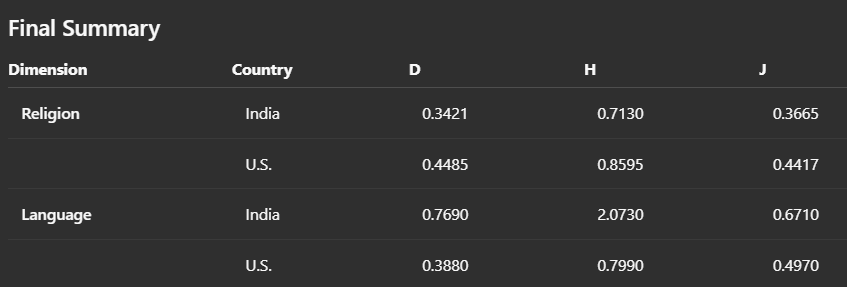
  • D = 0.3421
  • H = 0.7130
  • J = 0.3665

D=0.3421 means there’s about a 34.2% chance that two randomly selected individuals belong to different religions.

H=0.7130 quantifies the “information content” (higher → more diversity).

J=0.3665 (on a 0–1 scale) shows that the observed distribution is only about 36.7% as even as it would be if all seven groups were equally large.

United States (Pew 2014)

  • Christian: 70.6%
  • Unaffiliated: 22.8%
  • Jewish: 1.9%
  • Muslim: 0.9%
  • Buddhist: 0.7%
  • Hindu: 0.7%
  • Other/Unknown: 2.4%

Calculated metrics:

  • D = 0.4485
  • H = 0.8595
  • J = 0.4417

Conclusion: 

Higher D in the U.S. means there’s a greater probability (~44.9%) that two randomly selected Americans belong to different religious categories, versus ~34.2% in India.
 — Higher H and J likewise indicate the U.S. has both a richer mix of groups and a more even spread across them.

In sum, by these common indices, the U.S. is measurably more religiously diverse than India (as of the most recent comparable data).

Case Study 2: Linguistic Diversity

India (2011 Census — 22 Scheduled Languages)

Proportions range from Hindi (43.63%) to Sanskrit (0.002%), including Bengali, Telugu, Marathi, Tamil, etc.

Calculated metrics:

  • D = 0.7690
  • H = 2.0730
  • J = 0.6710

— We used the 2011 first‐language shares for the 22 schedule languages (e.g. Hindi 43.63%, Bengali 8.30%, …, Sanskrit 0.002%) and normalized them to sum to 1.
 — The high D (≈ 0.77) and H (≈ 2.07) reflect both the large number of language groups and that none besides Hindi completely dominates.
 — Evenness J≈0.67 shows the actual distribution is about 67% as even as it would be if all 22 languages were equally spoken.

United States (ACS 2011–5 Language Groups)

  • English only: 78.5%
  • Spanish: 13.4%
  • Other Indo-European: 4.7%
  • Asian & Pacific Islander: 3.6%
  • Other: 1.8%

Calculated metrics:

  • D = 0.3880
  • H = 0.7990
  • J = 0.4970

— We grouped home‐language use into five categories: “English only” 78.5%, “Spanish” 13.4%, “Other Indo-European” 4.7%, “Asian & Pacific Islander” 3.6%, and “All other languages” 1.8%, then normalized to sum 1
 — Lower D (≈ 0.39) and H (≈ 0.80) are driven by the very large English share.
 — Evenness J≈0.50 reflects that English heavily outweighs the other four groups.

India’s linguistic landscape is far more diverse and evenly distributed than that of the U.S.

Final Summary

Conclusion

Quantitative analysis reveals that while India exhibits extremely high linguistic diversity, the United States is more diverse in terms of religion and ethnicity. These metrics provide a robust foundation for comparative sociocultural studies and policy design in multicultural contexts.

References

Religious Composition Data

India

United States


Language Composition Data

India

United States

  • Source: U.S. Census Bureau, American Community Survey (ACS) 2011 — Language Spoken at Home
  • Link: https://data.census.gov

India's Constitutional Posts and Bodies: Time for Reforms

 India’s Constitution envisioned a robust framework of independent institutions to uphold democracy, federalism, and rule of law. But over the years, some of these constitutional offices and bodies—meant to be neutral arbiters—have come under criticism for erosion of credibility, political bias, and lack of accountability. Here are a few major issues affecting key institutions and what can be done to restore their integrity.


⚖️ 1. Politicization of the Office of the Speaker of the Lok Sabha

The Speaker is expected to be an impartial custodian of the House, but in practice, the post is deeply politicized.

Key Problems:

  • The Speaker is usually a senior leader of the ruling party and continues to remain politically affiliated even after election.

  • Discretionary powers like accepting or rejecting motions, and deciding on disqualification under the anti-defection law, are often used to protect party interests.

  • Delays in disqualification cases have undermined democratic fairness (e.g., prolonged inaction in cases of floor-crossing).

Reforms Needed:

  • Mandate resignation from party membership upon election to the Speaker’s post.

  • Shift anti-defection decisions to an independent tribunal or the Election Commission.

  • Ensure Deputy Speaker is elected from the opposition to maintain balance.


🧩 2. Appointment and Autonomy of Election Commission

The Election Commission (ECI) is critical for conducting free and fair elections. However, concerns about its independence have increased in recent years.

Key Problems:

  • All Election Commissioners are appointed by the executive without an independent selection mechanism.

  • Accusations of biased conduct during elections (e.g., unequal application of the Model Code of Conduct) have raised doubts about its impartiality.

  • Short tenures and lack of protection for Election Commissioners discourage assertive, independent functioning.

Reforms Needed:

  • Establish an independent, bipartisan collegium (e.g., including CJI, PM, and Leader of Opposition) for appointments.

  • Provide secure tenure and protection from arbitrary removal for all Commissioners.

  • Ensure transparency in decision-making, especially during high-stakes elections.


🏛️ 3. Weakening of Federal Institutions like the Governor’s Office

The role of the Governor, intended as a constitutional link between the Centre and states, has often been misused for partisan purposes.

Key Problems:

  • Governors have been accused of delaying decisions (e.g., calling assembly sessions or appointing chief ministers) to favor ruling parties at the Centre.

  • The office is often filled with retired bureaucrats or politicians loyal to the ruling party.

  • Frequent misuse of the Governor’s discretionary powers undermines state governments and federal principles.

Reforms Needed:

  • Set clear, time-bound guidelines for gubernatorial actions, especially during government formation.

  • Ensure appointments are made through a transparent and consultative process.

  • Limit post-retirement appointments for Governors to maintain neutrality.


🛠️ The Way Forward

India’s constitutional architecture rests on the integrity of its key offices and institutions. To preserve democratic values, we must:

  • De-politicize appointments.

  • Codify powers and processes.

  • Strengthen transparency and public accountability.

Without such reforms, these vital institutions risk becoming instruments of political convenience rather than guardians of the Constitution

Thursday, May 8, 2025

Does India Need a Misinformation Act? A Comparative Look at Global Approaches

 In recent weeks, Indian media has been dominated by the sensationalist coverage of "Operation Sindoor," where mainstream outlets pushed unverified narratives with little accountability. This has reignited debate around the regulation of misinformation in India. The current legal mechanisms appear either outdated, misused, or insufficiently enforced — raising the question: does India need a dedicated Misinformation Act?

India’s Current Legal Framework

India already has several laws that touch on misinformation, but none directly or comprehensively address the modern digital disinformation ecosystem.

The Indian Penal Code includes sections like 153, 295, and 505, which penalize speech that incites violence, promotes religious enmity, or causes public mischief. While useful in some contexts, these laws are often vague and open to misuse. For instance, criticism of the government is sometimes labeled as “hate speech,” which stifles free expression rather than curbing falsehoods.

The Information Technology Act was meant to govern digital activity, but its infamous Section 66A — used to arrest individuals for “offensive” posts — was struck down by the Supreme Court in 2015 for violating free speech. Alarmingly, reports show that police across India have continued using this defunct section, illustrating a dangerous legal vacuum and lack of awareness.

The IT Rules of 2021 (amended in 2023) require social media companies to remove any content flagged as “fake news” by the government’s Press Information Bureau (PIB). This essentially gives the government the unilateral power to decide what is true and what is false, with no independent review or appeals mechanism. Such power in the hands of any ruling party — irrespective of ideology — poses grave threats to press freedom and democratic discourse.

There are also provisions under the Representation of the People Act, which penalizes the spread of false information about political candidates, but enforcement is rare and the scope is limited to electoral contexts. Similarly, the Disaster Management Act was temporarily used during COVID-19 to penalize pandemic-related misinformation, but this was more reactive than systemic.

Risks of a Misinformation Act

While the demand for a dedicated Misinformation Act is growing, such legislation is not without significant risks:

  1. Censorship and Government Overreach: The biggest danger is that a Misinformation Act could be weaponized to silence dissent. If the government becomes the sole arbiter of truth, even legitimate criticism or investigative journalism can be labeled "fake news" and suppressed.

  2. Suppression of Marginalized Voices: Minority groups, activists, and opposition parties already face disproportionate scrutiny. A vague or overbroad law could deepen this imbalance, where power is used to erase inconvenient truths rather than combat actual falsehoods.

  3. Judicial Backlogs and Inefficiency: Even with an appeals process, India’s overburdened judiciary may not be able to provide timely recourse. This could lead to prolonged, unjust takedowns of truthful content — effectively silencing voices when they are most needed.

  4. Self-Censorship by Media and Citizens: If penalties are harsh and definitions are unclear, news organizations and social media users may begin to censor themselves preemptively. This chilling effect can erode democratic discourse and public debate.

  5. Misuse by Non-State Actors: A poorly drafted law could be exploited not just by the state, but by private entities and troll networks. They could file false complaints to harass journalists, rivals, or activists under the pretense of fighting misinformation.

  6. Stifling Innovation: Startups in the information, content, or social media space may find compliance too burdensome. This would favor big tech companies with legal teams and further concentrate control over digital communication.

Lessons from Other Countries

A look at international examples offers insight into how India could structure a balanced Misinformation Act.

Germany’s Network Enforcement Act (NetzDG) compels large digital platforms to remove illegal content — like hate speech and incitement — within 24 hours, or face heavy fines. However, the definitions of what constitutes illegal content are derived from existing German law, not arbitrary government claims. Although critics warn that this law leads to over-censorship by platforms, Germany’s strong judicial oversight acts as a check on government overreach.

The United States offers a contrasting approach. Its First Amendment protects nearly all speech, including misinformation, unless it causes direct harm (like libel or incitement to violence). Section 230 of the Communications Decency Act shields online platforms from liability for user-generated content, allowing them to moderate without fear of lawsuits. However, this hands-off approach has allowed the unchecked spread of conspiracy theories and disinformation — from election denial to vaccine falsehoods — highlighting the risks of under-regulation.

Singapore takes a stricter stance through its Protection from Online Falsehoods and Manipulation Act (POFMA), which allows government ministries to issue correction or takedown orders against online misinformation. While there is a formal appeals process through the courts, critics argue that it is slow, rarely successful, and often used against opposition figures, raising concerns about authoritarian misuse.

What Should India Do?

India urgently needs a legal framework tailored to its unique socio-political context and media landscape. But such a law must balance the need to curb harmful disinformation with the constitutional right to free speech.

A robust Misinformation Act should incorporate the following principles:

  1. Independent Oversight: Truth should not be dictated by the government alone. An independent misinformation review board — composed of retired judges, media experts, and civil society members — should oversee decisions about what constitutes misinformation.

  2. Appeals Process: Any takedown or correction order must be subject to appeal in a time-bound judicial framework. This would prevent arbitrary censorship and build trust among citizens and platforms.

  3. Transparency and Reporting: Platforms and government agencies must publish regular transparency reports, listing the number and type of misinformation takedowns requested and executed.

  4. Public-Private Cooperation: Rather than controlling platforms, the government should partner with fact-checking organizations, academia, and tech companies to build a resilient information ecosystem.

  5. Digital and Media Literacy: Education remains the most sustainable solution. A national curriculum on digital literacy — covering how to detect fake news, verify sources, and identify manipulated media — should be introduced in schools and public service training.

Conclusion

India sits at a critical crossroads. As digital access deepens, so does the reach of misinformation — threatening social cohesion, public health, and democratic integrity. The current legal patchwork is inadequate and often misapplied. However, any attempt to legislate against fake news must not become a tool for authoritarian control. A carefully drafted Misinformation Act, with independent checks and transparency at its core, could be the way forward — but only if the risks of abuse, overreach, and suppression are addressed head-on.

War Is Not the Solution to the India-Pakistan Conflict

 The India-Pakistan conflict, rooted in historical, political, and religious complexities, has long been a flashpoint in South Asia. From the partition of 1947 to the ongoing disputes over Kashmir, the two nations have faced multiple wars, skirmishes, and a persistent atmosphere of mistrust. Yet, in the face of rising tensions, ultra-nationalists on both sides often clamor for war, driven by religious hatred and political opportunism. Their rhetoric, however, ignores the catastrophic consequences of such a conflict—human casualties, economic devastation, international sanctions, and the loss of innocent lives. War is not the solution; it is a reckless path that fuels division and destruction rather than resolution.

The Human Cost of War
War between India and Pakistan would exact an unimaginable toll on human lives. Both nations possess significant military capabilities, including nuclear arsenals, making the stakes exponentially higher. A full-scale conflict could result in millions of deaths, both military and civilian, with cities reduced to rubble and entire communities displaced. The 1999 Kargil War and earlier conflicts demonstrated the heavy price paid by soldiers and civilians alike, with thousands killed or injured. Ultra-nationalists, often far removed from the frontlines, dismiss these losses, framing war as a glorious pursuit of national pride. Yet, the reality is far grimmer: families torn apart, children orphaned, and generations scarred by trauma.
Innocent lives are particularly vulnerable. Civilians living along the Line of Control (LoC) in Kashmir already endure cross-border shelling and violence. A broader war would amplify their suffering, displacing millions and creating a humanitarian crisis. Hospitals, schools, and homes would become collateral damage, as seen in past conflicts. Those fanning the flames of war rarely acknowledge these human stories, instead prioritizing ideological victories over the sanctity of life.
Economic Devastation
The economic fallout of war would be catastrophic for both nations, which are already grappling with domestic challenges. India, with its burgeoning economy, and Pakistan, striving for stability, would see their progress derailed. Military spending would skyrocket, diverting resources from education, healthcare, and infrastructure. Trade, tourism, and foreign investment would grind to a halt as global markets react to the instability. The 2019 Pulwama attack and subsequent airstrikes led to temporary disruptions in air travel and trade; a prolonged conflict would multiply these effects manifold.
International sanctions would likely follow, particularly if nuclear capabilities were involved or if either nation violated international norms. Sanctions would cripple industries, exacerbate poverty, and isolate both countries diplomatically. For Pakistan, already reliant on international aid, the consequences would be dire. For India, aspiring to global leadership, war would undermine its credibility and economic ambitions. Ultra-nationalists, blinded by fervor, fail to consider these long-term ramifications, focusing instead on short-term political gains.
The Role of Religious Hatred and Political Opportunism
At the heart of the war rhetoric lies a dangerous mix of religious hatred and political manipulation. Ultra-nationalists on both sides exploit religious differences—Hindu nationalism in India and Islamic fervor in Pakistan—to stoke division. This rhetoric paints the other side as an existential threat, dehumanizing entire populations and justifying violence. Social media amplifies these narratives, with inflammatory posts and misinformation fueling public anger. Yet, this hatred ignores the shared history, culture, and humanity of the people of India and Pakistan, who have coexisted for centuries.
Politicians and media outlets often exploit these tensions for their own gain. War rhetoric rallies voters, distracts from domestic failures, and strengthens the grip of hardline leaders. In India, elections have seen Kashmir and Pakistan used as political tools to consolidate power. In Pakistan, anti-India sentiment is similarly leveraged to unify a fractured polity. These actors thrive on division, not resolution, and their calls for war serve their agendas rather than the public good. The casualties, economic ruin, and global isolation that would follow are mere footnotes in their calculations.
The Path to Peace
War is not inevitable; it is a choice. India and Pakistan have the opportunity to pursue dialogue, diplomacy, and cooperation to address their differences. Confidence-building measures, such as reopening trade routes, easing visa restrictions, and resuming backchannel talks, can reduce tensions. People-to-people exchanges—through art, sports, and education—can rebuild trust eroded by decades of hostility. The Indus Water Treaty, a rare example of sustained cooperation despite conflicts, proves that mutual benefit is possible even in challenging times.
International mediation, though often resisted, could provide a neutral platform for dialogue. The United Nations and regional powers could facilitate discussions on contentious issues like Kashmir, provided both sides approach talks in good faith. Civil society, including activists, academics, and youth, must also play a role in countering nationalist narratives and promoting peace.
Ultra-nationalists may dismiss these efforts as weakness, but peace requires courage and vision. It demands leaders who prioritize the welfare of their people over political expediency and who recognize that true strength lies in unity, not destruction. The people of India and Pakistan deserve a future free from the specter of war—one where resources are invested in schools, not bombs, and where borders are bridges, not battlegrounds.
Conclusion
The India-Pakistan conflict is a complex challenge that cannot be resolved through the blunt instrument of war. The ultra-nationalists who advocate for conflict, driven by religious hatred and political ambition, ignore the devastating costs: loss of life, economic ruin, and global isolation. Their rhetoric may win applause in the short term, but it risks a future of suffering for millions. Instead of war, India and Pakistan must choose the harder but wiser path of dialogue, cooperation, and peace. Only then can both nations honor the shared humanity of their people and build a future worthy of their aspirations. War is not the solution—it is the surrender to our worst instincts.

The Weaponization of Performance Improvement Plans in India’s Service Sector: A Covert Layoff Strategy

 In recent years, India’s service sector, particularly the Big 4 and other major IT and professional services companies, has come under scrutiny for its use of Performance Improvement Plans (PIPs) as a tool to quietly reduce headcount while maintaining a façade of employee welfare. Far from being a constructive mechanism to help employees improve, PIPs have increasingly been weaponized to push employees out without the optics of a formal layoff. This practice not only undermines employee morale but also raises serious ethical questions about corporate transparency and accountability.

The PIP Facade: A Tool for Covert Layoffs
A Performance Improvement Plan is ostensibly designed to help underperforming employees address deficiencies, improve skills, and align with organizational expectations. In theory, it’s a structured process with clear objectives, timelines, and support from management. However, in practice, many Indian service sector companies have turned PIPs into a coercive mechanism to force resignations.
Employees report being placed on PIPs without prior indication of poor performance. Often, these individuals have received satisfactory or even stellar performance reviews before being unexpectedly flagged for “underperformance.” The tasks assigned under a PIP are frequently vague, overly ambitious, or outright impossible to achieve within the stipulated timeline. For instance, an employee might be asked to complete a complex project single-handedly under unrealistic deadlines or meet arbitrary metrics that even high-performing peers would struggle to achieve.
The Pressure Cooker: Coercion and Intimidation
Once an employee is placed on a PIP, the process becomes a psychological gauntlet. Managers, directors, and even HR representatives often exert relentless pressure to make the employee feel isolated and incompetent. Regular check-ins turn into sessions of criticism rather than support, with little to no constructive feedback. Employees describe being micromanaged, scrutinized excessively, or given conflicting instructions, all designed to ensure failure.
HR, which should ideally serve as a neutral mediator, frequently aligns with management, dismissing employee grievances or gaslighting them into believing they are at fault. Complaints about unfair treatment or impossible PIP objectives are met with boilerplate responses like, “This is for your growth,” or “You need to take accountability.” In some cases, employees are explicitly encouraged to resign, with subtle or overt threats about the consequences of failing the PIP—namely, termination.
The psychological toll is immense. Employees report anxiety, sleeplessness, and a loss of confidence as they navigate a process rigged against them. The message is clear: quit voluntarily, or face the stigma of being fired for “poor performance.”
The Hypocrisy: “We Never Lay Off”
Perhaps the most galling aspect of this practice is the public stance of these companies. Many, including the Big 4, proudly claim that they “never lay off employees” or have a “people-first culture.” By forcing resignations through PIPs, they maintain this narrative while sidestepping the legal, financial, and reputational repercussions of mass layoffs. Employees who resign under duress are not counted as layoffs, allowing firms to project stability and employee-centric values to clients, investors, and the public.
This hypocrisy is particularly stark in India, where the service sector employs millions and is seen as a cornerstone of economic growth. Companies leverage the country’s vast talent pool to maintain high headcounts during boom periods, only to quietly shed employees during downturns or when cost-cutting is prioritized. The use of PIPs as a layoff tool ensures that these workforce reductions fly under the radar, avoiding media scrutiny or backlash from labor unions.
The Employee’s Dilemma: No Recourse, No Justice
For employees, the PIP process leaves little room for recourse. Those who attempt to challenge the process internally find HR and leadership closing ranks. External options, such as legal action, are daunting due to the time, cost, and difficulty of proving coercion in a resignation. Moreover, the stigma of being labeled a “poor performer” or having a termination on record can severely hamper future job prospects in India’s competitive job market.
Employees are thus trapped in a lose-lose situation: endure a demoralizing PIP process with slim chances of success, or resign and preserve some semblance of professional dignity. Either way, the outcome aligns with the company’s goal of reducing headcount without admitting to layoffs.
A Call for Accountability
The weaponization of PIPs in India’s service sector is a systemic issue that demands greater scrutiny. Employees, labor advocates, and policymakers must push for reforms to ensure that PIPs are used transparently and ethically. Potential measures include:
  1. Mandatory Documentation: Companies should be required to provide clear, evidence-based justification for placing an employee on a PIP, including prior performance reviews and specific incidents of underperformance.
  2. Independent Oversight: HR departments or third-party mediators should oversee PIP processes to prevent bias and ensure fairness.
  3. Legal Protections: Labor laws should be strengthened to recognize coerced resignations as constructive dismissals, giving employees grounds to seek redress.
  4. Public Reporting: Companies should be mandated to disclose workforce reduction practices, including the number of employees placed on PIPs and their outcomes.
Conclusion
The misuse of Performance Improvement Plans by Indian service sector companies, including the Big 4, reveals a troubling trend of prioritizing corporate optics over employee well-being. By cloaking layoffs in the guise of performance management, these firms erode trust, exploit workers, and perpetuate a culture of fear. It’s time for employees to share their stories, for regulators to demand transparency, and for the industry to confront its hypocrisy. Only then can the service sector live up to its proclaimed values of integrity and people-first leadership.

When Privilege Gets Help, It’s “Networking”; When Others Get Help, It’s “Quota”

  When Privilege Gets Help, It’s “Networking”; When Others Get Help, It’s “Quota” Unpacking the Double Standards of Caste Privilege in India...