Tuesday, April 15, 2025

Is India’s Education Policy Linked to Political Control? A Critical Analysis of Education, IQ, and Religion


Is India’s Education Policy Linked to Political Control? A Critical Analysis of Education, IQ, and Religion

India’s education system has long been a subject of debate, with critics pointing out that despite being one of the fastest-growing economies, the country’s public education system remains underfunded, outdated, and largely inaccessible for vast segments of the population. But what if there is more at play here than just bureaucratic inefficiency?

A theory circulating among political analysts and social commentators suggests that there could be a deliberate underinvestment in quality education by the Indian government. The underlying belief is that:

  • Lower IQs in the population correlate with higher religiosity.
  • Higher religiosity can be leveraged for political power, particularly in a system dominated by identity politics.
  • As a result, religiosity-driven voting could help political parties like the BJP retain their support base.

Is there any truth to this theory? Let’s explore the facts and patterns.


Underinvestment in Education: A Historical Trend?

India’s public education budget has long been a topic of concern. The country spends just 2.9% of its GDP on education, which is far below the global average of about 4.5%. The New Education Policy (NEP) 2020 suggests increasing education spending to 6% of GDP, but there’s no clear timeline or binding commitment to achieve this goal.

The effects of this underinvestment are visible in various forms:

  • Poor infrastructure: Schools in rural and marginalized areas often lack proper buildings, sanitation, and access to digital resources.
  • Low learning outcomes: A report from UNESCO in 2022 highlighted that nearly 60% of Indian children in grade 5 cannot read a grade 2-level text.
  • High dropout rates: A study by Pratham found that over 60% of children in rural areas dropout before completing secondary education.

This state of affairs has created an education system that primarily focuses on rote memorization rather than critical thinking, leaving many students underprepared to engage in complex discussions or challenge traditional beliefs.


IQ, Education, and Religiosity: What’s the Link?

Psychological studies have shown that there is a correlation between lower IQ and higher religiosity. For example, studies conducted by researchers like Zuckerman, Silberman, & Hall (2013) found that people with lower cognitive ability tend to exhibit higher religiosity.

But how does this relate to India?

  • According to Richard Lynn and Tatu Vanhanen’s “IQ and the Wealth of Nations” (2006), India’s average IQ is approximately 81, which is below the global average of 100. This is partly due to disparities in access to quality education.
  • Lower IQ scores can correlate with increased belief in religious explanations rather than secular, scientific thinking. In a country like India, where religion plays a central role in politics, this pattern is particularly pronounced.
  • In India, Hinduism remains the dominant religion, with 79.8% of the population identifying as Hindu, followed by Muslims (14.2%) and other religions like Christianity and Sikhism making up smaller portions. Religiosity in India is often tied to political loyalty and is leveraged in the BJP’s electoral strategy, especially in regions with lower educational outcomes.

Religion and Voting Behavior: The BJP’s Strategy?

Religiosity, particularly in the form of Hindu nationalism, has been central to the Bharatiya Janata Party (BJP)’s political identity. The party’s massive support base, particularly in states like Uttar Pradesh, Madhya Pradesh, and Bihar, comes from Hindu-majority areas with relatively low educational indicators.

The BJP has made concerted efforts to:

  • Build temples and religious monuments like the Ram Mandir in Ayodhya.
  • Use religious symbolism to rally voters, such as by promoting Hindu festivals and holding religious rallies.

This is not just a matter of religious devotion, but a political tool. The BJP’s use of religion as a mobilizing force has made it possible to secure votes based on religious identity rather than policy platforms. States with lower education levels also tend to see higher voter loyalty for the BJP.


The Cycle: Education, Religiosity, and Politics

Critics argue that this pattern forms a self-perpetuating cycle:

  1. Poor education leads to low IQ levels, which in turn increases religiosity among the population.
  2. Increased religiosity makes people more vulnerable to identity-based politics, where their voting behavior is guided by religious affiliations.
  3. Politicians, particularly those in the BJP, use religious appeal to maintain power, creating a cycle where educational reform remains underprioritized.

While this theory is speculative, it highlights a potential link between educational underinvestment and the dominance of religiously motivated politics.


Counterarguments: A Complex Reality

It’s important to note that this theory is not universally accepted. There are several counterpoints:

  • BJP’s role in education reform: Under the BJP government, initiatives like Skill India, the New Education Policy (NEP), and SWAYAM, a platform for digital learning, have been introduced. These efforts aim to provide skill development and online education to India’s youth, especially in rural areas.
  • Religiosity is not inherently harmful: Many highly educated religious leaders and thinkers have emerged from India’s religious communities.
  • Educational neglect predates the BJP: India’s education system has struggled with low investment and inequality long before the BJP came to power. Previous Congress governments also failed to meet the country’s educational aspirations.

Thus, while education and religion are deeply connected in shaping society, this theory should not be treated as an absolute but rather as a starting point for deeper social, political, and educational discussions.


Conclusion: Is It a Conspiracy or a Systemic Issue?

While the idea that the government is deliberately keeping IQ low to maintain political control is a theory, the broader critique about India’s education system and its intersection with politics is undeniable. The lack of robust investment in education, combined with the BJP’s focus on religious identity politics, raises significant questions about how education and religion shape Indian democracy.

India needs an urgent education overhaul to provide future generations with the tools to think critically, engage in rational discourse, and challenge the status quo. This is the only way to break the cycle where education and politics become tools of control rather than empowerment.


Disclaimer:
 This article is based on publicly available research and sociopolitical theory. The intent is not to accuse or defame any particular individual or party, but to critically examine systemic issues within India’s educational policies and their potential social implications.


Ending Caste Discrimination: A Call for Justice and Equality in India


Ending Caste Discrimination: A Call for Justice and Equality in India

In July 2023, a deeply disturbing video emerged from Madhya Pradesh’s Sidhi district, capturing a man urinating on a tribal laborer. This act of humiliation was not an isolated incident but a stark reminder of the entrenched caste-based discrimination that continues to plague Indian society.

The Incident and Immediate Response

The video, which quickly went viral, showed an upper-caste man committing an act of degradation against a tribal individual. The Madhya Pradesh government responded promptly:

  • Arrest and Legal Action: The accused was arrested and charged under multiple sections of the Indian Penal Code, including the SC/ST (Prevention of Atrocities) Act. Additionally, the stringent National Security Act (NSA) was invoked against him.
  • Demolition of Property: Authorities demolished a portion of the accused’s family home, citing it as an illegal construction.
  • Compensation to the Victim: The state government sanctioned financial assistance totaling ₹6.5 lakh for the victim — ₹5 lakh as relief and ₹1.5 lakh for the construction of a house.
  • Symbolic Gesture: Chief Minister Shivraj Singh Chouhan met the victim, washed his feet, and offered a public apology on behalf of the state.

Political Affiliations and Controversy

The accused was reportedly associated with a local Bharatiya Janata Party (BJP) Member of Legislative Assembly (MLA). His father claimed he served as a representative for the MLA. However, the MLA denied any such association, stating that the accused was neither his representative nor connected to the BJP. The BJP’s state president also emphasized that individuals committing such acts do not belong to any party and confirmed that the accused had been removed from the party.

Community Reactions and Controversial Statements

The incident elicited varied responses from different quarters:

  • Brahmin Organizations’ Stance: The Akhil Bharatiya Brahmin Samaj (ABBS) condemned the act but opposed the demolition of the accused’s home, arguing that his family should not be punished for his actions. They demanded a judicial inquiry into the incident, an apology from the state government for demolishing the house, compensation for rebuilding it, and revocation of the NSA.
  • Controversial Remarks: National President of the Brahmin Mahasabha, sparked outrage by questioning the severity of the act, asking, “What is the crime in urinating? What harm does it cause?” He also raised doubts about the victim’s state during the incident.
  • Support for the Accused’s Family: The ABBS launched a fundraising campaign, reportedly donating ₹51,000 to the accused’s family, with contributions pouring in from across the state.

Legal and Social Implications

The invocation of the NSA, typically reserved for threats to national security, in this case, sparked debates about the proportionality of legal responses. Some legal experts questioned its application, while others argued that extraordinary measures are necessary to address the deep-rooted caste-based violence that has long operated with impunity.

The incident also highlighted the challenges in delivering justice, especially when community organizations and political affiliations come into play, potentially influencing the course of legal proceedings and public perception.

Conclusion

This incident underscores the pervasive nature of caste-based discrimination in India. While swift governmental action and public condemnation are steps in the right direction, addressing the systemic nature of such discrimination requires sustained efforts, including legal reforms, education, and societal change.

Ending caste discrimination is not just a concern for marginalized communities; it’s a national imperative. India must respond not only with outrage when such incidents come to light but with consistent action that affirms the dignity and equality of every individual.

Monday, April 14, 2025

The Myth of Meritocracy: Why Success Isn’t Just About “Merit”

 Lately, there's been a flood of posts on social media claiming that Brahmins succeed because they’re “more meritorious”—as if centuries of systemic privilege had nothing to do with it. Let’s unpack that.

Because meritocracy—as it’s often thrown around—is not as clean, fair, or neutral as it sounds. Especially not in India.


๐Ÿง  What Even Is Meritocracy?

Meritocracy is the idea that people succeed based on their abilities, intelligence, and effort—rather than their caste, class, or connections. Sounds fair, right?

But what happens when some people have been denied opportunities for generations, while others have had unbroken access to education, resources, and networks?

As Dr. B.R. Ambedkar said:

"Caste is not a division of labour, it is a division of labourers."

Brahmins weren’t just taught books. They were assigned the exclusive right to knowledge itself. Others weren’t just uneducated—they were forbidden from being educated.


๐Ÿงฑ Merit Is Built—Not Born

Let’s say two kids are running a race. One starts from the start line, the other starts 100 meters behind. Who wins? Who’s “faster”?

The one with the head start might say, “I won because I trained harder.”

But in truth—they just started ahead. And society clapped for them, calling it "merit".

This is India’s story with Brahminical success.

Kancha Ilaiah puts it bluntly in his book Post-Hindu India:

“The Brahmin child is born with a spoon of English in the mouth and Sanskrit in the brain.”


๐Ÿซ Access, Not Ability

Before we talk about "merit", ask:

  • Who had teachers in their family?

  • Who had money for coaching?

  • Who had libraries at home?

  • Who had the mental peace to study without worrying about caste-based violence, hunger, or discrimination?

“Merit” without equality of conditions is just privilege pretending to be excellence.


๐Ÿงพ A History of Head-Starts

  • Manusmriti made sure Dalits were punished for even hearing the Vedas.

  • Colonial education systems were built around upper-caste norms.

  • Post-independence bureaucracy was dominated by those already fluent in English and administrative culture.

Ambedkar again, hitting hard:

“The caste system is not merely a division of labour—it is also a division of laborers in a graded manner.”


๐ŸŽฏ So Why Does This Narrative Persist?

Because it feels good. It flatters the ego. It's easier to believe “I earned this” than to confront a system that boosted you from birth.

It’s not that individual Brahmins haven’t worked hard. Many have. But to ignore the invisible support structure behind them is dishonest.

It’s like inheriting a mansion and then saying you’re a self-made architect.


๐Ÿ”ฅ Final Word

If India were truly a meritocracy, Ambedkar wouldn’t have had to write Annihilation of Caste. Phule wouldn’t have had to open the first schools for Shudras. And reservation wouldn’t have been necessary.

So next time someone brags about meritocracy favoring Brahmins, remember:

"Those who have enjoyed privilege for generations often see equality as oppression."

How Long Will It Take for India’s Per Capita GDP to Catch Up with China’s?


How Long Will It Take for India’s Per Capita GDP to Catch Up with China’s?

India and China, two of the largest economies in the world, have followed distinct economic paths over the past few decades. While both countries have experienced rapid growth, their per capita GDPs (a measure of economic output per person) are starkly different. In 2023, China’s per capita GDP is approximately six times higher than India’s. This raises an intriguing question: how long will it take for India to catch up with China, assuming both countries continue to grow at their historical average rates?

In this article, we explore different growth scenarios to estimate the timeline for when India’s per capita GDP might match China’s, based on the current growth rates of both countries.

The Basics of Economic Growth and Per Capita GDP

Before diving into the calculations, let’s clarify some concepts. Per capita GDP is the total economic output (GDP) of a country divided by its population. It provides a way to compare the average economic well-being of citizens across countries, regardless of their size.

Both India and China have experienced remarkable economic growth over the last few decades. China, having started its economic reforms in the late 1970s, has maintained an average annual growth rate of around 9% over the past 40 years. India, on the other hand, began its economic reforms in the early 1990s and has seen average annual growth rates around 6–7% during the same period.

However, despite China’s impressive growth, India’s economy is catching up, with projections suggesting that India will continue to grow faster than China in the coming decades due to its younger demographic and economic reforms.

The Assumptions

For simplicity, let’s use some basic assumptions to calculate when India’s per capita GDP will catch up with China’s:

  • India’s current per capita GDP (2023): $2,000
  • China’s current per capita GDP (2023): $12,000
  • India’s historical average growth rate: Varies between 6–9% annually.
  • China’s historical average growth rate: Varies between 4–5% annually.

These assumptions are simplified for the sake of this article, but they help us form a model based on the exponential growth of GDP. The formula for exponential growth is:

GDP_t = GDP_0 * (1 + g)^t

Where:

  • GDP_t is the GDP at time t,
  • GDP_0 is the initial GDP (2023 value),
  • g is the annual growth rate, and
  • t is the number of years into the future.

To find the year when India’s per capita GDP catches up with China’s, we solve the equation:

India's GDP = China's GDP

This gives us the equation

(1 + g_I)^t / (1 + g_C)^t = 6

Where g_I and g_C represent the growth rates for India and China, respectively. By solving for t, we can estimate the number of years it would take for India to catch up with China.

Scenario Analysis: The Five Scenarios

Let’s explore five different scenarios, each assuming different growth rates for India and China.

Scenario 1: A Modest Growth Advantage (India at 5%, China at 4%)

  • India’s growth rate: 5% (0.05)
  • China’s growth rate: 4% (0.04)

This scenario assumes that India continues to grow at a faster pace than China, but only by 1 percentage point.

  • Catch-Up Time: 187 years
  • Catch-Up Year: 2210

This scenario presents a fairly slow pace of convergence, where India will take nearly two centuries to catch up, assuming these growth rates persist.

Scenario 2: A Moderate Advantage (India at 7%, China at 5%)

  • India’s growth rate: 7% (0.07)
  • China’s growth rate: 5% (0.05)

Here, India maintains a 2 percentage point advantage over China. While the gap is still modest, this difference significantly shortens the timeline.

  • Catch-Up Time: 95 years
  • Catch-Up Year: 2118

With this moderate growth advantage, India would close the gap in just under a century, catching up by the year 2118.

Scenario 3: A Slight Advantage (India at 6%, China at 5%)

  • India’s growth rate: 6% (0.06)
  • China’s growth rate: 5% (0.05)

This scenario assumes a 1 percentage point advantage, similar to Scenario 1 but with a slightly higher growth rate for India.

  • Catch-Up Time: 189 years
  • Catch-Up Year: 2212

Interestingly, this scenario yields a timeline similar to Scenario 1, indicating that the precise rate of India’s growth is crucial in determining the catch-up time, even for small differences in growth rates.

Scenario 4: A Strong Advantage (India at 8%, China at 5%)

  • India’s growth rate: 8% (0.08)
  • China’s growth rate: 5% (0.05)

In this scenario, India grows at a rate 3 percentage points higher than China. This results in a much quicker convergence.

  • Catch-Up Time: 64 years
  • Catch-Up Year: 2087

With this stronger growth differential, India would catch up with China in just over 60 years. The higher the growth advantage, the shorter the catch-up period.

Scenario 5: A Significant Advantage (India at 9%, China at 5%)

  • India’s growth rate: 9% (0.09)
  • China’s growth rate: 5% (0.05)

This final scenario assumes India grows even faster, at 9% annually, compared to China’s 5%. This is one of the more optimistic projections.

  • Catch-Up Time: 48 years
  • Catch-Up Year: 2071

Under this scenario, India could close the gap in just under 50 years, potentially reaching China’s per capita GDP by the 2070s.

Key Insights and Implications

  1. Growth Differentials Are Crucial: The most significant factor in determining how long it will take India to catch up with China is the difference in their growth rates. Even a small difference in growth rates can result in vastly different timelines for convergence.
  2. China’s Growth Rate Is Slowing: While China has historically maintained high growth rates, its economy is beginning to slow down as it matures. If India can maintain a higher growth rate (especially with its younger population and ongoing economic reforms), it could shorten the timeline significantly.
  3. The Younger Demographics Advantage: India’s demographic structure is much younger than China’s, with a larger working-age population, which could provide a natural boost to its economy in the coming decades.
  4. Long-Term Projections Are Uncertain: These calculations rely on the assumption that both countries will continue growing at their historical average rates. However, many factors, such as changes in policy, technological advancements, global economic shifts, and population changes, could alter these projections.

Conclusion

India’s per capita GDP could catch up with China’s much sooner than many people expect, depending on how both economies evolve in the future. If India can maintain a higher growth rate — especially in scenarios where it grows at 8–9% annually — it could close the gap within a few decades. However, if the growth differential remains narrow, it could take well over a century.

As India continues to reform its economy and harness its demographic potential, it may indeed become a major economic force, capable of rivaling China’s per capita GDP much sooner than expected.

๐Ÿงฎ When Will India's Per Capita GDP Catch Up to the USA? A Data-Driven Look at 5 Scenarios


๐Ÿงฎ When Will India’s Per Capita GDP Catch Up to the USA? A Data-Driven Look at 5 Scenarios

A Data-Driven Look at 5 Scenarios

India’s economic story is remarkable. As one of the fastest-growing major economies, people often ask:

“When will India’s per capita income catch up to that of the United States?”

It’s a meaningful question — not just about raw GDP but about economic prosperity per person.

Let’s break this down — using real math and multiple realistic scenarios.


๐Ÿ‡ฎ๐Ÿ‡ณ vs ๐Ÿ‡บ๐Ÿ‡ธ: Where We Stand Today

As of 2023:

  • India’s per capita GDP: ~$2,500
  • USA’s per capita GDP: ~$70,000
  • Income gap (USA / India): 28x

If both countries grow at the same rate, India will never catch up. So, the key is India growing faster — which has been true historically.


๐Ÿ“ The Math of Catching Up

We model this using compound growth for both countries:

Let:

  • P_I0 = current per capita GDP of India = 2,500
  • P_U0 = current per capita GDP of USA = 70,000
  • g_I = India’s annual per capita GDP growth rate
  • g_U = USA’s annual per capita GDP growth rate
  • t = number of years it takes to catch up

The future per capita GDPs:

P_I(t) = P_I0 * (1 + g_I)^t  
P_U(t)
= P_U0 * (1 + g_U)^t

India catches up when:

P_I(t) = P_U(t)

So we get:

(P_I0 / P_U0) = ((1 + g_U) / (1 + g_I))^t

Taking natural logs on both sides:

t = ln(P_U0 / P_I0) / ln((1 + g_I) / (1 + g_U))

P_U0 / P_I0 = 70,000 / 2,500 = 28

So the final formula becomes:

t = ln(28) / ln((1 + g_I) / (1 + g_U))

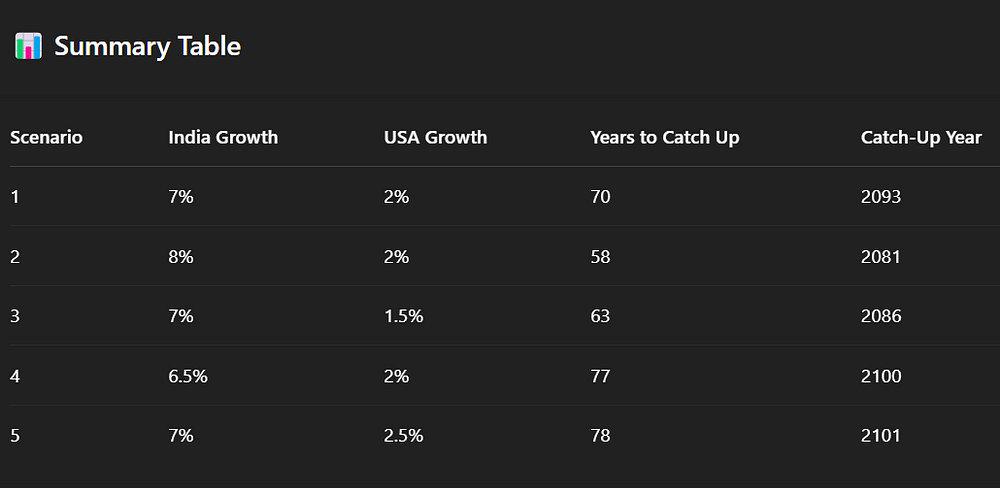
๐Ÿ”ฎ Scenario 1: India grows at 7%, USA at 2%

t = ln(28) / ln(1.07 / 1.02)
= 3.332 / 0.04785 ≈ 69.6

India catches up in ~70 years → Year 2093


๐Ÿš€ Scenario 2: India at 8%, USA at 2%

t = 3.332 / ln(1.08 / 1.02)
= 3.332 / 0.0572 ≈ 58.3

India catches up in ~58 years → Year 2081


๐Ÿ“‰ Scenario 3: India at 7%, USA at 1.5%

t = 3.332 / ln(1.07 / 1.015)
= 3.332 / 0.0528 ≈ 63.1

India catches up in ~63 years → Year 2086


๐Ÿข Scenario 4: India at 6.5%, USA at 2%

t = 3.332 / ln(1.065 / 1.02)
= 3.332 / 0.0432 ≈ 77.2

India catches up in ~77 years → Year 2100


๐Ÿ’ผ Scenario 5: India at 7%, USA at 2.5%

t = 3.332 / ln(1.07 / 1.025)
= 3.332 / 0.0430 ≈ 77.5

India catches up in ~78 years → Year 2101

Summary table

Final Thoughts

This is not a prediction — it’s a simplified mathematical model. In reality, growth isn’t linear, and many factors (policy, innovation, global markets, etc.) will influence the future.

Still, if India sustains strong growth, it could close the per capita income gap with the US in the second half of this century.

The Rising Threat of Hindutva Radicalism in the US: A Call for Immediate Action


The Rising Threat of Hindutva Radicalism in the US: A Call for Immediate Action


In recent years, the United States has become an unexpected stage for the spread of Hindutva radicalism — a hyper-nationalist, extremist ideology rooted in Hindu supremacism, distinct from the diverse and pluralistic faith of Hinduism. While the world watches developments in India, few are paying attention to how this ideology is quietly embedding itself in American communities, institutions, and even politics.

What Is Hindutva Radicalism?

Hindutva, coined by Vinayak Savarkar in the 1920s, is not merely a religious identity — it is a political ideology that envisions India as a Hindu Rashtra (Hindu nation), where minorities are second-class citizens. This vision is fundamentally incompatible with liberal democratic values, secularism, and pluralism.

While its most visible effects are seen in India — rising hate crimes, lynchings, media manipulation, and suppression of dissent — its influence has gone transnational. Diaspora communities in the U.S. have become both ideological and financial hubs for Hindutva groups.

The American Blind Spot

Despite the growing body of evidence, U.S. institutions and law enforcement have largely failed to acknowledge Hindutva extremism as a domestic threat. Here’s why:

1. Religious Camouflage

Hindutva groups often present themselves as cultural or religious organizations promoting Indian heritage. This masks their true agenda and shields them from scrutiny under the guise of religious freedom.

2. Model Minority Myth

South Asian communities, especially upper-caste Hindus, are often viewed through the lens of the “model minority” stereotype. This creates an illusion of harmlessness and respectability, allowing radical ideologies to grow unchecked.

3. Strategic Lobbying

Organizations like the Hindu American Foundation (HAF), Overseas Friends of BJP (OFBJP), and others have built strong lobbying arms in D.C., often aligning with conservative U.S. groups. This political proximity gives them undue influence and protection.

4. Lack of Awareness

U.S. policymakers and the public often conflate Hinduism with Hindutva, unaware that many Hindus themselves oppose the latter. This confusion delays meaningful intervention and fuels further radicalization.

Real-World Impact

Hindutva radicalism in the U.S. isn’t just rhetoric — it translates into action:

  • Harassment if academics and activists, especially those critical of Modi or caste oppression.
  • Intimidation of minorities within South Asian diaspora communities — particularly Muslims, Dalits, and Sikhs.
  • Funding of far-right causes in India, including groups accused of hate crimes and violence.
  • Infiltration into school curriculums, trying to whitewash caste, Islamophobia, and India’s human rights record.

What Must the U.S. Do?

The U.S. cannot afford to treat Hindutva radicalism as an “Indian problem.” It is a growing domestic threat, and action is overdue. Here are immediate steps that must be taken:

1. Designate Hindutva Extremist Groups as Hate Groups

Just like the U.S. tracks white supremacists, the Southern Poverty Law Center and other watchdogs should begin categorizing Hindutva outfits pushing hate speech or violence.

2. Hold Diaspora Organizations Accountable

Audit and investigate groups that fund or promote hate, both in the U.S. and abroad. Apply the Foreign Agents Registration Act (FARA) to those lobbying on behalf of Indian political parties like the BJP.

3. Protect Vulnerable Minorities Within the Diaspora

Provide support for Dalit, Muslim, and other marginalized groups in the U.S. who face discrimination, especially in tech and educational spaces.

4. Support Academic Freedom

Stand with scholars and students targeted by online mobs and Hindutva pressure groups. Campuses must reject intimidation and defend open discourse.

5. Raise Public Awareness

The media, civil society, and influencers must help break the silence around Hindutva’s spread in the U.S. This is not about religion — it’s about a violent, supremacist ideology.

Final Thoughts

Fascism doesn’t always wear jackboots — sometimes, it arrives draped in saffron. The U.S. has a moral and civic obligation to confront all forms of extremism. Hindutva radicalism must be recognized, named, and countered before its poison further corrodes the values we claim to hold dear.

The Caste Divide in Bangalore’s IT Sector: What the Data Tells Us

 In the sleek glass towers of Bangalore—the Silicon Valley of India—the conversation around meritocracy often takes center stage. The IT industry prides itself on being a level playing field, where skills matter more than surnames. But recent and historic data tell a different story, one rooted in centuries of structural inequality.

Who Really Works in Bangalore's IT Sector?

A 2007 study by anthropologist Carol Upadhya revealed that over 70% of IT employees in Bangalore belong to upper caste backgrounds. These include Brahmins, Baniyas, and other forward castes historically privileged in Indian society.

Another report by DNA India (2006) found that 86% of employees in India’s IT and ITES sectors are from upper castes, with Brahmins alone accounting for a disproportionately large chunk of the workforce. This finding was based on industry surveys and internal assessments.

"The industry, it seems, is still dominated by people who have had historical access to English education, elite institutions, and urban networks." — Carol Upadhya

But Who Makes Up Karnataka’s Population?

Compare that with the findings of the Karnataka caste census (2024), and the contrast is staggering.

According to the survey:

  • Other Backward Classes (OBCs): 70%

  • Scheduled Castes (SCs): 18%

  • Scheduled Tribes (STs): 7%

  • Muslims: 13%

  • Upper castes (including Brahmins, Lingayats, Vokkaligas, etc.): far less than 15%

The data reveals that the overwhelming majority of Karnataka's population comes from historically marginalized communities, yet these groups are massively underrepresented in the IT industry.

Why This Disparity Exists

Several systemic factors drive this divide:

  • Access to English-medium education and elite engineering colleges remains skewed towards upper castes.

  • Urban networks, referrals, and “soft skills” (coded language, accent, behavior) often gatekeep hiring.

  • Major tech companies recruit heavily from the IITs, NITs, and private institutions like BITS Pilani—where marginalized communities are underrepresented due to cost and access barriers.

The Illusion of Meritocracy

The myth that the IT sector is caste-neutral falls apart when you examine recruitment patterns, leadership demographics, and access to opportunity.

The upper caste dominance in tech isn’t just a coincidence—it’s a byproduct of centuries of systemic privilege. If we truly want to build an inclusive digital India, we need to confront this reality, not hide behind the faรงade of "merit."

What Needs to Change

  • Caste-disaggregated diversity data in tech must be made public.

  • Companies should set diversity hiring goals that include caste as a metric, not just gender.

  • Reservation in private sector jobs—long resisted—needs serious policy discussion.

Conclusion

India cannot build a digital future on the foundations of social exclusion. As tech becomes the backbone of the Indian economy, ensuring caste equity in its workforce is not just a moral imperative—it’s a democratic one.

The numbers don’t lie. The question is: are we willing to act on them?

The Shadow of Karma: How an Ancient Doctrine Cemented Centuries of Suffering for India’s Untouchables

  The Shadow of Karma: How an Ancient Doctrine Cemented Centuries of Suffering for India’s Untouchables In the labyrinth of India’s social h...