Showing posts with label dalit. Show all posts

Thursday, December 4, 2025

The Shadow of Karma: How an Ancient Doctrine Cemented Centuries of Suffering for India’s Untouchables


The Shadow of Karma: How an Ancient Doctrine Cemented Centuries of Suffering for India’s Untouchables

In the labyrinth of India’s social history, few concepts have wielded as much power — and inflicted as much pain — as the theory of karma. For millennia, this philosophical pillar of Hinduism has been invoked to explain, and often justify, the rigid hierarchies of the caste system. At the bottom of this pyramid lay the “untouchables,” now known as Dalits, whose lives of destitution, discrimination, and dehumanizing labor were framed not as societal failures, but as cosmic consequences. Imagine being told that your poverty, your exclusion from temples, and even the violence inflicted upon you are all deserved — payments for sins committed in a life you can’t remember. This is the insidious logic that karma imposed on millions, turning oppression into divine decree.

But how did this happen? How did a idea meant to encourage moral living become a tool for perpetuating inequality? In this exploration, we’ll unpack the historical and philosophical threads that wove karma into the fabric of untouchability, revealing a system so entrenched that even its victims often accepted it as fate.

The Foundations: Caste and Karma in Ancient India

India’s caste system, one of the world’s oldest forms of social stratification, traces its roots back to the Vedic period around 1500 BCE. Described in the Rig Veda, society was initially divided into four varnas (classes): Brahmins (priests and scholars), Kshatriyas (warriors and rulers), Vaishyas (merchants and farmers), and Shudras (laborers). Outside these varnas were the outcastes, or untouchables — groups deemed so impure that contact with them was believed to pollute higher castes. These untouchables, often indigenous tribes or defeated communities, were relegated to the fringes of society, performing the most menial and degrading tasks, like cleaning sewers, handling dead bodies, or manual scavenging.

Enter karma, a core tenet of Hindu philosophy derived from the Upanishads (circa 800–200 BCE). Karma posits that every action — good or bad — generates consequences that carry over into future lives through reincarnation (samsara). The cycle of birth, death, and rebirth continues until one achieves moksha (liberation), breaking free from this wheel.

In theory, it’s a system of cosmic justice: live righteously, and you’ll reap rewards in the next life.But in practice, karma was twisted to reinforce birth-based hierarchies. Texts like the Chandogya and Kaushitaki Upanishads linked one’s rebirth to past deeds, suggesting that good karma led to birth in higher varnas, while bad karma resulted in lower ones — or worse, as an untouchable. 

The Manusmriti, an influential legal text from around 200 BCE to 200 CE, codified this by prescribing harsher punishments for lower castes and restricting their access to education, property, and rituals. Thus, an untouchable’s suffering in this life wasn’t random; it was penance for sins in a previous existence.

Justifying the Unjust: Suffering as Deserved Fate

This linkage created a powerful narrative: If you’re born an untouchable, it’s because of your own past misdeeds. Your current hardships — poverty, social isolation, and backbreaking labor — are not the fault of the upper castes or the system, but a direct result of your soul’s history. Upper castes, conversely, enjoyed their privileges as rewards for prior virtue, giving them a moral license to maintain the status quo.

The doctrine went further by tying karma to dharma (duty). For untouchables, salvation lay in faithfully performing their assigned roles — no matter how degrading. Manual scavenging, for instance, was seen as their dharma; by enduring it without complaint, they could accumulate good karma, potentially earning a higher birth in the next life and eventual moksha. The Bhagavad Gita reinforces this in verses like 18:47, stating that it’s better to perform one’s own dharma imperfectly than another’s well, implying that straying from caste duties invites more bad karma.

This framework didn’t just justify exploitation; it sanctified it. Untouchables were barred from entering temples, drawing water from common wells, or even casting shadows on higher castes, all under the guise of preserving ritual purity. Violence against them, including beatings or killings for “transgressions,” was rationalized as upholding cosmic order. For thousands of years, from the Vedic era through medieval times and into colonial India, this ideology held sway, ensuring social stability at the expense of human dignity.

The Tragic Acceptance: Internalization and Brainwashing

Perhaps the most heartbreaking aspect is how untouchables themselves internalized this belief. Through generations of religious indoctrination, many came to view their plight as self-inflicted, a form of radicalization that turned victims into unwitting enforcers of their own oppression. System Justification Theory in psychology explains this: Believing in karma provides a sense of certainty and security, making unbearable suffering feel meaningful rather than arbitrary. It fosters low self-esteem and diminished aspirations, perpetuating the cycle without needing overt coercion.

This brainwashing was amplified by religious leaders and texts. Shankaracharya of Puri, a prominent Hindu figure, emphasized that caste (jati) is determined by birth alone, not actions, to preserve “pure” lineages. Untouchables were taught that rebellion would only worsen their karma, dooming them to even lower rebirths. Even today, echoes of this persist in rural India, where Dalits sometimes accept discrimination as fate, despite constitutional protections.

Breaking the Cycle: Lessons for Today

The story of karma and untouchability is a cautionary tale about how philosophies can be co-opted to serve power. It reminds us that true justice requires questioning inherited beliefs, not accepting them as destiny. As India evolves, shedding these shadows could pave the way for a society where birth doesn’t dictate worth — and where karma inspires personal growth, not perpetual chains.

Monday, November 17, 2025

The Parallel Shadows: White Supremacy in the West and Caste Supremacy in India


The Parallel Shadows: White Supremacy in the West and Caste Supremacy in India


In an increasingly globalized world, discussions about discrimination often focus on race or caste as isolated phenomena. Yet, beneath the surface, striking parallels emerge between white supremacist ideologies in the West — particularly in the United States — and caste supremacist attitudes in India. Both systems, rooted in notions of inherent superiority and inferiority, have historically justified oppression and continue to fuel resistance against efforts to level the playing field. This article explores how both groups decry affirmative action (or reservations in India) as “reverse discrimination” and selectively highlight underperformance among marginalized groups to perpetuate myths of lesser capability, intelligence, or work ethic — echoing the justifications once used to defend slavery.

Historical Foundations: Myths of Inferiority

White supremacy in the West didn’t emerge in a vacuum. During the era of transatlantic slavery, enslavers propagated the idea that Black people were inherently inferior, biologically suited for subjugation. This “myth of Black inferiority” portrayed Africans as less intelligent, more primitive, and naturally subservient, making slavery not just economically expedient but morally defensible.

Enslaved individuals were seen as wearing a “racial uniform” that marked them for exploitation, with pseudoscientific arguments claiming their supposed traits made them ideal for labor-intensive roles. After emancipation, these ideas intensified, evolving into Jim Crow laws and segregation to maintain white dominance.

Similarly, India’s caste system has long entrenched hierarchies based on birth, with upper castes (particularly Brahmins) viewing themselves as superior. Dalits (formerly “untouchables”) and other lower castes, including Scheduled Castes (SC) and Scheduled Tribes (ST), were historically deemed impure and fit only for menial tasks. This system, predating modern racism, shares ontological roots with white supremacy, where discrimination is cyclical and self-reinforcing.

As Isabel Wilkerson argues in her book Caste, both caste supremacy and racism function as hidden structures of domination, with white supremacy in the U.S. mirroring the “Caucasian caste” that enforces solidarity to secure privilege.

In India, caste manifests in servitude and disproportionate incarceration of Dalits, much like racism’s impact on Black Americans.

These parallels aren’t coincidental. Both ideologies rely on descent-based discrimination, where one’s birth determines worth. Efforts to equate caste with race have been debated globally, with Dalits pushing for recognition at forums like the UN, arguing that caste supremacy is a form of racism.

While differences exist — caste is more fluid in some contexts than race — the core mechanism of exclusion through perceived inferiority binds them.

Affirmative Action as “Reverse Discrimination”: A Shared Refrain

One of the most telling similarities is the backlash against policies aimed at rectifying historical injustices. In the U.S., affirmative action — designed to address systemic racism — has been lambasted by white supremacists as “reverse racism.” They claim it unfairly disadvantages whites, promoting a colorblind narrative that ignores ongoing white privilege. Phrases like “it’s OK to be white” have been co-opted to frame affirmative action as anti-white discrimination, echoing broader supremacist rhetoric. Critics argue it violates meritocracy, but this often masks resistance to challenging white supremacy’s hold on power. Even post-civil rights, “respectable” white supremacist ideas adopt reverse discrimination frames to delegitimize such programs.In India, caste-based reservations for SC/ST communities — quotas in education, jobs, and politics — face analogous attacks. Upper-caste opponents, often embodying caste supremacist views, decry them as “reverse casteism,” arguing they compromise efficiency and merit by favoring the “undeserving.” They claim reservations perpetuate division rather than dismantle caste, with some asserting that SC/ST beneficiaries are inherently less capable, thus lowering standards.

This mirrors the U.S. narrative: both frame equity measures as unfair advantages, ignoring centuries of exclusion that created the need for them in the first place.

Data, however, debunks efficiency losses, showing reservations often enhance representation without sacrificing quality — yet the myth persists to preserve upper-caste privilege.

On platforms like X (formerly Twitter), anti-reservation discourse amplifies these caste supremacist arguments, often under hashtags like #EndReservation and #FightForMerit.

Users frequently share examples of candidates with negative or low scores securing positions via reservations while high-scorers are denied, claiming this proves reservations reward “birth over worth” and push beneficiaries toward “lifelong shame.”

Common refrains include calls to “stop rewarding birth” and assertions that reservations undermine meritocracy, leading to inefficiency and a lack of dignity for all involved.

Influential accounts highlight stories of general category successes without quotas to argue that the system punishes talent, framing reservations as a “permanent seat” rather than a temporary ladder.

Others label anti-Brahminism or criticism of upper castes as “reverse discrimination,” drawing parallels to broader caste politics and votebank strategies.

These online echo chambers reinforce the narrative that reservations are a form of “new-age reverse casteism,” often ignoring socioeconomic contexts and portraying them as tools for division rather than justice.

Politicians in both contexts exploit these divisions. In the U.S., resistance to affirmative action aligns with broader anti-Black policies; in India, caste politics fuels anti-reservation sentiments, uniting upper castes against perceived threats.

As one analysis notes, these arguments serve as a “smokescreen” for maintaining hierarchy.

Weaponizing Performance to Reinforce Inferiority

Both ideologies selectively use data on “poor performance” to imply innate deficiencies. White supremacists historically cited enslaved Blacks’ supposed laziness or low intelligence to justify slavery, postulating that freedom would expose their “inferiority.”

Today, this evolves into claims that affirmative action admits “unqualified” minorities, whose underperformance “proves” racial hierarchies. Such narratives ignore structural barriers like unequal education and bias, instead blaming victims.In India, caste supremacists point to lower academic or professional outcomes among SC/ST groups as evidence of lesser capability, arguing reservations “prove” their point by promoting the unprepared. This overlooks systemic discrimination: unequal access to resources, prejudice in evaluations, and intergenerational trauma from caste oppression. Studies show that disparities stem from “unequal treatment” rather than inherent traits, yet the rhetoric endures to undermine reservations. Just as slavery’s defenders used pseudoscience, modern caste supremacists wield anecdotal “evidence” to argue that SC/ST communities are less hardworking or intelligent, echoing the racial justifications for bondage.These tactics aren’t just rhetorical — they perpetuate cycles of marginalization. In both societies, extractive capitalism thrives on such divisions, with racism and caste supremacy fueling exploitation.

Why These Parallels Matter

Recognizing the similarities between white supremacy and caste supremacy isn’t about equating experiences but understanding shared mechanisms of power. Both systems rely on myths of inferiority to resist change, framing equity as oppression. In the U.S., caste-like racism persists in incarceration and wealth gaps; in India, caste discrimination mirrors Jim Crow in exclusion and violence. Global migration has even exported caste to places like the U.S., where South Asians report ongoing bias.Dismantling these requires confronting the myths head-on. Affirmative action and reservations aren’t perfect, but they’re essential counters to entrenched privilege. As debates rage — from U.S. Supreme Court rulings to India’s reservation expansions — acknowledging these parallels can foster solidarity across borders, challenging the hierarchies that divide us.

Note: Views expressed are based on historical and sociological analyses; this article aims to inform, not endorse division.

Monday, October 6, 2025

The CJI Gavai Shoe-Throwing Incident: Unpacking the Controversy, Selective Outrage and Misplaced Anger in India

In a brazen act of courtroom disruption on October 6, 2025, 71-year-old lawyer Rakesh Kishore attempted to throw a shoe at Chief Justice of India (CJI) Bhushan Ram Gavai during a Supreme Court hearing.

Shouting slogans about the “insult to Sanatan Dharma,” Kishore was swiftly detained by security, but the incident has since spiraled into a national conversation on judicial respect, communal tolerance, and the double standards in India’s socio-political landscape.

This event, rooted in Kishore’s fury over a prior judgment by CJI Gavai, not only exposes the volatility of religious sentiments but also reveals how certain groups weaponize them while others exercise restraint.

Amid this chaos, the Supreme Court has issued numerous judgments in recent years that have been perceived as challenging Muslim practices, yet no Muslim has ever resorted to such violence against the judiciary. This stark difference underscores the Muslim community’s tolerance in the face of adversity. Meanwhile, the lack of stringent action against Kishore — despite his act — highlights how Hindutva fanatics often evade accountability, potentially emboldening further extremism.

The Prior Judgment: A Misconstrued Remark on Lord Vishnu and the Role of ASI

The shoe-throwing incident was not spontaneous but stemmed from simmering resentment over a Supreme Court judgment delivered by CJI Gavai in mid-September 2025, in what has come to be known as the Khajuraho case.

The plea, filed by a devotee, sought directions to reconstruct and reinstall a seven-foot idol of Lord Vishnu, which had been beheaded during the Mughal era and was discovered as an archaeological artifact in Khajuraho, Madhya Pradesh.

Dismissing the petition, CJI Gavai emphasized that the matter fell squarely under the jurisdiction of the Archaeological Survey of India (ASI), an expert body responsible for preserving historical artifacts.

He noted, “It’s an archaeological find, whether the ASI would permit such a thing to be done or not… there are various issues.”

In a light-hearted aside to the petitioner, who professed deep devotion to Lord Vishnu, the CJI suggested, “If you are saying that you are a strong devotee of Lord Vishnu, then you pray and do some meditation.”

This remark was misconstrued by elements within the Hindutva ecosystem as an insult to Sanatan Dharma, with critics accusing the CJI of mocking Hindu beliefs and deities.

However, the comment was far from insulting — it was a pragmatic redirection to the appropriate authority, underscoring the judiciary’s role in deferring to specialized bodies like the ASI for matters involving historical preservation.

CJI Gavai later clarified his stance, affirming, “I respect all religions” and emphasizing his belief in true secularism, while noting that his words had been taken out of context.

The judgment itself was neutral, avoiding judicial overreach into archaeological decisions.The ASI, established in 1861, operates under the Ministry of Culture, which is part of the central government led by Prime Minister Narendra Modi.

As such, any policy on restoring or altering artifacts like the Vishnu idol ultimately falls under the executive branch’s purview. If the Hindutva ecosystem is dissatisfied with the ASI’s potential reluctance — due to guidelines protecting the integrity of historical finds — they should direct their ire toward the Modi government, which has the authority to influence or amend such policies through legislative or administrative means.

Yet, the outrage has been disproportionately aimed at CJI Gavai, perhaps because deferring to the ASI disrupts narratives seeking judicial validation for religious restorations. This misplaced anger ignores the government’s role, raising questions about whether the criticism is truly about devotion or a strategic attack on judicial independence.

Supreme Court Judgments and the Muslim Community’s Restraint

In contrast to this aggressive response, the Supreme Court has handed down several rulings in recent years that have directly impacted Muslim communities, often reshaping their religious and cultural practices. The 2017 ban on instant triple talaq, the 2022 upholding of hijab restrictions in certain educational institutions, and ongoing discussions on a Uniform Civil Code have all been met with criticism from Muslim groups for encroaching on personal laws.

Despite these setbacks, Muslims have channeled their dissent through peaceful protests, legal appeals, and democratic engagement — never through physical assaults on judges.

No Muslim has thrown a shoe at a CJI, even amid judgments perceived as biased or intrusive. This pattern of tolerance, rooted in a commitment to non-violence and institutional respect, stands as a testament to the community’s resilience. As social media users have pointed out, “Muslims face rulings on talaq, polygamy, and more, yet respond with petitions, not projectiles.”

The shoe incident, conversely, exemplifies how some Hindutva proponents resort to extremism when faced with even mild judicial pushback.

Hindutva Fanatics Roam Free: No FIR, Muted Response

Following the incident, Kishore was questioned and released without an FIR being filed, as CJI Gavai personally directed officials not to press charges, opting instead for composure and continuity in proceedings.

The Bar Council of India suspended his license, but Kishore expressed no regret, claiming a “divine force” compelled him.

This leniency is telling: Had the perpetrator been Muslim, the fallout would be immense — multiple FIRs under contempt and assault charges, nationwide condemnations from BJP leaders, and a barrage of dehumanizing campaigns by the party’s IT cell.

In reality, while PM Modi called the act “utterly condemnable,” there have been no statements from the President or governors. BJP figures have issued measured rebukes, but online, Hindutva supporters defend Kishore as a “hero” defending faith. Critics like Nupur J. Sharma have shifted blame to the CJI’s “loose tongue.”

This asymmetry grants a free hand to Hindutva extremists, normalizing violence under religious pretexts.

A Broader Implication: Erosion of Secular Fabric

The episode, intertwined with caste dynamics given CJI Gavai’s Dalit heritage, signals deeper biases.

By targeting the judiciary while sparing the government, the Hindutva narrative risks undermining institutions. India’s Muslims have shown exemplary tolerance; it’s imperative that all communities follow suit to preserve the nation’s democratic ethos. Unchecked, such incidents could pave the way for more “Hindutva terrorism,” where fanaticism trumps law and reason.

Sunday, May 25, 2025

The Selective Lens of Hindu Nationalism: Ignoring Dalit Oppression in Historical Narratives


The Selective Lens of Hindu Nationalism: Ignoring Dalit Oppression in Historical Narratives

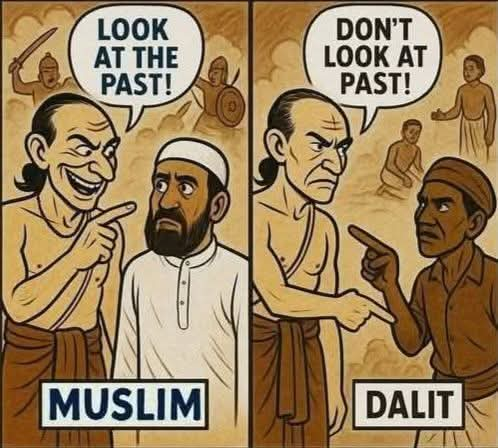
Hindu nationalism in India often constructs its identity around a selective reading of history, emphasizing perceived injustices inflicted by Muslim rulers while sidelining the deep-rooted and millennia-long oppression of Dalits within Hindu society. This selective historical narrative serves a political purpose but distorts the broader reality of India’s social history, particularly the systemic discrimination faced by Dalits under caste hierarchies that predate and outlast any external rule. By focusing almost exclusively on Hindu-Muslim conflicts, Hindu nationalists conveniently evade accountability for the internal structural violence perpetuated by upper-caste Hindus against Dalits, a practice that has persisted for over two millennia.

The Hindu Nationalist Historical Narrative

Hindu nationalism, as propagated by organizations like the Rashtriya Swayamsevak Sangh (RSS) and its affiliates, often portrays Indian history as a saga of Hindu victimhood under Muslim rule, particularly during the Mughal era. This narrative highlights events like temple destructions or forced conversions, framing Muslims as perpetual aggressors against a monolithic Hindu identity. While historical instances of conflict between Hindu and Muslim rulers are undeniable, this framing deliberately oversimplifies India’s complex past, ignoring the diversity of Hindu society and its internal hierarchies.

What is conspicuously absent from this narrative is any acknowledgment of the caste system’s role in oppressing millions of Dalits, who were relegated to the margins of society long before the arrival of Muslim rulers. By fixating on external “invaders,” Hindu nationalists deflect attention from the internal systemic injustices that have defined Hindu social order for centuries.

The Millennia-Long Oppression of Dalits

The caste system, deeply embedded in Hindu social and religious practices, has systematically marginalized Dalits (formerly referred to as “untouchables”) for over two thousand years. Ancient texts like the Manusmriti codified discriminatory practices, prescribing harsh punishments for lower castes who dared to transgress their assigned roles. Dalits were deemed impure, their touch or even shadow considered polluting by upper-caste Hindus. These beliefs were not isolated but institutionalized, shaping social interactions, economic opportunities, and religious access.

Historical accounts, such as those by the Chinese traveler Faxian (Fa-Hsien) during the Gupta period (4th–6th century CE), describe the plight of the Chandalas, a lower-caste group forced to live outside villages and announce their presence to avoid “polluting” others. This is not a relic of the distant past; discriminatory practices persisted into the modern era. Dalits were barred from temples, forbidden from drawing water from village wells, and subjected to humiliating customs like the “breast tax” in parts of South India, where lower-caste women were forced to pay to cover their bodies. These practices were not imposed by Muslim rulers but were enforced by upper-caste Hindus, who held social and religious authority.

Even today, the legacy of caste oppression endures. Manual scavenging, a dehumanizing practice where individuals (overwhelmingly Dalits) clean human waste from dry latrines, remains a stark reminder of caste-based exploitation. Despite legal bans, reports estimate that over 1.3 million Dalits are still engaged in this work, facing social stigma and health risks. Hindu nationalist discourse rarely addresses these modern injustices, focusing instead on historical grievances against Muslims or contemporary issues like “love jihad.”

Why Hindu Nationalists Avoid the Dalit Question

The reluctance of Hindu nationalists to confront caste oppression stems from both ideological and strategic considerations. Ideologically, their vision of a unified Hindu identity requires downplaying internal divisions like caste, which fracture the notion of a cohesive “Hindu nation.” Acknowledging the historical and ongoing oppression of Dalits would force a reckoning with the role of upper-caste Hindus in perpetuating this system, undermining the narrative of Hindu victimhood.

Strategically, Hindu nationalism relies on mobilizing a broad Hindu voter base, including Dalits, to counter perceived threats from minorities. Admitting the historical guilt of upper-caste oppression risks alienating Dalit communities, who have increasingly asserted their rights through movements inspired by leaders like Dr. B.R. Ambedkar. Instead, Hindu nationalist rhetoric often co-opts Dalit identity, portraying them as part of the Hindu fold while ignoring their specific grievances. This tokenism is evident in the selective celebration of Ambedkar as a Hindu icon, while his critiques of caste and Hinduism are conveniently ignored.

The Consequences of Selective History

This selective reading of history has profound implications. By focusing on Muslim oppression while ignoring caste-based atrocities, Hindu nationalists perpetuate a distorted understanding of India’s past that fuels communal tensions. This narrative not only marginalizes Dalits but also erases the contributions of lower-caste reformers who fought against caste oppression, from Jyotirao Phule to Periyar.

Moreover, it distracts from addressing contemporary issues like manual scavenging, caste-based violence, and discrimination in education and employment. According to a 2020 report by the National Campaign on Dalit Human Rights, over 40% of Dalit households in rural India still face untouchability practices, such as being denied access to public spaces or services. These are not relics of a distant past but ongoing realities that Hindu nationalist discourse sidesteps.

Toward a More Honest Historical Reckoning

A balanced understanding of Indian history requires acknowledging both external conflicts and internal injustices. The oppression of Dalits is not a peripheral issue but a central feature of India’s social history, one that predates and outlasts Muslim rule. Hindu nationalists must confront the uncomfortable truth that upper-caste Hindus were complicit in a system that dehumanized millions for millennia. Only by addressing this can India move toward a more inclusive national identity that honors all its citizens.

This is not to diminish the complexities of Hindu-Muslim relations or the historical realities of invasions and conquests. But a singular focus on one form of oppression while ignoring another is not just selective — it’s dishonest. True nationalism should uplift the marginalized, not erase their suffering. Until Hindu nationalists engage with the full spectrum of India’s history, including the painful legacy of caste, their vision of a unified nation will remain incomplete.


Tuesday, May 6, 2025

The Myth of Merit in India: Unpacking the Reservation Debate

 In India, the concept of "merit" is often wielded as a weapon in debates over caste-based reservations, particularly by those from the general category. Critics argue that reservations for Scheduled Castes (SC), Scheduled Tribes (ST), and Other Backward Classes (OBC) undermine merit by prioritizing caste over hard work. The underlying assumption is that general category students succeed solely through diligence, while reserved category students are "lazy freeloaders" who benefit unfairly. This narrative, however, ignores the structural inequalities that shape access to opportunities. Merit, as popularly understood, is not a neutral measure of hard work but a product of socioeconomic privilege, access to resources, and systemic advantages. This article explores why merit is not what most Indians think it is, using data to highlight disparities in wealth, education, and access to resources.
The Misconception of Merit as Hard Work
The popular notion of merit equates it with individual effort—hours spent studying, discipline, and perseverance. General category critics often imply that their success in competitive exams like JEE, NEET, or UPSC is due to superior hard work, while reserved category students rely on "undeserved" quotas. This framing paints SC, ST, and OBC students as inherently less capable, ignoring the broader context of their circumstances.
In reality, success in competitive exams is not solely a function of hard work. Access to quality education, private coaching, and socioeconomic stability plays a massive role. As the Supreme Court noted in 2022, “Merit cannot be reduced to narrow definitions of performance in an open competitive examination” and must be “socially contextualized” to account for systemic inequalities. The court emphasized that competitive exams do not reflect the “social, economic, and cultural advantage” accrued by privileged groups, which significantly boosts their performance.
The Resource Gap: Private Schools, Coaching, and Wealth Disparities
One of the most significant factors shaping exam performance is access to resources, which is heavily skewed along caste and class lines. General category students, who are disproportionately from upper castes, often benefit from better schools, private coaching, and tuition—resources that are financially out of reach for many SC, ST, and OBC families.
Private Schooling and Quality Education
  • Disparity in Access: A 2024 study in Tamil Nadu revealed that 62% of upper-caste students attend private elite schools, compared to only 16% of SC and 25% of Most Backward Classes (MBC) students. Meanwhile, 60-70% of SC/ST students study in low-quality government schools, where English is often introduced only in the fifth or sixth grade. This early educational divide creates a lasting gap in foundational skills.
  • Impact on Outcomes: Private schools offer better infrastructure, trained teachers, and exposure to English, which is critical for competitive exams. The National Sample Survey Organisation (NSSO) data shows that scheduled castes are the most educationally backward, followed by STs and OBCs, with large gaps in higher education enrollment compared to upper castes.
Coaching and Tuition
  • Cost of Coaching: Preparing for exams like JEE or NEET often requires enrolling in expensive coaching institutes, with fees ranging from ₹1-2 lakh per year. General category students, with greater financial resources, dominate these programs. In contrast, SC, ST, and OBC students, who often come from economically weaker backgrounds, are less likely to afford such coaching.
  • Wealth Disparities: The 2011-12 India Human Development Survey showed that upper-caste households have a median income nearly twice that of SC households and significantly higher than ST and OBC households. This wealth gap limits access to supplementary education. For example, a 2023 post on X noted that Dalits own only ~5% of rural land, reflecting their limited economic resources.
  • Coaching Impact: Coaching institutes provide structured preparation, mock tests, and exam strategies, giving students a competitive edge. Without this, even hardworking SC/ST/OBC students face a disadvantage, as their preparation relies on self-study or subpar resources.
Socioeconomic Barriers
  • Financial Strain: Many SC/ST/OBC students come from families with limited means, forcing them to balance studies with economic responsibilities. A 2016 study highlighted that SC/ST students often drop out between school and college due to accommodation costs, travel expenses, and lack of family support for higher education.
  • Cultural Capital: Upper-caste students inherit “cultural capital”—social networks, communication skills, and familiarity with elite institutions—that enhances their confidence and performance. The Supreme Court in 2022 noted that this capital, including “access to quality schooling and tutorials,” is a privilege not available to marginalized groups.
The Structural Reality: Merit as a Product of Privilege
The “merit vs. reservation” debate often ignores how privilege shapes outcomes. Michael Sandel, in The Tyranny of Merit (2020), argues that meritocracy can exacerbate inequalities by rewarding those with pre-existing advantages. In India, this is evident in the dominance of upper castes in elite institutions:
  • Faculty Representation: Only 6% of faculty in Indian Institutes of Management (IIMs) and 9% in Indian Institutes of Technology (IITs) are from SC/ST/OBC categories, with 98% of academics in top IITs belonging to upper castes.
  • Systemic Bias: A 2011 study by economists Ashwini Deshpande and Thomas Weisskopf found no evidence that reservations in Indian Railways reduced productivity, suggesting that diversity does not compromise quality. Meanwhile, private sector recruitment often favors upper-caste surnames, indicating caste-based discrimination.
The Supreme Court’s 2022 ruling on OBC quotas in NEET emphasized that “reservation is not at odds with merit but furthers its distributive consequences.” It argued that merit must account for “fortitude and resilience” in overcoming deprivation, not just exam scores. This reframing challenges the narrow view of merit as individual achievement.
The Reservation Reality: Addressing Historical Injustices
Reservations were introduced to correct centuries of caste-based exclusion, not to reward laziness. The Indian Constitution, drafted under Dr. B.R. Ambedkar, recognized that SC, ST, and OBC communities were denied basic rights, including education and employment. Data underscores the ongoing need for affirmative action:
  • Poverty and Caste: Five out of six people below the poverty line in India are from SC, ST, or OBC communities.
  • Educational Gaps: The Gross Enrollment Ratio (GER) in higher education for SCs (25.9) and STs (21.2) lags behind the national average (28.4).
  • Discrimination: A 2023 article in Nature highlighted implicit casteism in academic institutions, where SC/ST students face derogatory labeling as “reserved” and experience mental health challenges due to discrimination.
Reservations provide a pathway for marginalized groups to access opportunities, but they do not level the playing field entirely. SC/ST/OBC students still compete in a system stacked against them, with fewer resources and greater social barriers.
Reframing Merit: Toward a Fairer System
The criticism of reservations as “anti-merit” stems from a flawed understanding of merit as an individual trait divorced from context. To address this:
  • Economic-Based Criteria: Some argue for replacing caste-based reservations with economic criteria, but the Supreme Court in 1992 ruled that economic backwardness alone cannot define backwardness, as caste-based discrimination persists.
  • Strengthening Access: Increasing scholarships, free coaching, and quality government schools for SC/ST/OBC students can reduce the resource gap. Programs like those for ST female students, which led to a 47.6% enrollment increase from 2017-18 to 2021-22, show the impact of targeted support.
  • Challenging Narratives: Public discourse must move beyond the “merit vs. reservation” binary. As a 2023 post on X stated, “Merit is a myth” when social capital determines outcomes. Recognizing privilege is key to understanding true merit.
Conclusion
The idea that reservations undermine merit ignores the reality that merit itself is shaped by access to resources, wealth, and privilege. General category students, often from upper castes, benefit from private schools, coaching, and socioeconomic stability, giving them an edge in competitive exams. Meanwhile, SC, ST, and OBC students, despite facing systemic barriers, demonstrate remarkable resilience and achievement. Data shows that reserved category students often meet or exceed general cutoffs, debunking the myth of their “inferiority.” By reframing merit to account for structural inequalities, India can move toward a more equitable system where hard work is truly rewarded, regardless of caste or class. Reservations are not the opposite of merit—they are a step toward making merit accessible to all.

The Shadow of Karma: How an Ancient Doctrine Cemented Centuries of Suffering for India’s Untouchables

  The Shadow of Karma: How an Ancient Doctrine Cemented Centuries of Suffering for India’s Untouchables In the labyrinth of India’s social h...