Friday, May 16, 2025

Paying Taxes: The Ultimate Act of Nationalism for Indians

 In a country as diverse and vibrant as India, nationalism is often expressed through grand gestures—hoisting the tricolor on Independence Day, cheering for the Indian cricket team, or celebrating the achievements of our armed forces. Yet, for the average Indian, the most profound and practical way to contribute to the nation’s growth is not by standing at the border with a gun but by fulfilling a civic duty that is often overlooked: paying taxes. Taxes are the lifeblood of a nation, funding everything from infrastructure to defense, healthcare to education. In a country where the majority of citizens will never fight in a war, paying taxes is arguably the most patriotic act one can perform. However, a troubling paradox persists—while many proudly wave the national flag and sing praises of India, some, including politicians and businessmen, exploit loopholes to evade taxes, undermining the very nation they claim to champion.

Taxes: The Backbone of Nation-Building
India’s progress as a nation depends heavily on its ability to generate revenue through taxation. Taxes fund critical public services: roads that connect rural villages to urban centers, schools that educate the next generation, hospitals that save lives, and the defense forces that protect our borders. According to the Government of India’s 2023-24 Union Budget, tax revenue accounts for over 50% of the country’s total revenue receipts, with direct taxes like income tax and indirect taxes like GST playing a pivotal role. Without these funds, the government’s ability to invest in nation-building would grind to a halt.
For the average Indian, paying taxes is a direct contribution to this collective effort. It’s a way to ensure that the country’s infrastructure grows, that soldiers are equipped to defend the nation, and that marginalized communities have access to welfare programs. Unlike volunteering for military service or running for public office, paying taxes is a universal act of patriotism accessible to every earning citizen. It’s a quiet, consistent way to say, “I believe in India’s future, and I’m willing to invest in it.”
The Hypocrisy of Tax Evasion
Ironically, some of the loudest proponents of Indian pride—politicians, businessmen, and public figures—are often the ones dodging their tax obligations. On Independence Day, it’s common to see these individuals draped in the national flag, delivering impassioned speeches about “Bharat Mata” and the greatness of India. Yet, behind closed doors, many employ a range of tactics to avoid contributing their fair share to the nation’s coffers. This hypocrisy is not just a betrayal of civic duty; it’s a direct assault on the idea of nationalism they so publicly espouse.
Tax evasion in India is a pervasive issue, with estimates suggesting that the country loses billions of rupees annually due to unreported income and fraudulent practices. According to a 2022 report by the Central Board of Direct Taxes (CBDT), only 1.5% of India’s population pays income tax, a stark contrast to developed nations where tax compliance is much higher. While India’s informal economy and low per capita income play a role, deliberate tax evasion by the wealthy and influential is a significant factor.
Common Ways Indians Cheat the Tax System
Tax evasion in India takes many forms, from subtle manipulations to outright fraud. Here are some of the most common methods:
  1. Underreporting Income: Businessmen and professionals often underreport their earnings to fall below taxable income thresholds. For instance, a shopkeeper might maintain two sets of books—one for actual transactions and another for tax purposes—showing significantly lower profits to reduce their tax liability.
  2. Fake Income Proofs: A particularly rampant practice is the submission of fraudulent income certificates to qualify for benefits or exemptions. This is especially prevalent among businessmen who manipulate documents to show annual earnings below a certain threshold, such as ₹8 lakh per annum, to avail of schemes meant for lower-income groups.
  3. Benami Transactions: Some individuals hide their wealth by purchasing assets like property or gold in the names of relatives, employees, or fictitious entities. These “benami” transactions allow them to evade taxes on their actual income and wealth.
  4. Cash Transactions: The use of cash for large transactions, particularly in sectors like real estate and retail, helps individuals bypass the tax net. By not issuing receipts or maintaining digital records, they avoid scrutiny from tax authorities.
  5. Offshore Accounts and Tax Havens: Wealthy individuals and corporations often park their money in offshore accounts or shell companies in tax havens like the British Virgin Islands or Panama. The 2016 Panama Papers leak exposed several prominent Indians, including businessmen and politicians, who used such methods to hide their wealth.
A Case Study in Tax Fraud: The MCN Scholarship Scam at BITS Pilani
A striking example of how tax evasion permeates even the most unexpected places comes from my personal experience at BITS Pilani, one of India’s premier engineering institutions. The institute offers a Merit-cum-Need (MCN) scholarship, designed to support students from low-income families by waiving a portion of their tuition fees. To qualify, a student’s family income must be below ₹8 lakh per annum. While the scholarship is a lifeline for genuinely deserving students, it has become a magnet for fraudulent claims, particularly from the children of businessmen.
In my time at BITS Pilani, it was an open secret that many students availing of the MCN scholarship were not from low-income families. Instead, their parents—often businessmen—submitted fake income proofs to show earnings below the ₹8 lakh threshold. These documents were typically fabricated by colluding with chartered accountants or local authorities to underreport business income or claim fictitious losses. Shockingly, I encountered more cases of fraudulent MCN recipients than genuine ones. Students who arrived on campus with luxury cars, designer clothes, and the latest gadgets were often the same ones claiming financial hardship to secure the scholarship.
This rampant misuse of the MCN scholarship is not just a disservice to deserving students; it’s a microcosm of the broader tax evasion culture in India. By falsifying income proofs, these families not only cheat the education system but also deprive the government of tax revenue that could be used for public welfare. It’s a stark reminder that tax evasion is not a victimless crime—it undermines the nation’s ability to support its most vulnerable citizens.

The EWS Reservation: A Larger Canvas for Fraud

The fraudulent income proofs plaguing schemes like the MCN scholarship are not an isolated issue but a symptom of a deeper malaise that extends to national policies like the 10% Economically Weaker Section (EWS) reservation. Introduced in 2019, the EWS quota aims to provide educational and job opportunities to economically disadvantaged general-category individuals with a family income below ₹8 lakh per annum. However, just as businessmen manipulate income documents to secure scholarships at institutions like BITS Pilani, similar tactics are likely being used on a grand scale to exploit EWS benefits. Reports, such as a 2021 Indian Express investigation, reveal widespread issuance of dubious EWS certificates, often for bribes, allowing affluent families to claim reservations meant for the truly needy. This abuse not only deprives deserving candidates of opportunities but also siphons off public resources, mirroring the tax evasion tactics of those who publicly champion nationalism while undermining the nation’s welfare through deceit.

The Nationalism of Tax Compliance
The contrast between tax evaders and honest taxpayers is stark. While the former may wave the flag with fervor, it’s the latter who truly embody the spirit of nationalism. Paying taxes is an act of trust in the nation’s future, a belief that collective contributions will pave the way for a stronger, more equitable India. It’s a way for every citizen—whether a salaried employee, a small business owner, or a corporate executive—to stand shoulder-to-shoulder with soldiers, teachers, and public servants in building the nation.
To combat tax evasion and foster a culture of compliance, several steps can be taken:
  • Strengthening Enforcement: The government must continue to leverage technology, such as data analytics and Aadhaar-linked financial tracking, to detect and penalize tax evasion. The introduction of GST and mandatory PAN reporting has already helped, but more needs to be done.
  • Public Awareness Campaigns: Educating citizens about the direct link between taxes and national development can encourage voluntary compliance. Highlighting success stories—like how tax revenue funded a new highway or hospital—can make the connection tangible.
  • Closing Loopholes: Simplifying tax laws and closing loopholes, such as those exploited in benami transactions or offshore accounts, can reduce opportunities for evasion.
  • Celebrating Honest Taxpayers: Recognizing and rewarding honest taxpayers, as some countries do, can create a positive incentive for compliance. India’s “Taxpayer Pride” initiative, launched by the CBDT, is a step in this direction.
Conclusion
In a country where nationalism is often measured by loud proclamations and symbolic gestures, paying taxes stands out as a quiet yet powerful act of patriotism. It’s a way for every Indian to contribute to the nation’s growth, regardless of their profession or proximity to the border. Yet, the hypocrisy of those who evade taxes while flaunting their love for India reveals a deep disconnect between words and actions. From businessmen submitting fake income proofs to secure scholarships at institutions like BITS Pilani to politicians hiding wealth in offshore accounts, tax evasion is a betrayal of the very nation they claim to serve.
As India strives to become a global superpower, the path forward lies in fostering a culture of tax compliance. Every rupee paid in taxes is a brick in the foundation of a stronger, more prosperous India. So, the next time you file your taxes, take pride in knowing that you’re not just fulfilling a legal obligation—you’re performing the most nationalistic act an Indian can do. Let’s wave the flag, sing the anthem, and pay our taxes with equal fervor, for that is the true essence of loving our nation.

Wednesday, May 14, 2025

Survivor Bias in India: Why Celebrating Winners Alone Can Mislead You

 In India, success stories are everywhere — from rags-to-riches entrepreneurs like Dhirubhai Ambani and Ritesh Agarwal, to IIT toppers who crack UPSC and land top government jobs, to cricketers like Virat Kohli making the nation proud. We love these stories because they inspire us, fuel ambition, and show us what’s possible.

But here’s the catch — when we only focus on winners and success stories, we fall prey to a cognitive trap called survivor bias. This bias can distort how we view success, effort, and the risks involved. Let’s unpack what survivor bias means and why, in the Indian context, being aware of it is crucial.


What Is Survivor Bias?

Survivor bias happens when we look only at the “survivors” — those who succeeded — and ignore those who tried the same path but didn’t make it. The failures, struggles, and silent exits remain invisible. This skews our understanding because the visible winners are only a small, unrepresentative sample of everyone who started.

For example:

  • We read about Indian startup founders who became billionaires, but thousands of startups never take off or shut down.

  • We celebrate the IIT graduate who built a successful tech company, but don’t often hear about those IIT grads struggling to find jobs.

  • We admire a cricketer who played for India, but overlook the countless talented players who never got a chance.


Why Is This a Problem?

1. False Perception of Success Probability

If you only see winners, you might overestimate how likely success is, leading to unrealistic expectations. For instance, many young Indians aspire to start their own business inspired by Flipkart’s success, without realizing that about 90% of startups fail.

2. Ignoring the Role of Luck and Timing

Success isn’t just hard work or talent; often, luck and timing play huge roles. Survivor bias hides this, making success look purely due to skill or effort.

3. Underestimating Risks and Challenges

By focusing on success stories, people might underestimate the risks or challenges. This can lead to poor decisions — like dropping out of college thinking it’s a shortcut, inspired by a handful of famous dropout billionaires.


Is Highlighting Winners Bad?

Absolutely not! Celebrating achievers motivates society, spreads hope, and shows what’s possible. India thrives on its success stories to inspire millions.

The key is balance: Along with winners, we must recognize the silent majority who struggled or failed. This balanced view helps us understand the true path to success — which often involves failures, retries, and learning.


How Can We Avoid Survivor Bias?

1. Listen to Failure Stories

Entrepreneurs should share their failures, not just wins. Educational institutions can highlight students’ struggles, not just toppers.

2. Be Realistic About Success Rates

Understand that for every successful startup or athlete, many tried and failed. Don’t underestimate the odds.

3. Acknowledge Luck and External Factors

Recognize that timing, connections, and external circumstances matter too.

4. Learn from the Whole Spectrum

Study success and failure cases to get a realistic roadmap.


Examples from India

  • Startup Scene: While Ola and Paytm are celebrated, thousands of startups quietly shut down each year. Recognizing this prepares aspiring founders better.

  • Competitive Exams: UPSC toppers are applauded, but most aspirants clear preliminary exams only after multiple attempts or never at all. Coaching institutes could emphasize this reality more.

  • Sports: Cricket legends shine on TV, but countless players play at club and district level without ever getting a big break.


Conclusion

Survivor bias is a natural cognitive shortcut but being aware of it is vital — especially in a country like India where success stories inspire millions. Celebrate winners, yes, but also recognize the invisible struggles and failures that paint the full picture.

This balanced perspective empowers smarter decisions, more realistic expectations, and a healthier appreciation of what success really entails.

Tuesday, May 13, 2025

The Hidden Inequality in India's Reservation System: Why OBCs Face the Toughest Competition

 India's reservation system is often painted in binaries: reserved vs. unreserved, merit vs. quota. But the true picture is far more complex—and far more unfair to the very communities reservations are meant to uplift.

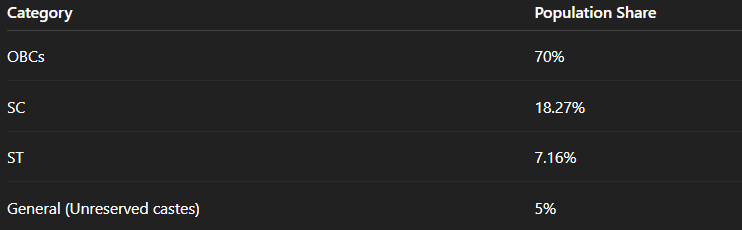
Recent data from the Karnataka caste survey—the most detailed since the 1931 British census—reveals something shocking: the Other Backward Classes (OBCs), despite being the largest social group, are vastly underrepresented in the actual seats reserved for them.


🔍 The Numbers: What the Karnataka Caste Survey Revealed

The Socio-Economic and Educational Survey (2015), submitted in 2023 by the Karnataka State Commission for Backward Classes, estimated the population composition of the state as:

This means OBCs alone form the overwhelming majority of Karnataka’s population.


🎯 But What About Seat Allocation?

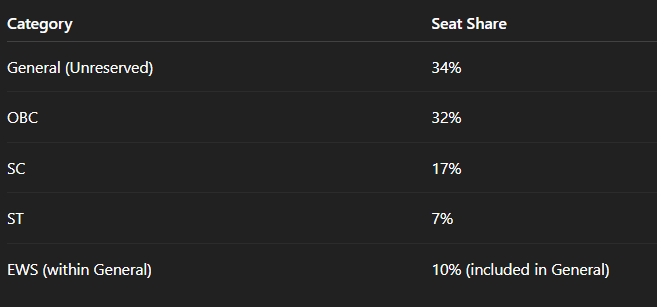
Let’s look at how government jobs and education seats are allocated in Karnataka:

The Real Shock: Seat-to-Population Ratio

By comparing each group's share of seats with their share of population, we get the seat-per-capita ratio—a clear indicator of how much competition a member of that category faces.

This means:

  • General category candidates have almost 7× more seats per capita than their population share. Their competition is the lowest.

  • OBCs, despite being the largest group, have less than half the seats they proportionally deserve.

  • SC/ST categories, while historically disadvantaged, now receive seats roughly in proportion to their population.


🧠 What Does This Really Mean?

It means OBCs are fighting for crumbs on their own table. A student or job aspirant from an OBC background faces nearly double the competition as an SC/ST counterpart—and more than 13× the competition faced by someone from an unreserved (General) caste.

And yet, public discourse often portrays OBCs as having an “easy ride” due to reservations. The numbers say otherwise.


❓ Why Is This Happening?

  1. Cap on total reservation: The Supreme Court has historically capped reservations at 50% (though Karnataka exceeds this), meaning even large groups like OBCs can’t get proportional seats.

  2. No proportional quotas: Reservations aren’t based on current caste population data (except in Tamil Nadu and now Bihar).

  3. General category advantages: The General category, which includes dominant castes, ends up with a disproportionate share despite being numerically tiny.


🔁 What Needs to Change?

  • Make caste census data public across India

  • Base reservation percentages on actual population share

  • Sub-categorize OBCs so that dominant OBCs don’t crowd out marginalized ones

  • Include seat-to-population ratio in policy-making


⚖️ Final Thought

The reservation debate often turns emotional, but data helps us see clearly. And the data is unambiguous:

The biggest victims of India’s flawed reservation system are often those it claims to empower: the OBCs.

It’s time to recalibrate the system—not against one group, but in favor of justice, logic, and equality.

The Hidden Inequity in Reservation: Why Bihar’s Backward Classes Face the Toughest Competition

 In a country where debates around reservation policies are often politically charged and emotionally sensitive, hard data can be the clearest guide. A close look at Bihar’s recently released caste survey and its 2023 reservation policy reveals something surprising, even counterintuitive: despite receiving the largest share of reservation, Backward Classes (OBC + EBC) in Bihar are actually the most disadvantaged when it comes to per capita access to seats in jobs and education.

Meanwhile, General category, Scheduled Castes (SC), and Scheduled Tribes (ST)—despite having fewer total reserved seats—actually face less competition per seat within their respective categories.

This article breaks down the numbers to explain how and why this happens.

This data shows that nearly two-thirds of Bihar’s population falls under the OBC/EBC umbrella, forming the majority.


🪑 Reservation Breakdown (Bihar, 2023)

In November 2023, Bihar passed a landmark law increasing total reservation to 75% in public employment and education. 


This means General (unreserved) category students are competing for just 25% of total seats—yet that’s still more per capita access than any other group.


🧮 Let’s Do the Math: Seats per Person

To understand which category is most competitive within itself, we compare each group’s percentage of population to the percentage of seats available to it.


🎯 Interpretation:

  • A ratio > 1 means more seats per capita than your population share (easier competition).

  • A ratio < 1 means fewer seats per capita than your population share (harder competition).

So, despite having the largest share of reservation, the Backward Classes collectively face the toughest odds simply because they have to share it with a huge chunk of the population.


🧠 Why This Feels Counterintuitive

The public narrative often assumes that reserved seats automatically mean advantage—but this ignores how many people are competing for those reserved seats.

A General category candidate might be competing for fewer seats overall, but they’re also part of a much smaller population group (15.52%). Meanwhile, a BC candidate is fighting for more seats (43%) but against more than 4 times the number of people (63.14%).


⚖️ A Broken Equity?

This leads us to a simple but overlooked conclusion: seat distribution does not automatically mean equity unless it’s proportional to population. While Bihar has gone further than most states in trying to align reservation with caste numbers, the most populous category—Backward Classes—still ends up short.

Unless the seat-to-population ratios are brought into balance, meritorious candidates from backward groups will continue to be under more pressure to outperform their peers, even within the quota system.


🛠️ What Could Be Done?

  • Subcategorization of OBC/EBC: Breaking them into more granular quotas, as suggested by several commissions, could balance internal disparities.

  • Dynamic seat allocation: Using a model that adjusts seat percentages based on real-time population and demand data.

  • Horizontal reservations within OBC/EBC to ensure representation of the most marginalized (e.g., Muslim OBCs, Most Backward Castes).


📌 Final Thoughts

This data-driven view forces us to rethink assumptions about reservation and merit. Equity is not just about allocating seats—it’s about fair access per person. And by that measure, Bihar’s reservation system, while progressive on paper, still leaves its largest and most disadvantaged population group at a competitive loss.

The system isn’t unfair because it gives “too much” to some—it’s unfair because it doesn’t give proportionately enough to the ones who need it most.

Monday, May 12, 2025

The Absurdity of War: Why Do Young People Die for the Pride of Old Men?

 "Only the dead have seen the end of war." — George Santayana

Every generation, it seems, must learn the same terrible lesson: war is hell. Yet time and again, nations go to war — often for reasons that, in hindsight, seem more political than moral, more about pride than principle. One cannot help but ask: Isn’t war, at its core, a deeply stupid thing?

And more specifically: Why do young men and women fight and die because a few older, powerful men are upset?


🧓🏽 The Few Decide, the Many Suffer

War is rarely started by the people who fight it. The decisions to go to war are made in parliament buildings, presidential palaces, or military headquarters — not on the streets, not in the trenches. These decisions are often influenced by strategic calculations, personal egos, or historical grudges.

But once war begins, it is the young — conscripted soldiers, frontline fighters, civilians caught in the crossfire — who bleed and die.

It’s an old story. From the trenches of World War I to the deserts of Iraq, the pattern holds: the higher up you go in the chain of command, the further you are from the battlefield — and from the consequences.


🧠 War Is Rarely Rational

While governments often justify war in the name of national interest, security, or justice, the actual outcomes are often disastrous:

  • Lives are lost by the thousands, sometimes millions.

  • Entire economies collapse.

  • Generations grow up traumatized.

  • The reasons for war are often revealed to be hollow or false.

World War I began because of a botched assassination and a tangle of alliances. The Iraq War was waged over weapons of mass destruction that didn’t exist. In both cases, those who paid the price were not the policymakers — but the soldiers and civilians.


🗣️ Manufactured Consent: The Role of Propaganda

If war is so destructive, why do people support it?

The answer lies in nationalism, fear, and propaganda. Leaders often wrap war in noble language — calling it a defense of honor, faith, or homeland. The media is mobilized. Enemies are dehumanized. Dissenters are silenced or called traitors.

Ordinary people are convinced that dying in war is heroic — even when the war itself is unnecessary or unjust.


🔁 The Cycle of Revenge

Wars rarely end cleanly. They create bitterness and trauma that last generations. One war begets another.

  • World War I created the conditions for World War II.

  • The U.S. invasion of Iraq gave rise to ISIS.

  • India and Pakistan have fought multiple wars — and their border remains volatile to this day.

When wars are fought for pride, for vengeance, or to “teach a lesson,” they rarely bring lasting peace. Instead, they plant the seeds of future violence.


✊ Youth as Cannon Fodder — or Agents of Change?

What’s perhaps most tragic is that the young people who are made to fight in wars are often the ones with the most to lose — and the most to gain from peace.

Young minds can build nations, not just defend them.
Young bodies can farm, teach, create, innovate — not just die in muddy trenches or burned cities.
When we say "Support the troops," maybe we should also mean "Support them by not sending them to fight unjust wars."


🕊️ The Case for Peace

Peace is not weakness. It requires strength, diplomacy, empathy, and patience. War is easy to start and hard to end. Peace takes work, but it’s the only rational path in a world that now possesses weapons capable of ending humanity.

More and more people are recognizing that war is not inevitable — it’s a choice. And a bad one, at that.


📌 Final Thought

History may glorify generals and conquerors, but we should remember the millions whose names were never recorded — the soldiers, civilians, and children whose lives were cut short by decisions they had no part in making.

So yes — going to war, more often than not, is stupid. It’s a tragic, violent expression of pride, fear, and failure. And it’s time we stopped pretending otherwise.

Sunday, May 11, 2025

How to Spot Misinformation and Disinformation Online (And Tools to Fact-Check Yourself)

 In today’s hyper-connected digital world, information spreads faster than ever — and so does misinformation and disinformation. While misinformation refers to false or misleading information shared without harmful intent, disinformation is deliberately deceptive content spread to manipulate public opinion, sow discord, or push agendas. Both can be harmful, especially when they go viral.

Fortunately, with some vigilance and the right tools, anyone can become their own fact-checker. Here's how you can spot misinformation and verify facts before sharing anything online.


How to Spot Misinformation/Disinformation

1. Check the Source

  • Ask yourself: Is the source credible? Is it a known news organization, or a random blog or social media page?

  • Look for IFCN certification (International Fact-Checking Network) on news sites. Certified sources follow a code of principles and transparency.

2. Look for Sensationalism

  • Headlines in ALL CAPS, with excessive exclamation points or fear-inducing language, often indicate clickbait or manipulation.

  • If it seems too outrageous or shocking, dig deeper.

3. Verify Dates and Context

  • Misleading posts often use old photos or articles to depict current events inaccurately.

  • Context matters: a real quote or image can be framed misleadingly to promote a false narrative.

4. Watch for Deepfakes and AI-Generated Content

  • Deepfake videos and AI-generated images are increasingly realistic. If a video or image seems off (weird lighting, unnatural movements, distorted features), you may be looking at synthetic media.


Tools to Fact-Check Information

1. Google Fact Check Explorer

  • Google Fact Check Explorer aggregates fact-checked claims from trusted sources.

  • Just type in keywords or paste a claim to see if it’s been fact-checked.

2. IFCN-Certified Fact-Checkers

These organizations are globally recognized and follow a standard code of conduct:

You can verify whether a fact-checker is IFCN-certified by checking the list at IFCN’s site.


Image and Video Verification Tools

3. Reverse Image Search

  • Helps check if an image was used before in a different context.

Tools:

  • Google Images: images.google.com – Click the camera icon to upload an image or paste the URL.

  • Yandex Reverse Image Search: More powerful than Google in some cases, especially for faces or less indexed content.

  • TinEye: tineye.com – Tracks where and when an image appeared first.

Browser Extensions:

  • RevEye Reverse Image Search (Chrome/Firefox): Lets you reverse search any image using multiple engines (Google, Yandex, TinEye, Bing).

  • Search by Image: A Chrome extension that gives a right-click option to search images across multiple engines.


Video Verification

  • Use InVID plugin (available as a Chrome extension) – ideal for frame-by-frame video analysis, reverse image search of keyframes, and metadata checks.


Additional Tips

  • Use metadata tools like ExifTool to check image details (camera used, date taken, location).

  • Cross-reference any questionable post with reliable news outlets.

  • If you see a viral post, search for the same claim on Google or Fact Check Explorer before engaging.

  • Don’t amplify unverified posts. Even if you’re calling it out, sharing helps spread misinformation.


Final Thought

In the age of information overload, being a responsible digital citizen means not just consuming content, but verifying it before reacting or sharing. With a few simple tools and critical thinking, you can protect yourself — and your network — from falling into the misinformation trap.

Stay skeptical. Stay informed.

Saturday, May 10, 2025

From Pahalgam to Propaganda: Terror, Retaliation, and the Battle for Narrative

In the wake of the devastating April 22, 2025, terrorist attack in Pahalgam, Kashmir, which claimed the lives of 26 civilians, India and Pakistan have engaged in a series of retaliatory military operations, escalating tensions in the region. This article examines global responses to similar terrorist incidents, India's and Pakistan's actions and motivations, the role of misinformation, restrictions on independent journalism, and potential pathways to de-escalation.


Global Responses to Terrorist Attacks

Internationally, countries often respond to terrorist attacks through a combination of legal, diplomatic, and military measures:

  • Legal Cooperation: Nations may engage in Mutual Legal Assistance Treaties (MLATs) and Joint Investigation Teams (JITs) to facilitate cross-border investigations. For instance, European countries have utilized JITs to address transnational terrorism effectively. ICCT

  • Military Alliances: In response to the September 11 attacks, NATO invoked Article 5, leading to collective military action in Afghanistan.

  • Judicial Measures: Countries like France have pursued judicial investigations and prosecutions following terrorist incidents, emphasizing the rule of law.


India's Response: Operation Sindoor

Following the Pahalgam attack, India launched "Operation Sindoor," targeting alleged terrorist infrastructure in Pakistan and Pakistan-administered Kashmir. The operation aimed to neutralize threats and serve as a deterrent against future attacks. The Sun

India's government framed the strikes as a measured and necessary response to protect national security. However, critics argue that the timing and publicity of the operation suggest political motivations, particularly with upcoming elections.

India’s leadership leveraged Operation Sindoor to reinforce a strongman image, rally nationalistic sentiment, and pre-empt criticism of its Kashmir policy—moves widely interpreted as intended to shore up electoral support ahead of upcoming polls. Domestic political actors across the spectrum quickly fell in line, and even opposition parties paused critique, reflecting the high stakes of appearing “soft” on terror.


Pakistan's Counteraction: Operation Bunyan Ul Marsoos

In retaliation, Pakistan initiated "Operation Bunyan Ul Marsoos," launching missile and drone strikes on Indian military targets. Pakistan's leadership condemned India's actions as violations of sovereignty and accused India of targeting civilian areas, claims that India denies. The Sun

Pakistan's response also appears influenced by domestic political considerations, aiming to unify public opinion and assert its stance on Kashmir.

Pakistan’s retaliation to India’s Operation Sindoor has likewise been leveraged for domestic political gain, mirroring India’s use of military strikes to stoke nationalist sentiment. Islamabad’s government vowed “avenge each drop of blood,” launched cross-border shelling under “Operation Bunyan Ul-Marsoos,” and orchestrated a widespread propaganda campaign—complete with debunked claims of captured Indian soldiers. While both capitals publicly emphasize sovereignty and security, their responses also serve to consolidate internal support and deflect criticism, underscoring how tit-for-tat violence on the Indo-Pak border often doubles as electoral theater.


Misinformation and Propaganda

Both nations have engaged in information warfare, spreading conflicting narratives:

Misinformation on the Indian Side

  1. Fake “captured Indian pilot” claims
    Rumors circulated on social media that Pakistan had captured an Indian Air Force woman pilot named Shivani Singh. The Press Information Bureau (PIB) officially debunked this, confirming no such incident occurred The Times of India.

  2. Old or unrelated images passed off as strike footage
    An image of a crashed aircraft from years ago was shared as proof that Pakistan had shot down an Indian Rafale jet. PIB’s fact-check labeled it “old” and “unrelated to Operation Sindoor” The Times of India.

  3. Communal “reprisal” lists after Pahalgam
    A viral list purported to show 15 Muslim victims of retaliatory attacks across India. Alt News traced it to unverifiable social-media forwards and flagged it as fake Alt News.

  4. ATM shutdown hoax
    Social-media forwards warned that ATMs would close for days due to a “Pakistan ransomware” reprisal. The Week’s fact-check confirmed no such shutdown was planned The Week.

Misinformation on the Pakistani Side

  1. Claims of “drones shot down” and zero civilian casualties
    Pakistani outlets asserted their Air Force downed Indian drones and that no civilians died in Pakistani territory. NDTV’s fact-check of Pakistani media broadcasts found both claims false and unsupported by independent evidence www.ndtv.com.

  2. Fabricated prisoner captures
    State-aligned channels claimed Pakistan had captured two Indian soldiers and even a female pilot. These were later retracted or disproven by Reuters and Pakistani military spokespeople YouTube.

  3. “21 lies” about Operation Sindoor
    Firstpost compiled and debunked a list of twenty-one major falsehoods spread by Pakistani media—ranging from phantom missile strikes to invented civilian deaths Firstpost.

  4. Denial of cross-border firing
    Despite video evidence of Pakistani shelling in Kashmir, some Pakistani state channels claimed no violations occurred. Independent observers and ceasefire monitors contradicted this narrative


Restrictions on Independent Journalism

1. Access Regimes in Indian-Administered Kashmir

1.1. Permit Requirements and Live-Coverage Ban

The Ministry of Information and Broadcasting’s advisory explicitly prohibits live coverage of counter-terror operations in Kashmir, citing security risks. Journalists must secure embedded-unit clearance from the Army’s Media Facilitation Centre or local police permits, a process that can take days and is often subject to arbitrary delay Committee to Protect Journalists.

1.2. Digital Censorship and Account Blocks

Since the Pahalgam attack on April 22, the Indian government has ordered the blocking of at least 16 Pakistani YouTube channels and over 8,000 social-media accounts (including independent voices like Free Press Kashmir and The Kashmiriyat) under the IT Act and Intermediary Guidelines Committee to Protect JournalistsThe News Minute.

1.3. Harassment and Physical Threats

Independent reporters covering protests have been physically assaulted—for example, Dainik Jagran’s Rakesh Sharma was attacked by political supporters in Kathua—and charged under sedition or anti-terror laws for social-media posts criticising the response Committee to Protect JournalistsThe Washington Post.

1.4. Press-Freedom Ranking

India now ranks 151st out of 180 countries in the RSF World Press Freedom Index, reflecting a climate of intimidation and self-censorship that severely limits independent on-ground reporting The GuardianThe News Minute.


 2. Access Regimes in Pakistan

2.1. New Social-Media Regulatory Law

In January 2025 Pakistan amended the PECA, creating a Social Media Regulatory Authority with powers to block websites, impose fines, and jail “false” reporters—measures condemned by the Pakistan Federal Union of Journalists (PFUJ) as a direct attack on press freedom Reuters.

2.2. Digital Censorship

Following India’s strikes, Pakistani authorities also slowed internet speeds in border areas and threatened legal action against journalists covering “cross-border aggression” without official clearance Instagram.

2.3. Press-Freedom Ranking and Safety

Pakistan ranks 158th out of 180 in the 2025 RSF index, with journalists facing killings, kidnappings, and legal harassment—seven were killed in the first half of 2024 alone—making independent field reporting near conflict zones extremely hazardous The Guardian.


 3. Practical Impact on Reporting

  • Limited “Eyewitness” Accounts: Both governments require reporters to file copies of all stories and raw footage with security agencies before publication, effectively chilling investigative journalism.

  • Reliance on Official B-Roll: Media outlets dependent on military-provided footage cannot verify ground realities, undermining independent scrutiny.

  • Editorial Self-Censorship: Fear of FIRs under the UAPA or PECA leads many outlets to avoid critical coverage altogether.

These actions have drawn criticism from press freedom organizations, emphasizing the importance of transparent and accurate reporting during crises.


Pathways to De-escalation

To prevent further escalation and promote stability:

  1. Diplomatic Engagement: Both nations should engage in direct talks, possibly facilitated by neutral international parties, to address underlying issues.

  2. Strengthening Legal Frameworks: Establishing or enhancing MLATs and JITs can facilitate joint investigations into terrorist activities.

  3. Combatting Misinformation: Collaborative efforts to fact-check and counter false narratives can reduce public hysteria and mistrust.

  4. Protecting Press Freedom: Ensuring journalists have access to conflict zones and can report without undue restrictions is vital for transparency.

  5. Confidence-Building Measures: Initiatives such as cultural exchanges, economic cooperation, and military hotlines can build trust and reduce the likelihood of misunderstandings.


The recent events underscore the volatility of the India-Pakistan relationship and the potential for rapid escalation. A commitment to dialogue, legal cooperation, and respect for press freedom is essential to navigate the complexities of regional security and prevent future tragedies. 

When Privilege Gets Help, It’s “Networking”; When Others Get Help, It’s “Quota”

  When Privilege Gets Help, It’s “Networking”; When Others Get Help, It’s “Quota” Unpacking the Double Standards of Caste Privilege in India...