Monday, May 26, 2025

Reassessing Bal Gangadhar Tilak: A Nationalist with Regressive Social Views

 Bal Gangadhar Tilak is widely celebrated as one of the foremost leaders of India’s early nationalist movement. Revered as “Lokmanya” (beloved of the people), he played a vital role in awakening political consciousness among Indians and popularizing the idea of Swaraj (self-rule). However, while his contributions to the independence struggle are undeniable, his views on social issues—particularly regarding women, caste, and reform—remain deeply problematic.

This article seeks to highlight and critically examine some of the more questionable positions Tilak held, as recorded in his writings and political interventions.


1. Opposition to the Age of Consent Act (1891)

Perhaps the most controversial stance Tilak took was his opposition to the Age of Consent Bill, which sought to raise the age of consent for girls from 10 to 12 years following the tragic death of Phulmoni Bai, a 10-year-old girl who died after being raped by her 30-year-old husband.

Tilak wrote in his newspaper Kesari that the law was an intrusion into Hindu religious traditions. More disturbingly, he blamed the young girl's death on her physiology, stating:

“The girl had defective female organs. She was a dangerous freak of nature.”

(Source: Wikipedia – Bal Gangadhar Tilak)

Such statements not only show insensitivity but also reflect a regressive attitude that prioritized religious orthodoxy over child protection and human rights.


2. Misogynistic Views on Women’s Role in Society

Tilak was a staunch defender of patriarchal norms and often cited the Manusmriti to justify his positions. He believed that:

“A woman must always remain under male control—first her father, then her husband, and then her son.”

(Source: Vedkabhed.com – Tilak’s Social Views)

He also criticized the British for "liberating" women, seeing it as a disruption of Hindu social order.


3. Hostility to Women’s Education

Tilak opposed the spread of modern education to girls, especially in English and the sciences. He argued that such learning would "de-womanize" them and make them immoral.

“Education in English for women would ruin their traditional virtues and destroy the Hindu household.”

(Source: Vedkabhed.com)

This position directly opposed the work of reformers like Ishwar Chandra Vidyasagar and Pandita Ramabai, who fought for women's education and empowerment.


4. Casteism and Opposition to Inter-caste Marriages

Tilak upheld orthodox Brahminical views on caste. He opposed 'pratiloma' marriages (between upper-caste women and lower-caste men), calling them unnatural and likening them to interracial marriages between whites and blacks:

“Just as whites don’t approve of blacks marrying their women, high castes must not allow lower castes to marry their daughters.”

(Source: Padhotoaise.in)

His stance perpetuated caste-based inequality and resisted movements for social justice.


5. Vilification of Social Reformers

Tilak often clashed with social reformers who challenged Hindu orthodoxy. He particularly targeted Pandita Ramabai, a noted social reformer and convert to Christianity. He accused her of using her educational efforts as a front for religious conversion and denounced her as an enemy of Hinduism.

(Source: Padhotoaise.in)


Conclusion: A Legacy of Contradictions

Bal Gangadhar Tilak’s role in the Indian independence movement is historic and pivotal. He was a fierce nationalist who awakened a generation with the cry of “Swaraj is my birthright, and I shall have it.” However, his social conservatism, patriarchal worldview, and casteist ideology must be acknowledged and critically examined.

Like many figures in history, Tilak's legacy is complex—a mix of progressive nationalism and deeply regressive social beliefs. Recognizing both aspects allows for a more honest and nuanced understanding of India’s freedom struggle and its leaders.

Sources:

Sunday, May 25, 2025

Why Income-Based Reservation Can’t Work Until We Fix Tax Evasion

 India’s reservation system, originally based on caste and social disadvantage, has increasingly moved toward incorporating economic criteria—especially with the introduction of the EWS (Economically Weaker Sections) quota. In theory, this is a step toward more inclusive and merit-based affirmative action. But in practice, income-based reservation policies are fundamentally flawed in a country where tax evasion is rampant.

The Crux: Income Data in India Is Unreliable

In an ideal world, a citizen’s declared income would reflect their actual economic standing. But India is far from that ideal. The informal economy, which employs more than 80% of the workforce, thrives on cash transactions and underreporting. Even among salaried professionals, many find ways to manipulate declared income.

As a result, when reservation or subsidy policies rely solely on declared income, they become vulnerable to gaming. Those with money and connections can easily understate their income and claim benefits meant for genuinely poor individuals.


A New Scam: Political Donations as a Tax Evasion Loophole

One of the lesser-known but growing tricks used by upper-middle-class professionals, including IT employees, involves "donations" to political parties. Here’s how it works:

  1. An individual “donates” a sum (say ₹10 lakh) to a Registered Unrecognized Political Party (RUPP).

  2. Under Section 80GGC of the Income Tax Act, the donation is 100% tax-exempt.

  3. The political party returns 90–95% of the donation in cash to the donor, keeping a small cut (usually 5–10%).

  4. The donor ends up paying little to no income tax, and the party earns commission income through laundering.

This has been documented by the Income Tax Department in recent years. A major ₹110 crore scam was unearthed in Hyderabad involving precisely this method.


Why This Undermines Income-Based Reservation

Income-based reservations like the EWS quota require applicants to fall below an income threshold (currently ₹8 lakh/year). But:

  • If you can mask your real income through fake donations, benami transactions, or under-the-table cash deals, you can qualify.

  • The system then rewards cheaters and penalizes honest taxpayers who disclose their true income.

  • It creates a perception of unfairness, further polarizing public opinion on affirmative action policies.


How to Fix This: Policy and Enforcement Solutions

1. Crack Down on Fake Political Parties

  • The Election Commission and Income Tax Department must audit RUPPs and de-register those without legitimate political activity.

  • Link donations with verified Aadhaar-PAN identities, and mandate digital trails for all contributions.

2. Audit Claims Under Section 80GGC

  • Any large donation claiming a full deduction should automatically trigger a red flag in the tax system.

  • Use AI-based anomaly detection to spot patterns (e.g., high donations followed by high cash withdrawals).

3. Make Income Proof More Robust

  • Instead of relying solely on IT returns, mandate a composite economic criteria:

    • Property ownership

    • Luxury vehicle data (VAHAN)

    • School fees paid for children

    • Foreign travel records

    • GST filings (for business owners)

4. Reward Whistleblowers

  • Introduce a confidential whistleblower mechanism with monetary rewards for reporting fraudulent donation rackets or income under-reporting.

5. Strengthen Digital Forensics and E-Governance

  • Integrate GST, PAN, Aadhaar, and property records to cross-verify economic standing.

  • Use machine learning to flag inconsistencies between lifestyle and declared income.


Conclusion

Income-based reservation is a sound idea—but only on paper. In reality, India’s parallel cash economy and weak enforcement mechanisms make it easy for high-income individuals to masquerade as poor. Until we crack down on tax evasion and reform the political funding loopholes, economic reservations will remain vulnerable to abuse.

If India wants to move toward a more just, meritocratic, and efficient welfare state, the first step must be to fix the system that measures income. Without that, any policy based on it is destined to fail.

The Caste-Based Reservation Debate: A Misunderstood Reality


The Caste-Based Reservation Debate: A Misunderstood Reality

In India, few topics ignite as much public passion as caste-based reservation. For some, it is a necessary corrective to centuries of discrimination. For others, it’s perceived as an unfair advantage. But what if much of the public debate is centered on a numerical illusion?

Contrary to widespread belief, caste-based reservation accounts for less than 2% of all jobs in India. This isn’t an opinion — it’s a hard number based on publicly available data.


Breaking Down the Numbers

Let’s start with the facts:

  • Total workforce in India (FY 2023–24): ~643 million people.
     [Source: Reserve Bank of India, CMIE]
  • Public-sector employment: Only about 3.8% of India’s jobs are in the public sector (including central/state government, PSUs, etc.).
     → 643 million × 3.8% = ~24.4 million public-sector jobs
  • Reservation coverage:
     Under central rules, 49.5% of government jobs are reserved:
  • SC (15%)
  • ST (7.5%)
  • OBC (27%)
  • → 49.5% of 24.4 million = ~12.1 million reserved jobs
  • Total reservation share in all jobs:
     12.1 million ÷ 643 million = ~1.9%

Yes, that’s it. Just 1.9% of all jobs in India are covered by caste-based reservation policies.


What About the Private Sector?

This number is so low because over 90% of India’s jobs are in the private and informal sectors, where caste-based reservation does not apply.

Despite calls from various political parties and social justice activists, no pan-India law mandates reservation in private companies. A few states like Maharashtra have experimented with it, but enforcement is patchy, and many such laws are stuck in legal limbo.


Why This Is So Worrying

  1. Policy vs. Perception Disconnect
     Walk into any WhatsApp group, college debate, or comment section, and you’ll hear that “reservation is everywhere” or that “merit is being destroyed.” But this data proves otherwise. The entire narrative rests on just 1.9% of all jobs.
  2. Misplaced Anger
     Many upper-caste youth who struggle in competitive exams often channel frustration toward caste-based quotas, even though most of their job prospects lie in the unreserved private sector. The real bottleneck isn’t reservation — it’s a broken job market, low economic growth, and lack of opportunities.
  3. Blind Spot in Social Justice
     On the other side, those who believe that reservation has “uplifted” entire communities must also acknowledge that its reach is extremely limited. The vast majority of Dalits, Adivasis, and OBCs are still stuck in informal jobs with no protections — let alone reservations.
  4. Myth of Overrepresentation
     There’s a recurring narrative that reserved groups are now overrepresented in bureaucracy or government. But data shows that SCs, STs, and OBCs are still underrepresented in higher government posts, courts, academia, and corporate leadership.

Why It Matters

We are debating less than 2% of the job pie while ignoring the 98% that’s unregulated, exclusionary, and caste-stratified in more subtle ways.

This massive disconnect leads to:

  • Divisive politics that weaponize identity.
  • Young people blaming the wrong system for their unemployment.
  • Neglect of real affirmative action reforms for the private sector.
  • Little to no pressure to create better universal job policy.

The Way Forward

We need to realign the conversation:

  • Acknowledge the data: Understand where reservation applies — and where it doesn’t.
  • Demand broader equity: Instead of fighting over the 1.9%, demand transparency, diversity, and opportunity in the remaining 98%.
  • Reframe the narrative: Stop treating reservation as a dominant force. Start recognizing it as a narrow tool trying to correct a vast historical imbalance.

Conclusion

The idea that caste-based reservation dominates India’s job market is a myth — and a dangerous one at that. By obsessing over a policy that affects just a sliver of the workforce, we ignore the real structural crises: job scarcity, inequality, and private-sector exclusion.

If we want a fairer India, we must move beyond rhetoric — and start looking at the numbers. Because right now, the perception is wildly out of sync with reality.

The Selective Lens of Hindu Nationalism: Ignoring Dalit Oppression in Historical Narratives


The Selective Lens of Hindu Nationalism: Ignoring Dalit Oppression in Historical Narratives

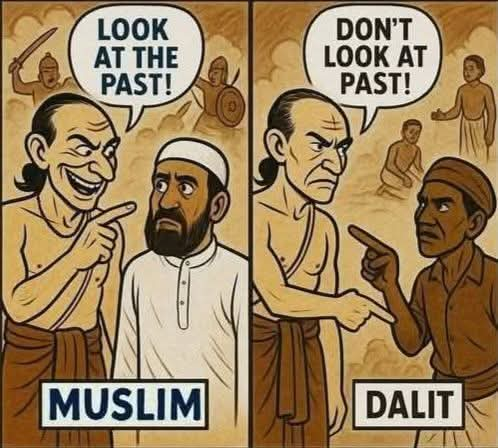
Hindu nationalism in India often constructs its identity around a selective reading of history, emphasizing perceived injustices inflicted by Muslim rulers while sidelining the deep-rooted and millennia-long oppression of Dalits within Hindu society. This selective historical narrative serves a political purpose but distorts the broader reality of India’s social history, particularly the systemic discrimination faced by Dalits under caste hierarchies that predate and outlast any external rule. By focusing almost exclusively on Hindu-Muslim conflicts, Hindu nationalists conveniently evade accountability for the internal structural violence perpetuated by upper-caste Hindus against Dalits, a practice that has persisted for over two millennia.

The Hindu Nationalist Historical Narrative

Hindu nationalism, as propagated by organizations like the Rashtriya Swayamsevak Sangh (RSS) and its affiliates, often portrays Indian history as a saga of Hindu victimhood under Muslim rule, particularly during the Mughal era. This narrative highlights events like temple destructions or forced conversions, framing Muslims as perpetual aggressors against a monolithic Hindu identity. While historical instances of conflict between Hindu and Muslim rulers are undeniable, this framing deliberately oversimplifies India’s complex past, ignoring the diversity of Hindu society and its internal hierarchies.

What is conspicuously absent from this narrative is any acknowledgment of the caste system’s role in oppressing millions of Dalits, who were relegated to the margins of society long before the arrival of Muslim rulers. By fixating on external “invaders,” Hindu nationalists deflect attention from the internal systemic injustices that have defined Hindu social order for centuries.

The Millennia-Long Oppression of Dalits

The caste system, deeply embedded in Hindu social and religious practices, has systematically marginalized Dalits (formerly referred to as “untouchables”) for over two thousand years. Ancient texts like the Manusmriti codified discriminatory practices, prescribing harsh punishments for lower castes who dared to transgress their assigned roles. Dalits were deemed impure, their touch or even shadow considered polluting by upper-caste Hindus. These beliefs were not isolated but institutionalized, shaping social interactions, economic opportunities, and religious access.

Historical accounts, such as those by the Chinese traveler Faxian (Fa-Hsien) during the Gupta period (4th–6th century CE), describe the plight of the Chandalas, a lower-caste group forced to live outside villages and announce their presence to avoid “polluting” others. This is not a relic of the distant past; discriminatory practices persisted into the modern era. Dalits were barred from temples, forbidden from drawing water from village wells, and subjected to humiliating customs like the “breast tax” in parts of South India, where lower-caste women were forced to pay to cover their bodies. These practices were not imposed by Muslim rulers but were enforced by upper-caste Hindus, who held social and religious authority.

Even today, the legacy of caste oppression endures. Manual scavenging, a dehumanizing practice where individuals (overwhelmingly Dalits) clean human waste from dry latrines, remains a stark reminder of caste-based exploitation. Despite legal bans, reports estimate that over 1.3 million Dalits are still engaged in this work, facing social stigma and health risks. Hindu nationalist discourse rarely addresses these modern injustices, focusing instead on historical grievances against Muslims or contemporary issues like “love jihad.”

Why Hindu Nationalists Avoid the Dalit Question

The reluctance of Hindu nationalists to confront caste oppression stems from both ideological and strategic considerations. Ideologically, their vision of a unified Hindu identity requires downplaying internal divisions like caste, which fracture the notion of a cohesive “Hindu nation.” Acknowledging the historical and ongoing oppression of Dalits would force a reckoning with the role of upper-caste Hindus in perpetuating this system, undermining the narrative of Hindu victimhood.

Strategically, Hindu nationalism relies on mobilizing a broad Hindu voter base, including Dalits, to counter perceived threats from minorities. Admitting the historical guilt of upper-caste oppression risks alienating Dalit communities, who have increasingly asserted their rights through movements inspired by leaders like Dr. B.R. Ambedkar. Instead, Hindu nationalist rhetoric often co-opts Dalit identity, portraying them as part of the Hindu fold while ignoring their specific grievances. This tokenism is evident in the selective celebration of Ambedkar as a Hindu icon, while his critiques of caste and Hinduism are conveniently ignored.

The Consequences of Selective History

This selective reading of history has profound implications. By focusing on Muslim oppression while ignoring caste-based atrocities, Hindu nationalists perpetuate a distorted understanding of India’s past that fuels communal tensions. This narrative not only marginalizes Dalits but also erases the contributions of lower-caste reformers who fought against caste oppression, from Jyotirao Phule to Periyar.

Moreover, it distracts from addressing contemporary issues like manual scavenging, caste-based violence, and discrimination in education and employment. According to a 2020 report by the National Campaign on Dalit Human Rights, over 40% of Dalit households in rural India still face untouchability practices, such as being denied access to public spaces or services. These are not relics of a distant past but ongoing realities that Hindu nationalist discourse sidesteps.

Toward a More Honest Historical Reckoning

A balanced understanding of Indian history requires acknowledging both external conflicts and internal injustices. The oppression of Dalits is not a peripheral issue but a central feature of India’s social history, one that predates and outlasts Muslim rule. Hindu nationalists must confront the uncomfortable truth that upper-caste Hindus were complicit in a system that dehumanized millions for millennia. Only by addressing this can India move toward a more inclusive national identity that honors all its citizens.

This is not to diminish the complexities of Hindu-Muslim relations or the historical realities of invasions and conquests. But a singular focus on one form of oppression while ignoring another is not just selective — it’s dishonest. True nationalism should uplift the marginalized, not erase their suffering. Until Hindu nationalists engage with the full spectrum of India’s history, including the painful legacy of caste, their vision of a unified nation will remain incomplete.


Thursday, May 22, 2025

Famines in India Before British Rule: Causes, Impact, and Resilience

When discussing famines in India, colonial-era policies often dominate the narrative — and for good reason. The British Raj oversaw some of the most devastating famines in Indian history. However, India’s struggle with famine predates colonial rule, with numerous severe food shortages recorded throughout ancient and medieval times. Understanding these early famines is key to grasping the broader context of India’s agrarian economy, environmental challenges, and the resilience of its communities.

A Land Vulnerable to Climate

India’s dependence on monsoons has historically made it vulnerable to drought. A delay or failure of the rains could mean disaster for crops, especially in areas with limited irrigation. Before modern infrastructure, failed monsoons often led to localized famines. The arid and semi-arid regions — such as parts of Rajasthan, Gujarat, and the Deccan — were particularly susceptible.

Additionally, India has always been home to a vast and growing population dependent on agriculture. In the absence of modern transportation or food storage systems, even temporary disruptions in food production could trigger serious shortages.

Ancient References to Famine

Ancient Indian literature contains many references to famine and drought. The Rigveda (circa 1500 BCE) speaks of scarcity and prayers for rain. Kautilya’s Arthashastra (circa 300 BCE), an ancient treatise on statecraft and economics, includes detailed prescriptions for famine relief — a sign that such events were both known and frequent.

Famines were considered natural calamities, and rulers were expected to intervene. Relief measures often included remissions of taxes, free distribution of grain from state granaries, construction projects (such as digging canals or temples) to provide employment, and trade regulation to prevent hoarding.

Notable Pre-Colonial Famines

Some major famines before British rule include:

1. Skanda Gupta Famine (c. 460–467 CE)

During the reign of Gupta emperor Skandagupta, severe crop failures due to drought led to widespread hardship. While specific death tolls are not documented, the famine contributed to the weakening of the Gupta Empire.

2. Famine during the Delhi Sultanate (1335–1342)

Ibn Battuta, the famous Moroccan traveler, documented a devastating famine during the reign of Muhammad bin Tughlaq. The failure of crops over successive years led to starvation and migration on a large scale.

3. Deccan Famine under the Vijayanagara Empire (mid-15th century)

Medieval inscriptions and records mention prolonged droughts and famines in the Deccan plateau. The empire’s response involved food relief and irrigation projects, but not all regions were reached in time. Specific death tolls are not available for this period.

4. Gujarat and Deccan Famine (1630–1632)

One of the most devastating famines in pre-colonial India occurred during the Mughal era. The famine resulted from three consecutive crop failures, leading to intense hunger, disease, and displacement. Contemporary Dutch records estimate that approximately 3 million people died in Gujarat in the ten months ending in October 1631, while another million died around Ahmednagar. The overall death toll for the region was estimated at 7.4 million by late 1631.

Local Relief and Resilience

Despite the frequent occurrence of famines, many Indian kingdoms had mechanisms to mitigate their impact. These included:

  • Temple-based granaries: Temples in South India, such as those in Tamil Nadu and Karnataka, maintained grain reserves that could be distributed during food shortages.
  • Village-level storage systems: Panchayats (village councils) often maintained grain reserves.
  • Charity and religious duty: Philanthropy was seen as a moral and religious obligation. Wealthy landowners and merchants were expected to feed the poor during distress.

The decentralized nature of governance often meant that famine relief was uneven, but the sense of local responsibility helped communities survive recurring crises.

Key Differences from Colonial-Era Famines

While pre-British famines were severe, they were often localized and met with active (if not always sufficient) royal or local intervention. In contrast, the colonial response was frequently marked by inaction or policies that worsened the crisis — such as continuing grain exports during shortages or enforcing market liberalization over food security.

Most importantly, pre-colonial famines were rarely accompanied by the scale of mortality seen under British rule, where estimates suggest tens of millions died between 1765 and 1947 due to repeated famines.

Conclusion

Famines in pre-British India were tragic yet recurrent features of agrarian life. They stemmed from ecological, climatic, and infrastructural vulnerabilities — but were often met with culturally rooted systems of relief and resilience. While these systems were not foolproof, they demonstrate a historical awareness of food insecurity and an enduring ethic of communal responsibility.

Understanding these early famines gives us not just a historical perspective, but also insights into how traditional Indian societies managed risk and survival — long before the arrival of colonial economic systems that disrupted these practices.

Wednesday, May 21, 2025

Why Income-Based Reservation Policies in India Struggle in Practice


Why Income-Based Reservation Policies in India Struggle in Practice

Income-based reservation policies, designed to uplift economically disadvantaged groups by reserving seats in education, jobs, or other opportunities, appear equitable and progressive on paper. Unlike caste-based reservations, which have long sparked debates over fairness and merit, income-based systems aim to target economic deprivation directly, offering a seemingly neutral criterion. In India, where economic disparities are stark, such policies hold intuitive appeal. However, in practice, these policies often fail to deliver their intended benefits due to widespread exploitation, systemic loopholes, and the ease with which affluent individuals manipulate income records. Drawing from real-world observations, including experiences like those at BITS Pilani, where students exploited merit-cum-need (MCN) scholarships, this article explores why income-based reservations falter in India and the loopholes that enable their misuse.

The Promise of Income-Based Reservations

Income-based reservations aim to level the playing field by prioritizing economic hardship over social identity. In theory, they address the root cause of inequality — poverty — while avoiding the contentious issue of caste. In 2019, India introduced a 10% reservation for Economically Weaker Sections (EWS) in education and government jobs for those with an annual family income below ₹8 lakh, excluding those already covered by caste-based reservations. The policy was hailed as a step toward inclusive growth, targeting families struggling to access opportunities due to financial constraints.

The appeal lies in its simplicity: income is a measurable metric, and helping the poor aligns with social justice goals. However, this simplicity is precisely why the system is vulnerable to exploitation in a country like India, where bureaucratic inefficiencies, corruption, and a thriving informal economy create fertile ground for manipulation.

The Reality: Loopholes and Exploitation

In practice, income-based reservations are undermined by the ease with which individuals, particularly from the business class or affluent sections, can falsify their financial status. Unlike salaried employees, whose incomes are documented through tax returns and pay slips, business owners, self-employed professionals, and those in the informal sector have significant leeway to underreport earnings. Below are some key loopholes that enable this exploitation:

  1. Underreporting Income in the Informal Economy
    India’s economy has a large informal sector, with many businesses operating on cash transactions that are poorly documented. Business owners can easily underreport their income on paper while maintaining a comfortable lifestyle. For instance, a shopkeeper or small business owner might declare an annual income below ₹8 lakh to qualify for EWS benefits, despite earning significantly more through unreported cash flows. The lack of robust mechanisms to verify actual income makes this a common tactic.
  2. Manipulation Through Tax Deductions
    Affluent individuals often exploit tax laws to reduce their taxable income, thereby qualifying for income-based benefits. One notorious method involves donating large sums to political parties or charitable trusts. Under Section 80G of the Income Tax Act, donations to certain organizations qualify for tax deductions. In some cases, individuals donate to entities with questionable legitimacy, only to receive a portion of the donation back in cash (black money). This reduces their reported income while preserving their actual wealth, allowing them to claim EWS status or other income-based benefits.
  3. Asset Concealment and Income Splitting
    Another loophole involves concealing assets or splitting income among family members to stay below the income threshold. For example, a family might transfer assets like property or investments to relatives or trusts to appear less wealthy on paper. Similarly, income can be distributed among multiple family members or fictitious entities to lower the reported household income. These strategies are particularly effective for business families with complex financial structures.
  4. Corruption and Forged Documentation
    India’s bureaucratic system is plagued by corruption, making it easy for those with resources to obtain fraudulent income certificates. Local officials, often under pressure or inducement, may issue certificates attesting to low income without proper verification. This allows affluent individuals to access reservations meant for the genuinely poor.
  5. Exploitation of Scholarships as a Precedent
    The misuse of income-based systems is not new. At prestigious institutions like BITS Pilani, students from well-off families have been known to exploit merit-cum-need (MCN) scholarships by submitting falsified income documents. These scholarships, intended to support financially disadvantaged students, are often claimed by those who can afford the fees but manipulate records to secure financial benefits. If students go to such lengths to avoid college fees or gain scholarships, it’s not hard to imagine the extent to which similar tactics are used for high-stakes benefits like reservations in jobs or elite institutions.

Case Study: The EWS Reservation

The EWS reservation introduced in 2019 is a prime example of a well-intentioned policy undermined by practical challenges. The ₹8 lakh income threshold is relatively high, covering many middle-class families, yet it fails to account for regional disparities in living costs or the informal economy’s opacity. Reports have surfaced of affluent families, including those owning businesses or multiple properties, securing EWS certificates by exploiting the loopholes mentioned above. In 2021, the Supreme Court raised concerns about the income ceiling and the lack of robust verification mechanisms, noting that the system risks benefiting the undeserving while sidelining the truly needy.

Why Verification Fails

Effective income verification requires a transparent, centralized system that cross-references income declarations with assets, lifestyle, and tax records. However, India’s administrative infrastructure struggles to implement such checks. Key challenges include:

  • Lack of Digital Integration: Tax records, property holdings, and other financial data are often siloed across different government departments, making comprehensive verification difficult.
  • Overburdened Bureaucracy: Local authorities lack the resources or training to scrutinize income claims thoroughly, leading to reliance on self-declared affidavits.
  • Cultural Factors: In India, social and political influence often overrides procedural rigor. Those with connections can bypass scrutiny, further eroding the system’s integrity.

The Consequences of Misuse

When affluent individuals exploit income-based reservations, the truly disadvantaged are crowded out. Students from genuinely poor backgrounds lose seats in premier institutions, and job seekers from marginalized economic groups miss out on opportunities. This breeds resentment and undermines public trust in reservation policies, fueling debates about fairness and merit. Moreover, it perpetuates inequality by allowing the already privileged to access benefits meant for the underprivileged.

The Way Forward

To make income-based reservations effective, India needs systemic reforms:

  1. Robust Verification Mechanisms: Implement a centralized database linking income, assets, tax returns, and lifestyle indicators (e.g., vehicle ownership, property records) to flag discrepancies.
  2. Stricter Penalties for Fraud: Impose heavy fines and legal consequences for falsifying income documents to deter manipulation.
  3. Dynamic Income Thresholds: Adjust income criteria based on regional cost-of-living differences and inflation to ensure fairness.
  4. Focus on Assets, Not Just Income: Include asset ownership (e.g., land, property) in eligibility criteria to prevent wealthy individuals from qualifying through income manipulation.
  5. Leverage Technology: Use AI and data analytics to detect patterns of fraud, such as unusual income drops or suspicious donations.

Conclusion

Income-based reservation policies hold immense promise for addressing economic inequality in India, but their success hinges on closing the loopholes that allow exploitation. The ease of faking income, whether through underreporting, tax deductions, or outright corruption, undermines the system’s integrity and deprives the truly needy. Experiences like those at BITS Pilani, where students manipulated MCN scholarships, underscore the lengths to which individuals will go for financial gain. Without robust verification, stricter enforcement, and a holistic approach to assessing economic status, income-based reservations risk becoming another tool for the privileged to maintain their advantage, leaving the poor further behind. For these policies to work, India must prioritize transparency and accountability to ensure benefits reach those who need them most.

Disclaimer: References to misuse of BITS Pilani’s Merit-cum-Need scholarships are based on my personal observations as a student. They reflect anecdotal instances, not the institution’s overall practices or policies.


Post-Truth India: Where Perception Trumps Reality

In today’s India, the truth is often a casualty of perception, shaped by relentless narratives and amplified by a sophisticated propaganda machinery. The Bofors, 2G, and Commonwealth Games (CWG) controversies—once dubbed as monumental scams—stand as stark examples of how perception can overshadow judicial verdicts and cement a narrative in the public psyche. Despite courts clearing the Congress party of wrongdoing in these cases, the taint lingers, fueled by a well-orchestrated campaign from the Bharatiya Janata Party’s (BJP) IT cell and the broader Sanghi ecosystem. This is the essence of post-truth India, where perception is everything, and the truth is often irrelevant.

The Ghost of “Scams” That Weren’t

The Bofors scandal, dating back to the 1980s, involved allegations of kickbacks in a defense deal. The 2G spectrum case of 2012 was painted as a massive telecom scam, with the Comptroller and Auditor General (CAG) estimating a notional loss of ₹1.76 lakh crore. The CWG scam, also from the Congress-led UPA era, was portrayed as a case of gross mismanagement and corruption in the 2010 Commonwealth Games. These controversies dominated headlines, shaped public discourse, and became synonymous with Congress’s alleged corruption.
Yet, the courts told a different story. In 2005, the Delhi High Court quashed charges in the Bofors case, citing lack of evidence. The 2G case, after years of scrutiny, saw all accused, including former Telecom Minister A. Raja, acquitted in 2017 by a special CBI court, which found no proof of corruption or financial loss. Similarly, the CWG case resulted in no major convictions, with allegations fizzling out under judicial review. Legally, these were not scams. But in the court of public opinion, the Congress remains guilty.

Why Perception Persists

Why do most Indians remain unaware of these judicial outcomes? The answer lies in the BJP’s masterful control of the narrative, powered by its IT cell and a vast network of supporters often referred to as the “Sanghi ecosystem.” This ecosystem—comprising social media warriors, WhatsApp groups, pliable news channels, and influencers—has perfected the art of perception management. Through memes, viral videos, and selective outrage, they have ensured that the word “scam” remains indelibly linked to Congress, regardless of facts.
The BJP’s IT cell operates like a well-oiled machine, flooding digital spaces with content that reinforces negative stereotypes about Congress. X posts, for instance, frequently recycle old headlines about Bofors or 2G, conveniently omitting court verdicts. WhatsApp forwards amplify half-truths, while prime-time TV debates—often skewed in favor of the ruling party—keep the narrative alive. The sheer volume of this messaging drowns out any attempt to set the record straight.
Contrast this with the Congress’s response—or lack thereof. The party has struggled to counter this propaganda, lacking the organizational muscle or digital savvy to match the BJP’s outreach. If the roles were reversed, and the BJP faced similar allegations, it’s likely that their ecosystem would have ensured every Indian knew about the court’s exoneration. Street protests, viral campaigns, and hashtags would have dominated the discourse, turning judicial vindication into a public relations victory. The BJP’s numbers advantage—both in terms of supporters and resources—gives it an unmatched ability to shape perceptions.

The Post-Truth Era

This phenomenon reflects a deeper shift in Indian society: the rise of a post-truth era where emotions and narratives trump facts. In this landscape, the truth is malleable, shaped by whoever shouts the loudest or spends the most on digital campaigns. The Sanghi ecosystem thrives on this, leveraging its scale to create a reality where Congress is perpetually corrupt, and the BJP is the harbinger of a “New India.” The average Indian, bombarded with information and lacking the time or inclination to verify court judgments, accepts the dominant narrative.
This isn’t just about political rivalry; it’s about the erosion of truth as a public good. When judicial verdicts are buried under a deluge of propaganda, and when perception becomes more powerful than evidence, democracy suffers. The Bofors, 2G, and CWG cases are not isolated incidents but symptoms of a larger malaise where facts are secondary to feelings.

The Way Forward

To counter this, the Congress and other opposition parties must invest in their own narrative-building machinery. They need to harness digital platforms, engage younger audiences, and simplify complex judicial outcomes into compelling stories. More importantly, civil society and the media must play a role in amplifying the truth, challenging propaganda with facts, and fostering a culture of critical thinking.
India’s post-truth reality is a warning: when perception is everything, the truth becomes a mere footnote. The Bofors, 2G, and CWG sagas show how effectively a narrative can be weaponized. Unless countered with equal vigor, the Sanghi ecosystem’s loudness will continue to drown out the truth, leaving India in a haze of half-truths and manufactured outrage. In this New India, the battle for truth is as critical as ever—but it’s a battle the opposition is yet to fully join.

When Privilege Gets Help, It’s “Networking”; When Others Get Help, It’s “Quota”

  When Privilege Gets Help, It’s “Networking”; When Others Get Help, It’s “Quota” Unpacking the Double Standards of Caste Privilege in India...