Showing posts with label shudras. Show all posts

Thursday, December 4, 2025

The Shadow of Karma: How an Ancient Doctrine Cemented Centuries of Suffering for India’s Untouchables


The Shadow of Karma: How an Ancient Doctrine Cemented Centuries of Suffering for India’s Untouchables

In the labyrinth of India’s social history, few concepts have wielded as much power — and inflicted as much pain — as the theory of karma. For millennia, this philosophical pillar of Hinduism has been invoked to explain, and often justify, the rigid hierarchies of the caste system. At the bottom of this pyramid lay the “untouchables,” now known as Dalits, whose lives of destitution, discrimination, and dehumanizing labor were framed not as societal failures, but as cosmic consequences. Imagine being told that your poverty, your exclusion from temples, and even the violence inflicted upon you are all deserved — payments for sins committed in a life you can’t remember. This is the insidious logic that karma imposed on millions, turning oppression into divine decree.

But how did this happen? How did a idea meant to encourage moral living become a tool for perpetuating inequality? In this exploration, we’ll unpack the historical and philosophical threads that wove karma into the fabric of untouchability, revealing a system so entrenched that even its victims often accepted it as fate.

The Foundations: Caste and Karma in Ancient India

India’s caste system, one of the world’s oldest forms of social stratification, traces its roots back to the Vedic period around 1500 BCE. Described in the Rig Veda, society was initially divided into four varnas (classes): Brahmins (priests and scholars), Kshatriyas (warriors and rulers), Vaishyas (merchants and farmers), and Shudras (laborers). Outside these varnas were the outcastes, or untouchables — groups deemed so impure that contact with them was believed to pollute higher castes. These untouchables, often indigenous tribes or defeated communities, were relegated to the fringes of society, performing the most menial and degrading tasks, like cleaning sewers, handling dead bodies, or manual scavenging.

Enter karma, a core tenet of Hindu philosophy derived from the Upanishads (circa 800–200 BCE). Karma posits that every action — good or bad — generates consequences that carry over into future lives through reincarnation (samsara). The cycle of birth, death, and rebirth continues until one achieves moksha (liberation), breaking free from this wheel.

In theory, it’s a system of cosmic justice: live righteously, and you’ll reap rewards in the next life.But in practice, karma was twisted to reinforce birth-based hierarchies. Texts like the Chandogya and Kaushitaki Upanishads linked one’s rebirth to past deeds, suggesting that good karma led to birth in higher varnas, while bad karma resulted in lower ones — or worse, as an untouchable. 

The Manusmriti, an influential legal text from around 200 BCE to 200 CE, codified this by prescribing harsher punishments for lower castes and restricting their access to education, property, and rituals. Thus, an untouchable’s suffering in this life wasn’t random; it was penance for sins in a previous existence.

Justifying the Unjust: Suffering as Deserved Fate

This linkage created a powerful narrative: If you’re born an untouchable, it’s because of your own past misdeeds. Your current hardships — poverty, social isolation, and backbreaking labor — are not the fault of the upper castes or the system, but a direct result of your soul’s history. Upper castes, conversely, enjoyed their privileges as rewards for prior virtue, giving them a moral license to maintain the status quo.

The doctrine went further by tying karma to dharma (duty). For untouchables, salvation lay in faithfully performing their assigned roles — no matter how degrading. Manual scavenging, for instance, was seen as their dharma; by enduring it without complaint, they could accumulate good karma, potentially earning a higher birth in the next life and eventual moksha. The Bhagavad Gita reinforces this in verses like 18:47, stating that it’s better to perform one’s own dharma imperfectly than another’s well, implying that straying from caste duties invites more bad karma.

This framework didn’t just justify exploitation; it sanctified it. Untouchables were barred from entering temples, drawing water from common wells, or even casting shadows on higher castes, all under the guise of preserving ritual purity. Violence against them, including beatings or killings for “transgressions,” was rationalized as upholding cosmic order. For thousands of years, from the Vedic era through medieval times and into colonial India, this ideology held sway, ensuring social stability at the expense of human dignity.

The Tragic Acceptance: Internalization and Brainwashing

Perhaps the most heartbreaking aspect is how untouchables themselves internalized this belief. Through generations of religious indoctrination, many came to view their plight as self-inflicted, a form of radicalization that turned victims into unwitting enforcers of their own oppression. System Justification Theory in psychology explains this: Believing in karma provides a sense of certainty and security, making unbearable suffering feel meaningful rather than arbitrary. It fosters low self-esteem and diminished aspirations, perpetuating the cycle without needing overt coercion.

This brainwashing was amplified by religious leaders and texts. Shankaracharya of Puri, a prominent Hindu figure, emphasized that caste (jati) is determined by birth alone, not actions, to preserve “pure” lineages. Untouchables were taught that rebellion would only worsen their karma, dooming them to even lower rebirths. Even today, echoes of this persist in rural India, where Dalits sometimes accept discrimination as fate, despite constitutional protections.

Breaking the Cycle: Lessons for Today

The story of karma and untouchability is a cautionary tale about how philosophies can be co-opted to serve power. It reminds us that true justice requires questioning inherited beliefs, not accepting them as destiny. As India evolves, shedding these shadows could pave the way for a society where birth doesn’t dictate worth — and where karma inspires personal growth, not perpetual chains.

Sunday, May 25, 2025

The Selective Lens of Hindu Nationalism: Ignoring Dalit Oppression in Historical Narratives


The Selective Lens of Hindu Nationalism: Ignoring Dalit Oppression in Historical Narratives

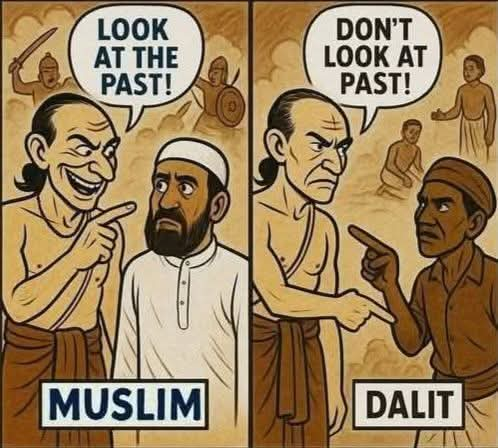
Hindu nationalism in India often constructs its identity around a selective reading of history, emphasizing perceived injustices inflicted by Muslim rulers while sidelining the deep-rooted and millennia-long oppression of Dalits within Hindu society. This selective historical narrative serves a political purpose but distorts the broader reality of India’s social history, particularly the systemic discrimination faced by Dalits under caste hierarchies that predate and outlast any external rule. By focusing almost exclusively on Hindu-Muslim conflicts, Hindu nationalists conveniently evade accountability for the internal structural violence perpetuated by upper-caste Hindus against Dalits, a practice that has persisted for over two millennia.

The Hindu Nationalist Historical Narrative

Hindu nationalism, as propagated by organizations like the Rashtriya Swayamsevak Sangh (RSS) and its affiliates, often portrays Indian history as a saga of Hindu victimhood under Muslim rule, particularly during the Mughal era. This narrative highlights events like temple destructions or forced conversions, framing Muslims as perpetual aggressors against a monolithic Hindu identity. While historical instances of conflict between Hindu and Muslim rulers are undeniable, this framing deliberately oversimplifies India’s complex past, ignoring the diversity of Hindu society and its internal hierarchies.

What is conspicuously absent from this narrative is any acknowledgment of the caste system’s role in oppressing millions of Dalits, who were relegated to the margins of society long before the arrival of Muslim rulers. By fixating on external “invaders,” Hindu nationalists deflect attention from the internal systemic injustices that have defined Hindu social order for centuries.

The Millennia-Long Oppression of Dalits

The caste system, deeply embedded in Hindu social and religious practices, has systematically marginalized Dalits (formerly referred to as “untouchables”) for over two thousand years. Ancient texts like the Manusmriti codified discriminatory practices, prescribing harsh punishments for lower castes who dared to transgress their assigned roles. Dalits were deemed impure, their touch or even shadow considered polluting by upper-caste Hindus. These beliefs were not isolated but institutionalized, shaping social interactions, economic opportunities, and religious access.

Historical accounts, such as those by the Chinese traveler Faxian (Fa-Hsien) during the Gupta period (4th–6th century CE), describe the plight of the Chandalas, a lower-caste group forced to live outside villages and announce their presence to avoid “polluting” others. This is not a relic of the distant past; discriminatory practices persisted into the modern era. Dalits were barred from temples, forbidden from drawing water from village wells, and subjected to humiliating customs like the “breast tax” in parts of South India, where lower-caste women were forced to pay to cover their bodies. These practices were not imposed by Muslim rulers but were enforced by upper-caste Hindus, who held social and religious authority.

Even today, the legacy of caste oppression endures. Manual scavenging, a dehumanizing practice where individuals (overwhelmingly Dalits) clean human waste from dry latrines, remains a stark reminder of caste-based exploitation. Despite legal bans, reports estimate that over 1.3 million Dalits are still engaged in this work, facing social stigma and health risks. Hindu nationalist discourse rarely addresses these modern injustices, focusing instead on historical grievances against Muslims or contemporary issues like “love jihad.”

Why Hindu Nationalists Avoid the Dalit Question

The reluctance of Hindu nationalists to confront caste oppression stems from both ideological and strategic considerations. Ideologically, their vision of a unified Hindu identity requires downplaying internal divisions like caste, which fracture the notion of a cohesive “Hindu nation.” Acknowledging the historical and ongoing oppression of Dalits would force a reckoning with the role of upper-caste Hindus in perpetuating this system, undermining the narrative of Hindu victimhood.

Strategically, Hindu nationalism relies on mobilizing a broad Hindu voter base, including Dalits, to counter perceived threats from minorities. Admitting the historical guilt of upper-caste oppression risks alienating Dalit communities, who have increasingly asserted their rights through movements inspired by leaders like Dr. B.R. Ambedkar. Instead, Hindu nationalist rhetoric often co-opts Dalit identity, portraying them as part of the Hindu fold while ignoring their specific grievances. This tokenism is evident in the selective celebration of Ambedkar as a Hindu icon, while his critiques of caste and Hinduism are conveniently ignored.

The Consequences of Selective History

This selective reading of history has profound implications. By focusing on Muslim oppression while ignoring caste-based atrocities, Hindu nationalists perpetuate a distorted understanding of India’s past that fuels communal tensions. This narrative not only marginalizes Dalits but also erases the contributions of lower-caste reformers who fought against caste oppression, from Jyotirao Phule to Periyar.

Moreover, it distracts from addressing contemporary issues like manual scavenging, caste-based violence, and discrimination in education and employment. According to a 2020 report by the National Campaign on Dalit Human Rights, over 40% of Dalit households in rural India still face untouchability practices, such as being denied access to public spaces or services. These are not relics of a distant past but ongoing realities that Hindu nationalist discourse sidesteps.

Toward a More Honest Historical Reckoning

A balanced understanding of Indian history requires acknowledging both external conflicts and internal injustices. The oppression of Dalits is not a peripheral issue but a central feature of India’s social history, one that predates and outlasts Muslim rule. Hindu nationalists must confront the uncomfortable truth that upper-caste Hindus were complicit in a system that dehumanized millions for millennia. Only by addressing this can India move toward a more inclusive national identity that honors all its citizens.

This is not to diminish the complexities of Hindu-Muslim relations or the historical realities of invasions and conquests. But a singular focus on one form of oppression while ignoring another is not just selective — it’s dishonest. True nationalism should uplift the marginalized, not erase their suffering. Until Hindu nationalists engage with the full spectrum of India’s history, including the painful legacy of caste, their vision of a unified nation will remain incomplete.


The Shadow of Karma: How an Ancient Doctrine Cemented Centuries of Suffering for India’s Untouchables

  The Shadow of Karma: How an Ancient Doctrine Cemented Centuries of Suffering for India’s Untouchables In the labyrinth of India’s social h...